
TWINO is a Latvian investment platform. By its own account, FLEXI pays a fixed 6% a year and ABS up to 12%. Both securities, as offered today, depend on Fincard, one borrower group in Poland. A Latvijas Banka licence covers the platform. It is not a repayment promise. No deposit guarantee applies, and a total loss is possible. It may fit readers who accept that concentration and possibly slower FLEXI withdrawals in a stress case.
Is TWINO Worth It? Our Short Verdict
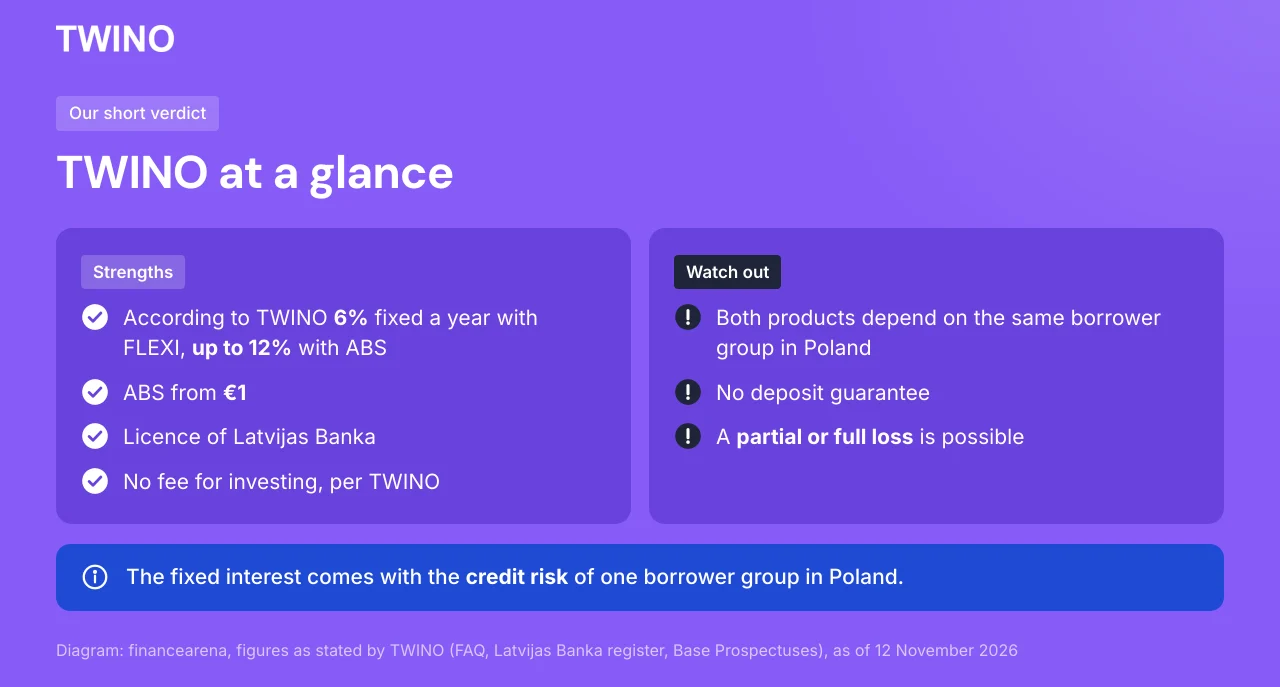
TWINO can be worth a look if you want fixed interest as one building block and can carry credit risk in Poland. In TWINO's own figures, FLEXI offers a fixed 6% a year and the 6-month and 12-month ABS up to 12%. ABS start from €1, FLEXI from €10, the platform holds a Latvijas Banka licence, and investing itself costs nothing. That said, today's FLEXI and ABS securities rest on Fincard, one borrower group in Poland. Neither product carries a deposit guarantee, and a total loss is possible.
TWINO Review on Video
The video covers our overall verdict. It looks at who TWINO is for, which products it offers, what it costs and how we use it ourselves.
The article adds a comparison table, figures from our own account and key passages from TWINO's documents.
What TWINO Is Today
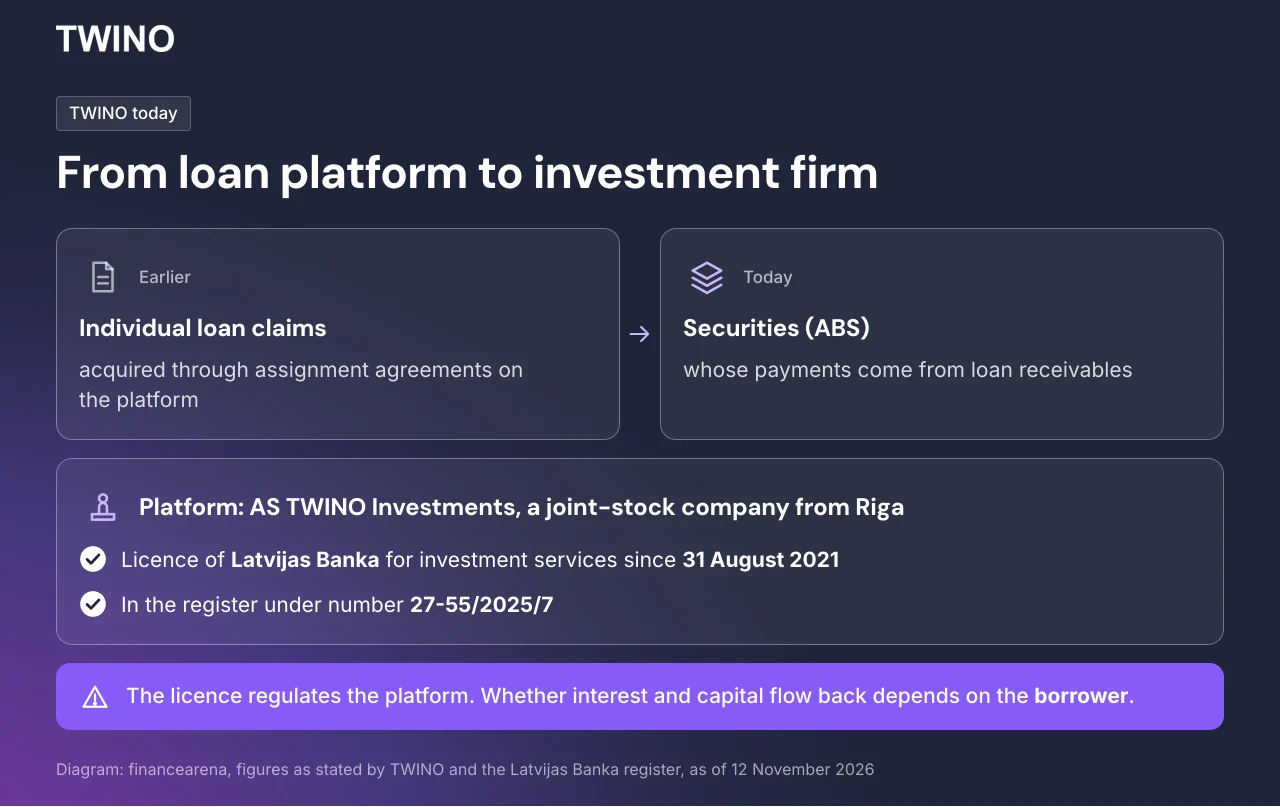
TWINO is run by AS TWINO Investments, a joint-stock company in Riga. It was incorporated on 26 March 2020. The company holds a Latvijas Banka licence for investment services, valid from 31 August 2021 under number 27-55/2025/7. According to a TWINO blog post of 5 August 2026, investors earlier bought individual loan claims on the platform through assignment agreements. Today TWINO sells securities as an investment firm.
With FLEXI and with fixed-term ABS alike, what you buy are asset-backed securities (ABS), linked to loan receivables. The chain behind them has four links:
- •Issuer: SIA TWINO Investments Poland, a special purpose company set up solely to issue these securities.
- •Lender: SIA TWINO Finance.
- •Loan originator and borrower: Fincard Sp. z o.o. in Warsaw, which operates under the consumer brands Netcredit and Halvo.
- •Distributor: AS TWINO Investments, which runs the platform.
In practice, interest and repayment reach you only as far as the borrower pays. The FLEXI Base Prospectus of 26 October 2026 says payments to you come only from sums the issuer receives on the loan receivables. Professionals call this limited recourse.
You can register as an individual or as a company.
Two Ways to Invest: FLEXI and ABS
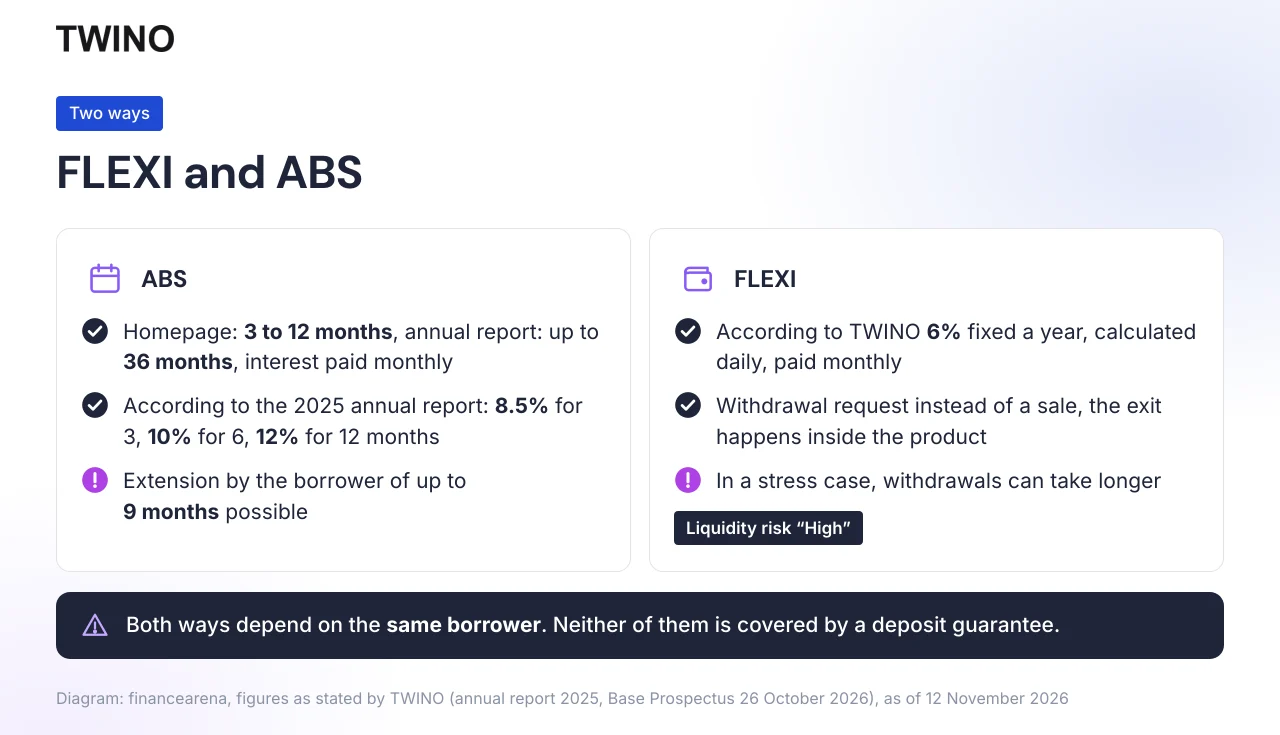
TWINO gives you two ways to earn fixed interest. They differ in rate and in how you get your money back. The borrower behind them is the same.
ABS with a fixed term tie up your money for the length of the series. TWINO's homepage shows a lock-in of 3 to 12 months, and the annual report 2025 says a series may run 3, 6, 12, 24 or 36 months. The same report pairs 8.5% with 3 months, 10% with 6 and 12% with 12. Per the FAQ, interest runs from the issue date (primary market) or from your purchase date (secondary market), with monthly payouts. On top of that, the borrower may extend the term up to three times by three months. That adds up to 9 months.
FLEXI offers a fixed 6% a year according to TWINO, calculated daily and paid out monthly. Behind it sits a 12-month ABS linked to consumer loans of Netcredit in Poland. You sell nothing yourself. You request a withdrawal instead. FLEXI starts from €10, and since 5 November 2026 the limit is €100,000 per client.
On liquidity, the wording matters. The FAQ says you can withdraw at any time, subject to FLEXI liquidity. Section 2.5.1 on liquidity risk in the Base Prospectus of 26 October 2026 explains how. In normal operation, collateral and early repayments from the loan originator should cover daily withdrawals. In a stress case, the prospectus says liquidity “most likely will fall short of the traditional 14 (fourteen) days for the early repayment framework”. Withdrawals can then take longer. The prospectus calls FLEXI an “illiquid instrument” and rates its liquidity risk “High”. A deposit guarantee covers neither product. TWINO FLEXI explained goes through the mechanics.
FLEXI, 6-Month ABS and 12-Month ABS Compared
The table sets the key terms side by side, with liquidity risk as rated in the prospectuses. The annual report 2025 also lists 3-month ABS at 8.5%.
FLEXI | 6-month ABS | 12-month ABS | |
|---|---|---|---|
| Rate per TWINO | 6% fixed a year | 10% in 2025, per annual report | 12% in 2025, per annual report |
| Minimum investment | €10 | €1 | €1 |
| Term | 12-month series (the prospectus also mentions extensions), exit by withdrawal request | 6 months, extension by the borrower up to 9 months | 12 months, extension by the borrower up to 9 months |
| Interest | Calculated daily, paid monthly | From issue or purchase date, paid monthly | From issue or purchase date, paid monthly |
| Getting out early | Withdrawal request, can take longer in a stress case | No right to early repayment. Sale on the secondary market at a discount of up to 29.9% or a premium of up to 4.9% | No right to early repayment. Sale on the secondary market at a discount of up to 29.9% or a premium of up to 4.9% |
| Limit per investor | €100,000 since 5 November 2026, personal limit follows the suitability test | No cap in the ABS prospectus, the Auto-Invest limit applies to Auto-Invest | No cap in the ABS prospectus, the Auto-Invest limit applies to Auto-Invest |
| Liquidity risk | High | Medium | Medium |
| Borrower | Fincard (Netcredit), Poland | Fincard (Netcredit), Poland | Fincard (Netcredit), Poland |
| Fee for investing | €0 | €0 | €0 |
| Deposit guarantee | No | No | No |
Tip: scroll horizontally to see all columns
What 6% or 12% Means in Euros
A simple calculation makes the gap concrete. Take €1,000 for twelve months. At 12%, the 12-month rate in the annual report 2025, simple interest comes to €120 before tax. In FLEXI at 6%, it comes to €60. This is our own calculation with no reinvestment and no missed payments. The real result depends on what the borrower pays.
For context, TWINO's October 2026 statistics show an average interest rate of 11.92%. We found no reference base for that figure. Read it as an average, not as the rate of your offer.
FLEXI's 6% sits below the ABS rates. The trade-off is access: you can request a withdrawal at any time, within the liquidity limits above.
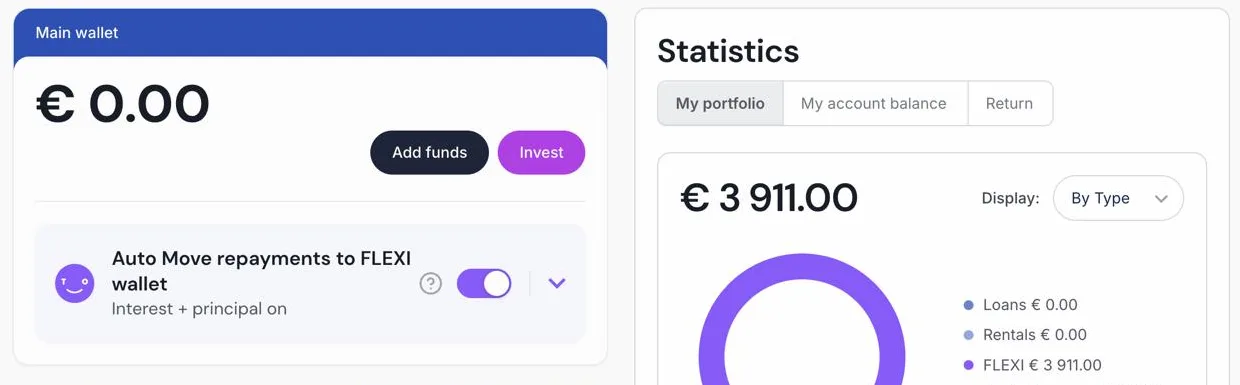
Reinvestment matters too. According to the FAQ, FLEXI Cash is uninvested money that earns nothing, and TWINO invests it automatically. Interest credits can land there first. The Auto-move feature can send ABS repayments to your FLEXI wallet as well. You switch it on beneath the Main Wallet card, and once it is on, interest and principal are both selected, though you can change that choice. The screenshot above shows the toggle on for both. Deposits and money withdrawn from FLEXI are not moved to FLEXI automatically.
Reinvested interest can add to the simple example. If the borrower stops paying, your result falls, up to a total loss.
Our TWINO Account: FLEXI With Our Own Money
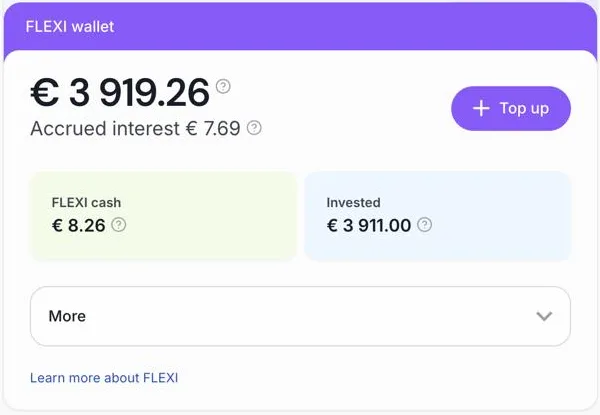
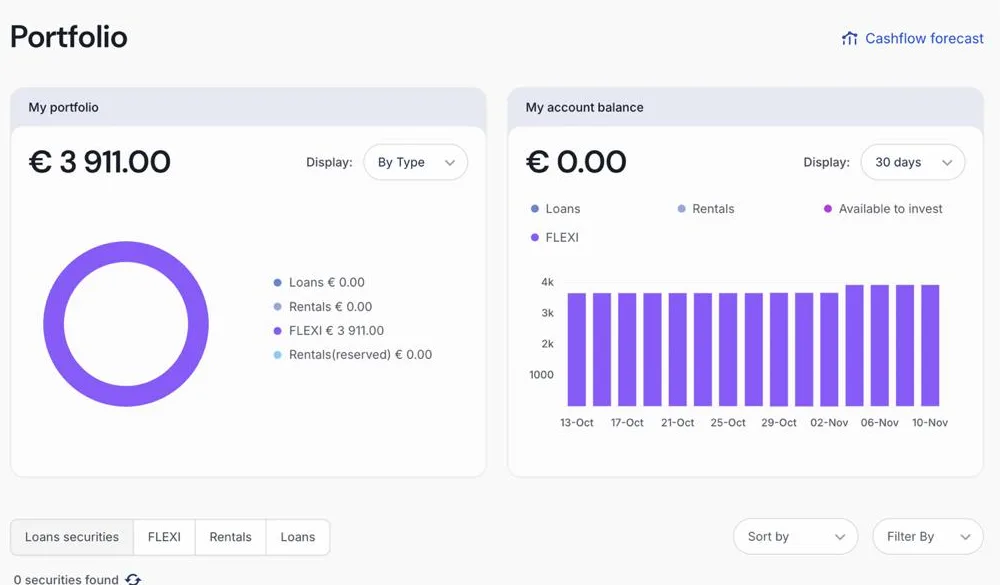
In our TWINO account, €3,911 is invested in FLEXI. By 10 November 2026, we had earned €58.03 in interest there, including €7.69 accrued and not yet paid out.
The wallet screenshot shows €3,919.26 in total. That is €3,911.00 invested plus €8.26 of FLEXI Cash, with the accrued €7.69 shown beside it. The €58.03 total is not visible in this crop.
Our Main Wallet shows €0.00, separate from the FLEXI wallet.
Here is what the screenshots do not cover. They show our balance, accrued interest and statement rows labelled Repayment, with interest and withholding tax. The rows do not name the product. They show no withdrawal, and the portfolio view shows 0 securities under Loans securities. For withdrawals and ABS, we rely on the FAQ and the prospectuses cited throughout.
Costs: What You Pay at TWINO
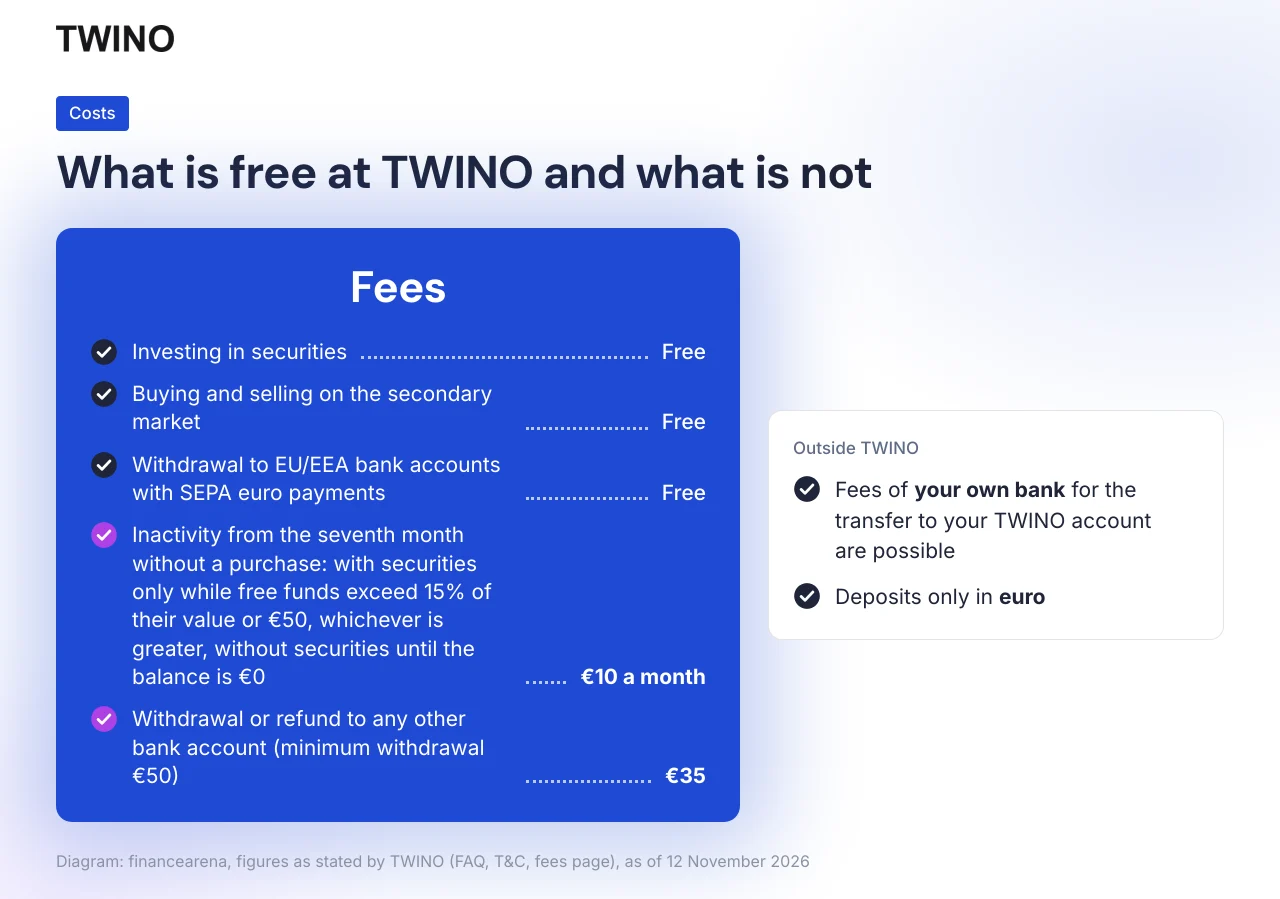
According to TWINO's FAQ and its ex-ante costs document of 29 June 2026, TWINO charges nothing for investing, for secondary-market trading or for withdrawals and refunds to EU/EEA bank accounts that support SEPA euro payments. Your own bank may still charge for transfers to TWINO. Deposits are accepted in euro only, which matters if your bank account runs in another currency.
Two charges apply. The first is €35 per withdrawal or refund to any account that does not qualify as an EU/EEA SEPA account. TWINO's FAQ names accounts in the UK and Switzerland as examples, even if they may support SEPA payments. For those withdrawals, the minimum is €50.
The other charge is the inactivity fee. If you make no purchase for more than six months, TWINO may deduct €10 a month from the seventh month (T&C clause 4.4). With securities in the account, it applies only while your free balance exceeds 15% of their value or €50, whichever is greater. Without securities in the account, TWINO deducts the fee until the balance reaches €0 (T&C clause 4.4.1). The FAQ suggests two ways around it: keep your funds invested, or withdraw unused funds. 10 things to know before investing in TWINO has the details.
How does TWINO earn money? The ex-ante costs document says the loan originator pays the platform a fixed monthly commission. You pay no separate fee for it.
TWINO says secondary-market trades and withdrawals to EU/EEA SEPA accounts are free of charge as well.
How to Start With TWINO
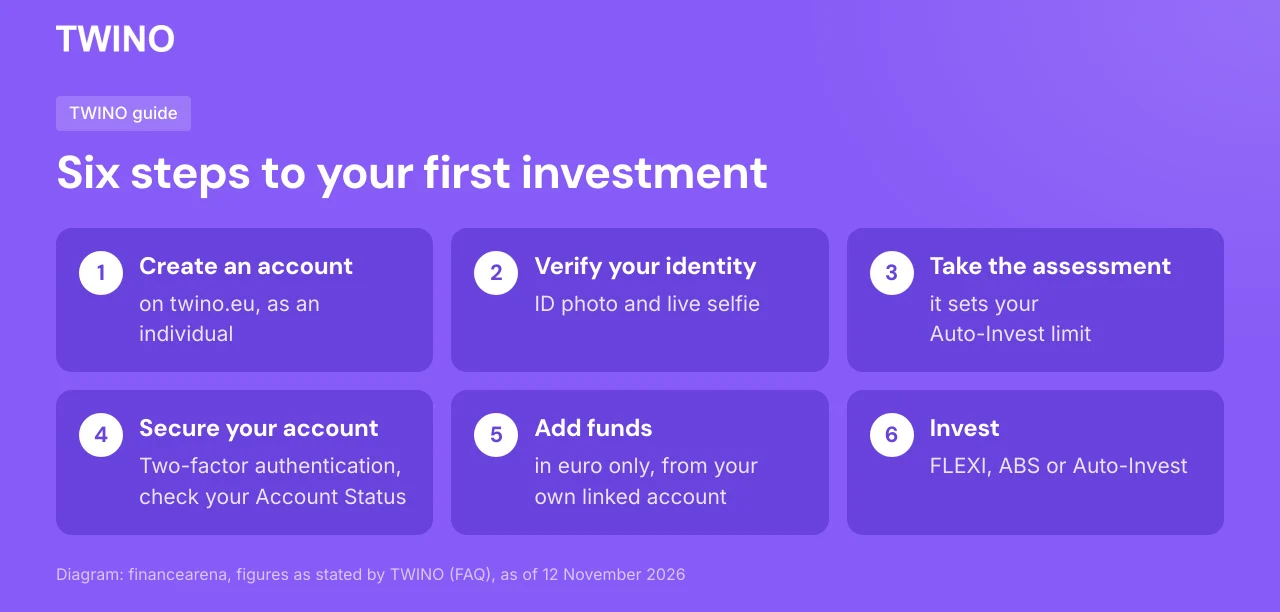
Getting started is straightforward, with one compulsory stop. You can register on twino.eu as an individual or a company. The six steps shown above are the route for individuals.
Per TWINO's FAQ, you need to be an EU/EEA resident, at least 18 years old, with full legal capacity. If you are unsure about your eligibility, TWINO advises contacting its client service.
After registration, you pass the ID check with a photo of a passport or national ID card plus a live selfie. According to the FAQ, this usually takes a few minutes. Then you fill in the suitability questionnaire, set up two-factor authentication and check “Account Status” in your profile. Deposits come from a bank account in your own name, in euro.
The deciding factor is the suitability test. TWINO requires the MiFID II suitability test from all investors. Its result sets your Auto-Invest limit. FLEXI needs the completed assessment and shares those limits. We found no explanation in the FAQ of how the tiers combine with the €100,000 FLEXI limit, so we do not calculate it. For manual investments, the FAQ says there is no set limit, though a notice may appear. How to invest in TWINO shows the tiers and how to raise your limit.
TWINO also runs a FLEXI cashback campaign for new investors. Per its terms, the cashback is a one-off monetary reward paid after the holding period. Conditions are in TWINO bonus.
The ID check, the questionnaire and two-factor login come before your first investment.
Taxes: What Our Statement Shows
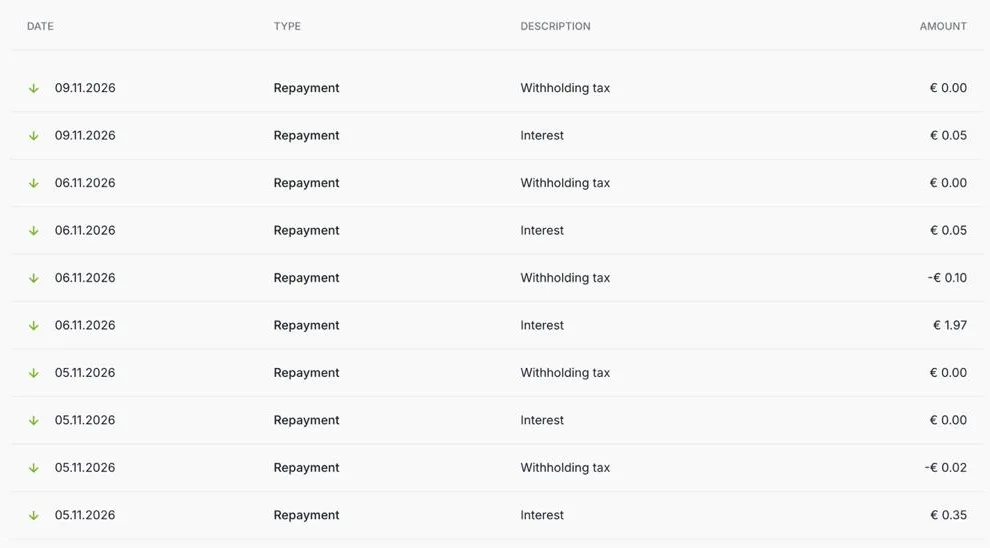
According to the FAQ of 16 September 2026, if you are not a tax resident of Latvia, withholding tax may be deducted at source before the interest is paid to you, so you receive the net amount. The FAQ says the Latvian domestic rate of 25.5% is generally used when you hold no valid Tax Residency Certificate that supports treaty relief. If you hold a certificate and a double-tax treaty applies, a reduced rate may follow instead. Entering your country of residence in the account is not official proof of tax residence. You upload the certificate under My Profile. TWINO's homepage adds that investors are responsible for declaring income and complying with local tax regulations.
One thing to flag: our statement shows a separate withholding tax line next to the interest rows. On 6 November 2026, it lists €1.97 of interest and €0.10 of withholding tax. That is about 5% by our own calculation. It is an observation from one account, not a rule for your rate. We draw no conclusion about which rate applies to you.
Beyond that, tax rules can change. The Base Prospectus says the issuer does not compensate you for tax increases. We give no tax advice here, so check your position with a qualified tax adviser or your local tax authority.
The Borrower Behind FLEXI and ABS
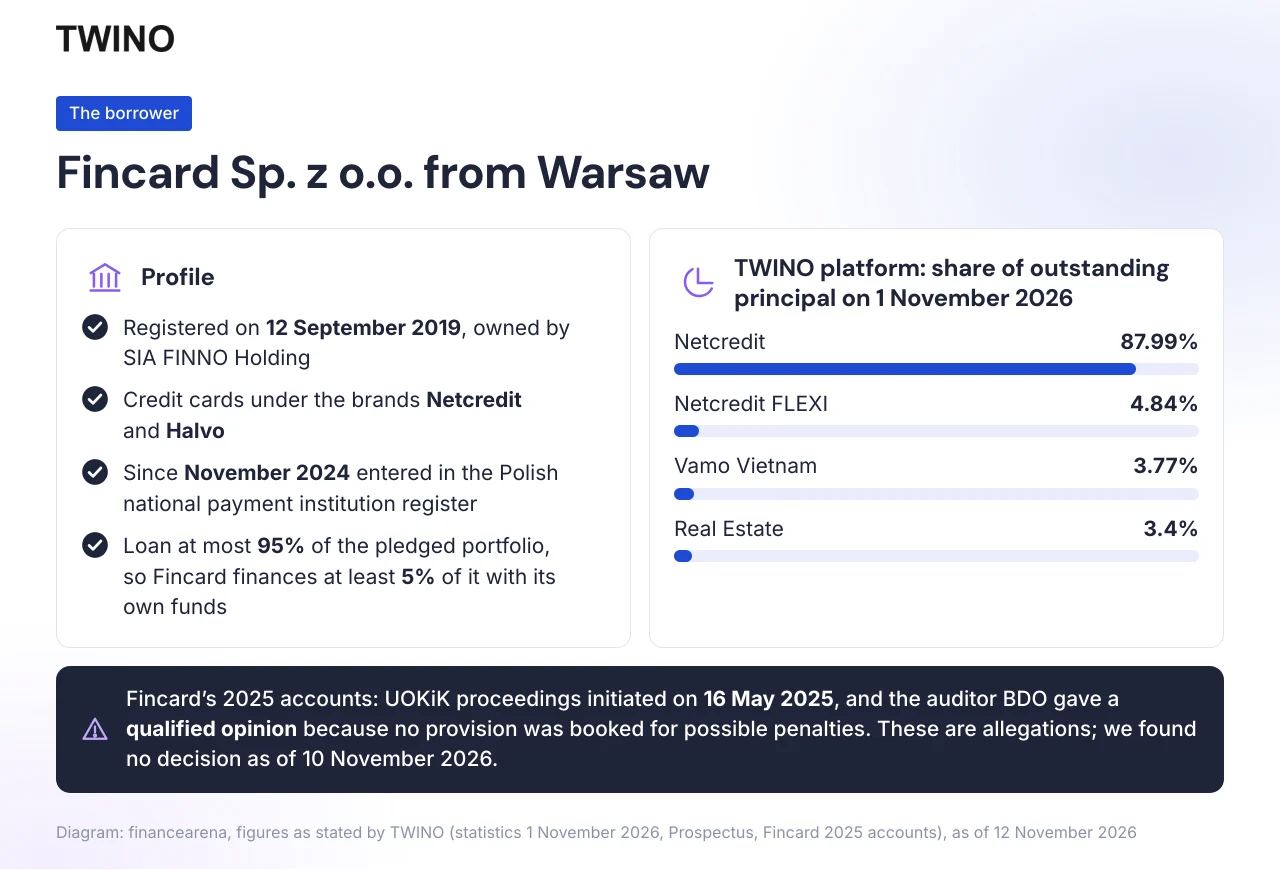
The product is simple. The question is the borrower behind it.
At TWINO, that is Fincard Sp. z o.o. in Warsaw, registered on 12 September 2019. It issues credit cards under two consumer brands, Netcredit and Halvo. According to the FLEXI Base Prospectus, it has been entered in Poland's national payment institution register since November 2024. TWINO's loan originator page calls it registered with the Polish Financial Supervision Authority (KNF). Fincard belongs entirely to SIA FINNO Holding.
In practice, concentration is what counts here. TWINO's statistics for 1 November 2026 show 87.99% of outstanding principal in Netcredit and 4.84% in Netcredit FLEXI. Vamo Vietnam accounts for 3.77% and real estate for 3.4%. TWINO's annual report 2025 also lists preferred shares in a company that acquires short-term rental properties. The FAQ calls the loan portfolio behind FLEXI diversified. Both base prospectuses, for FLEXI and for ABS, name a single loan originator, Fincard. For these FLEXI and ABS securities, you therefore depend on one borrower group in Poland, not on several loan originators.
On the positive side, the FLEXI Base Prospectus names where the risk sits: the loan originator, its brands and its owner. It also caps the loan at 95% of the pledged portfolio, so Fincard finances at least 5% of that portfolio with its own funds. The prospectus calls this skin in the game.
Fincard's 2025 accounts state that Poland's consumer protection authority, UOKiK, initiated proceedings on 16 May 2025 and that they were still ongoing when the accounts were prepared. The auditor, BDO, issued a qualified opinion because no provision was booked for possible administrative penalties from the ongoing proceedings, and BDO said estimating the amount was not practically feasible. A UOKiK press release of 15 June 2026 says the authority is conducting proceedings against Easy Payment and Fincard. The subject is the circumvention of rules on maximum interest for consumer credit. We read both documents as the same matter, but neither links them. These are allegations, and as of 10 November 2026 we found no decision in the documents we read. The FLEXI Base Prospectus of 26 October 2026 (section 2.4.2) rates the risk of complying with regulatory enactments High and cites the new Consumer Credit Directive (CCD II) and the UOKiK proceedings. In the same section, Fincard says it has submitted a response disagreeing with the allegations, and that the proceedings remain ongoing. We weigh this risk in Is TWINO safe in 2026?
Regulation and Investor Protection in Brief
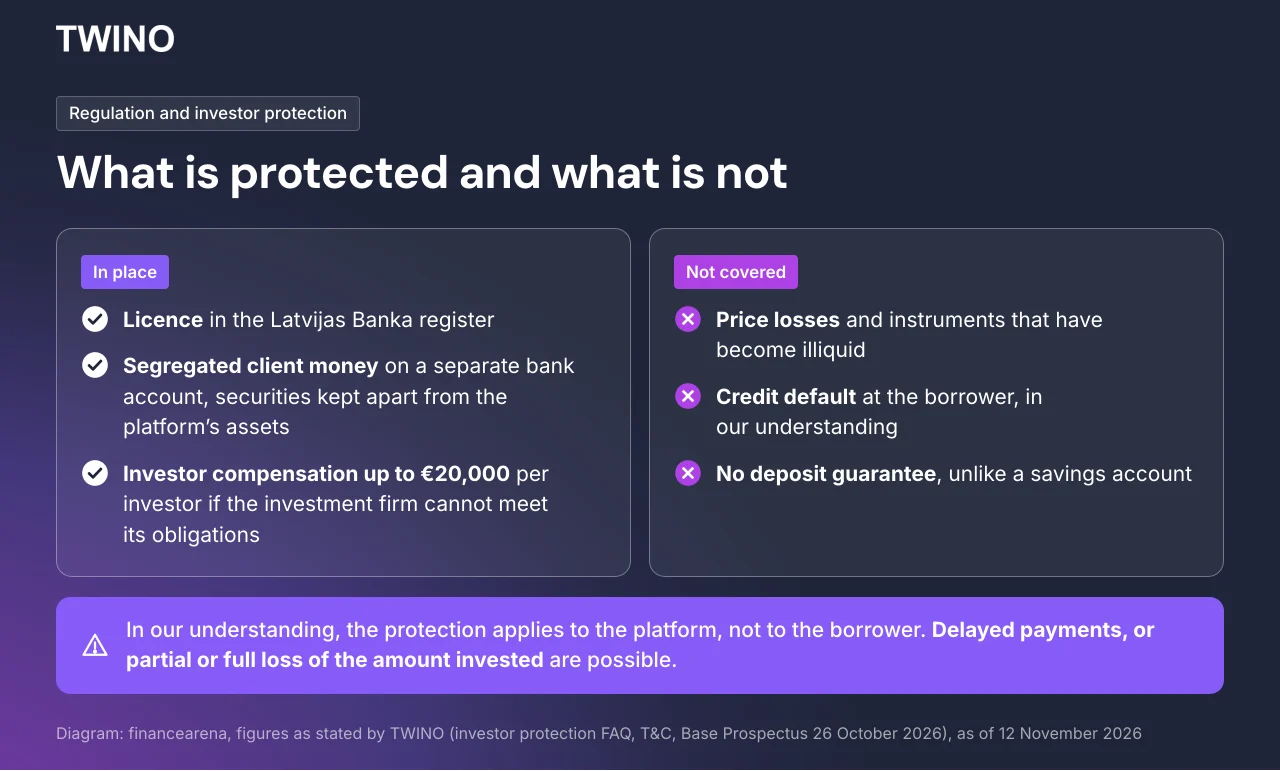
AS TWINO Investments appears with its licence in the Latvijas Banka register. The register also lists a freedom to provide services in 11 EEA countries from 18 July 2023, and our FAQ below names them. Latvijas Banka also approved the FLEXI Base Prospectus. That does not make it the issuer's supervisor. The prospectus itself says the approval is not an endorsement of the issuer.
Beyond that, TWINO keeps client money apart. TWINO's FAQ states that investor money is held on a separate bank account. The T&C say securities are managed separately from TWINO's assets.
Latvia's Investor Protection Law adds compensation of up to €20,000 per investor, according to TWINO's FAQ. It applies when the investment firm cannot meet its obligations. The FAQ says it does not apply to price losses or to instruments that have become illiquid. In our understanding, it does not cover credit defaults either, so the protection applies to the platform, not to the borrower. Delayed payments and a partial or full loss of the amount invested remain possible.
None of this is a deposit guarantee. Under Directive 2014/49/EU, deposit guarantee schemes cover each depositor's deposits at one bank, including savings deposits, up to €100,000. The FLEXI Base Prospectus says TWINO's securities are not bank deposits and fall outside such schemes. Is TWINO safe in 2026? walks through every layer.
Strengths and Points to Watch
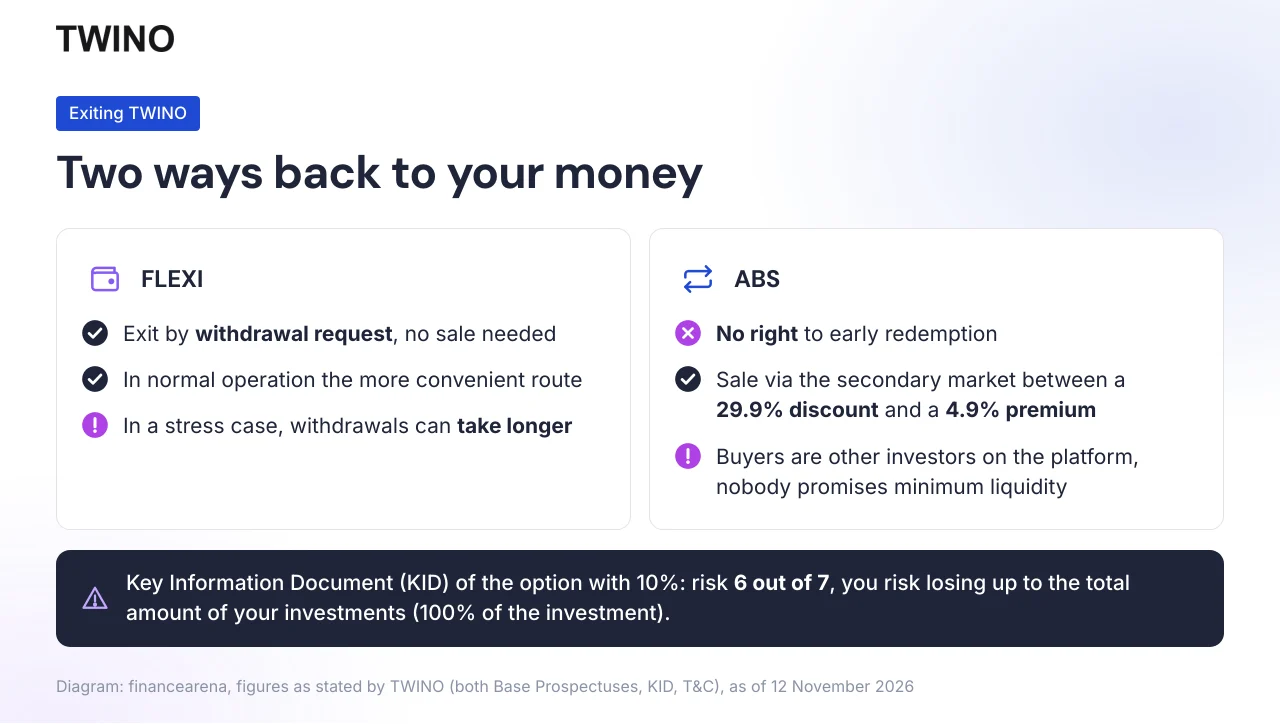
The strengths sit in access, costs and a licensed operator. The limits sit in credit risk and exit.
The interest is fixed, yet payment still depends on the borrower. TWINO's Key Information Document for ABS option C, renewed on 11 July 2025, rates the product 6 out of 7 on its risk scale. It says you risk losing up to 100% of the investment, so a total loss is possible.
Fixed-term ABS give you no right to early redemption. You can leave early only through the secondary market, where buyers are other investors on the platform, and section 12.16 of the ABS Base Prospectus also names the Distributor. Prices there are capped at a 29.9% discount and a 4.9% premium, and liquidity is not guaranteed. With FLEXI, the exit runs through a withdrawal request. In normal operation that is the convenient route. In a stress case, it can take longer.
Strengths
- Fixed rate per TWINO: 6% on FLEXI, up to 12% on ABS
- Entry from €1 for ABS and from €10 for FLEXI
- No fees for investing, and withdrawals to EU/EEA SEPA accounts are free
- Licensed operator (Latvijas Banka) with client money on a separate bank account
- Investor compensation up to €20,000 if the investment firm cannot meet its obligations
- App for iOS and Android, usable in four languages
Points to watch
- FLEXI and the ABS on offer depend on one borrower group in Poland
- No deposit guarantee, and a total loss is possible
- FLEXI withdrawals can take longer in a stress case
- ABS: no early redemption, and the borrower may extend the term by up to 9 months
- Inactivity fee of €10 a month after more than six months without a purchase, and with securities in the account only while free funds exceed 15% of their value or €50, whichever is greater
- Without a valid Tax Residency Certificate, the Latvian rate of 25.5% generally applies to non-residents, per the FAQ
For FLEXI and ABS, credit risk sits with the borrower in Poland.
Who TWINO May Suit
Overall, you get a licensed platform, no fee for investing and an entry from €1 in ABS.
TWINO may suit you if you want fixed interest as one building block next to other assets. It may also fit if you can start small and carry the credit risk that FLEXI and ABS place on one borrower group in Poland. With FLEXI, you accept that withdrawals can take longer in a stress case.
That said, it fits less well if you want to spread money across several loan originators in different countries. The same goes if you expect a deposit guarantee or may need your money back on a fixed date. A sensible first step is to complete the suitability test carefully and read the key documents.
The screenshot shows our portfolio on 10 November 2026: €3,911.00, all of it in FLEXI, with 0 securities under Loans securities. To see where TWINO sits next to other asset classes, use our alternative investments comparison.
This article is not investment advice. Invest only money whose loss you could bear, because a total loss is possible.
A total loss is possible, so invest only money you could afford to lose.
Frequently asked questions
You might also like
Is TWINO Safe in 2026? Licence, Investor Protection and Limits
Regulation, investor compensation and the chain down to the borrower.

TWINO FLEXI Explained: 6% Per TWINO, €100,000 Limit (2026)
How FLEXI pays interest, how withdrawals work and what changes in a stress case.

10 Things to Know Before Investing in TWINO (2026): Limits, Fees
Limit tiers, interest start, inactivity fee, withholding tax and exit in one checklist.
How to Invest in TWINO: Sign-Up, Deposit and First Steps (2026)
Registration, ID check, suitability test, deposit and first investment step by step.
Legal information
The content on this site has been researched carefully. Our sources are the providers' publicly available information and their terms and conditions. Despite regular checks we cannot warrant that the data is current, accurate or complete. Binding information on products and prices is only available on each provider's own website. Unless stated otherwise, the conditions shown apply to new customers.
Not financial advice
Our content is informational and comparative only. It is not financial, tax or legal advice, and it is neither a recommendation to buy nor an invitation to take out a financial product. Make your decisions based on your own situation and risk tolerance, and consult an independent adviser if you need one.
Risk warning
Every investment carries risk. Values can rise or fall, and past performance does not indicate future returns. You can lose part or all of the capital you invest. Crypto-assets are largely unregulated, are not covered by deposit guarantee or investor compensation schemes, and carry a high risk of total loss.
Advertising and affiliate links
Some links on this site are marked with an asterisk (*) and are affiliate links (advertising). If you take out a product through one of these links, we receive a commission from the provider at no additional cost to you. That is how you support our work.