
TWINO FLEXI is an automatic investment product on the Latvian platform TWINO. Per TWINO, your money goes into 12-month asset-backed securities linked to Netcredit consumer loans in Poland, with a fixed 6% a year, from €10 and up to €100,000 per client. Withdrawals can be requested at any time, but in a stress case they can take longer. No deposit guarantee applies, and a total loss is possible.
What Is TWINO FLEXI?
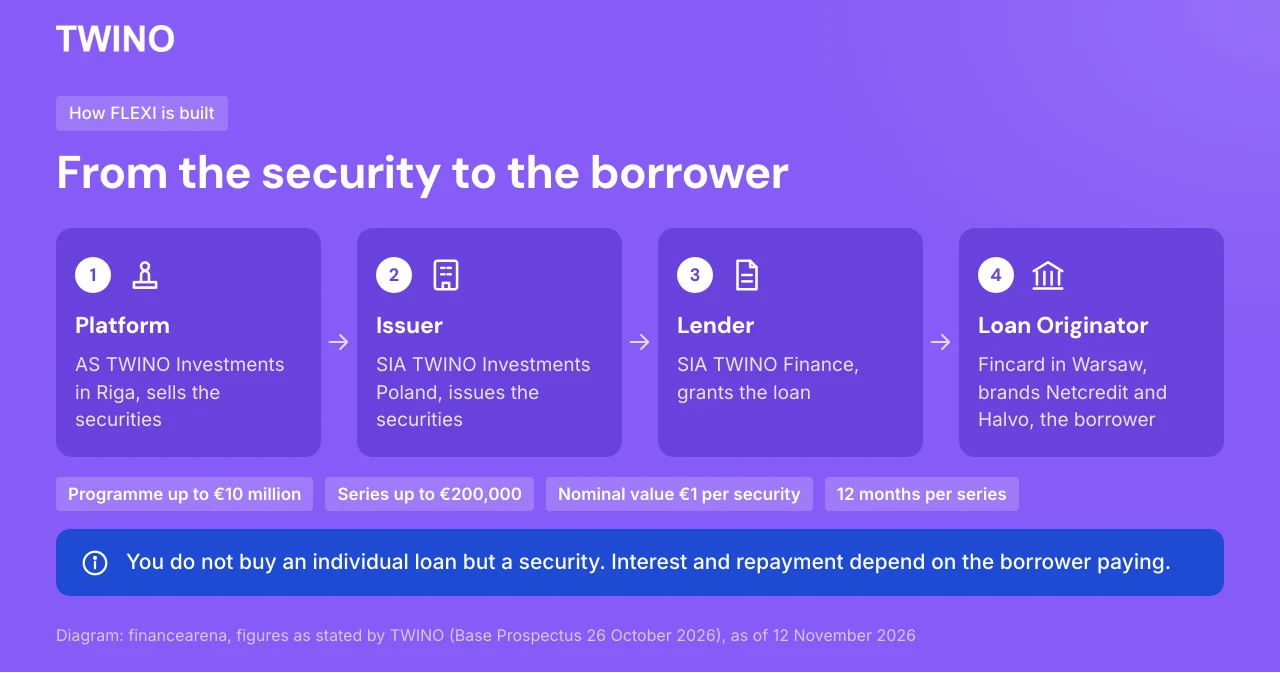
In short, TWINO FLEXI is an automatic investment product: your money goes into 12-month asset-backed securities (ABS) linked to consumer loans that Fincard originates in Poland under its Netcredit and Halvo brands. TWINO states a fixed 6% a year, calculated daily, from €10 and, since 5 November 2026, up to €100,000 per client.
You can request a withdrawal at any time, though in a stress case it may take longer. No deposit guarantee applies, and a total loss is possible.
Who stands behind the securities? According to the Base Prospectus of 26 October 2026, the borrower is Fincard Sp. z o.o. in Warsaw, which operates under the brands Netcredit and Halvo. SIA TWINO Investments Poland, a special purpose company, issues the securities, and AS TWINO Investments in Riga sells them. SIA TWINO Finance appears in the prospectus as the lender.
For you, that means a security, not an individual loan. Interest and repayment depend on the borrower paying.
The programme allows up to €10 million of outstanding securities, issued in series of up to €200,000. Each security has a nominal value of €1, and per the Base Prospectus summary each series runs 12 months from the issue date (extensions are possible, see below).
FLEXI launched at the end of April 2026 with a €10,000 cap per client. Our TWINO review places the product within the whole platform.
What the TWINO FLEXI Video Covers
The video explains how FLEXI works: the rate, the limit, and withdrawals in normal and stress situations.
Open an account, complete the suitability assessment, then top up the FLEXI wallet.
FLEXI Interest: 6% a Year per TWINO
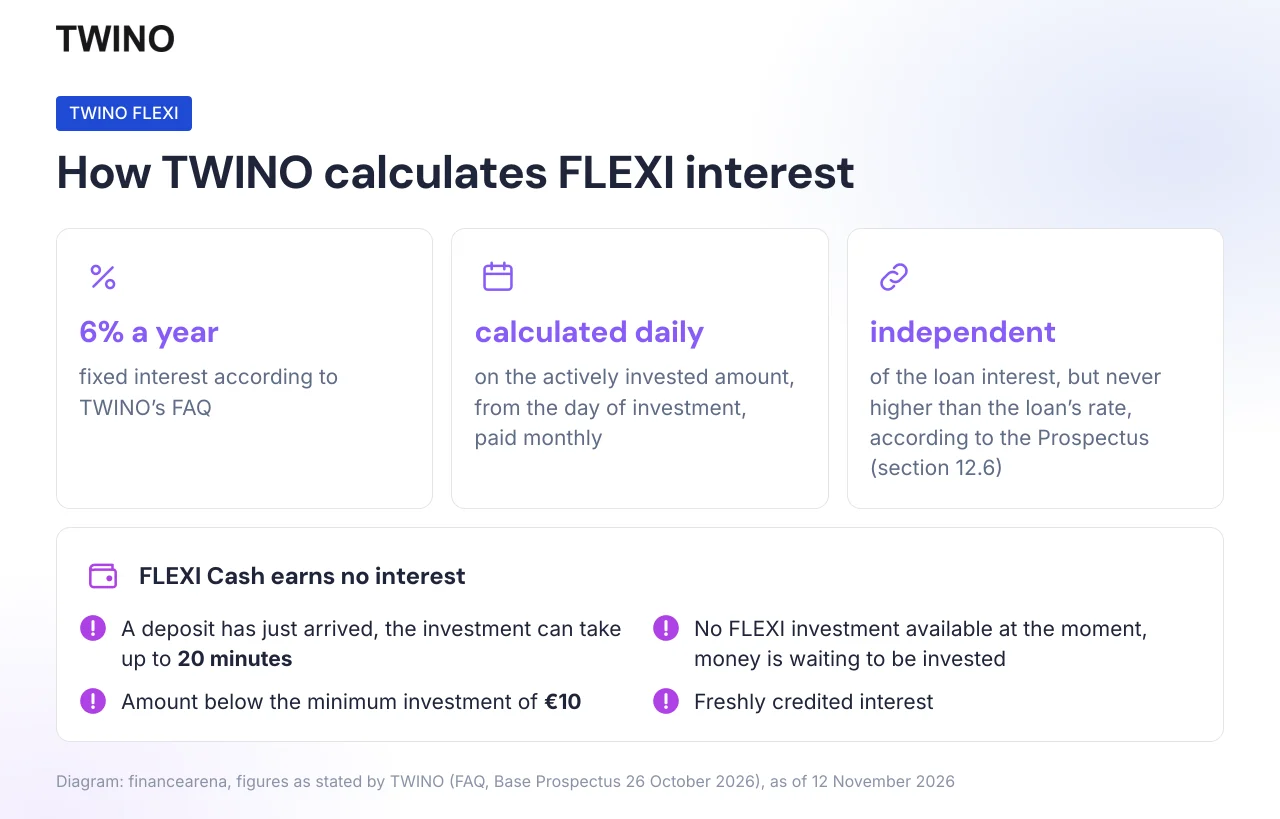
TWINO states a fixed 6% a year in its FAQ on FLEXI interest, calculated daily on the actively invested amount from the day of investment and paid out monthly.
One feature sets this product apart from the loans behind it. The Base Prospectus describes the interest rate of the security as “fixed and independent from the interest rates of the Loan Receivables”. Section 12.6 adds that it may differ from, but not be higher than, the annual rate of the relevant loan receivable. The prospectus gives no number itself.
One thing to flag is FLEXI Cash: uninvested money in your wallet that earns nothing. The FAQ names four situations in which it arises:
- •A deposit has just arrived, and the automatic investment can take up to 20 minutes.
- •No FLEXI investment is available at the moment, so your funds wait to be invested.
- •The amount is below the minimum investment of €10.
- •Interest has just been credited.
The platform invests FLEXI Cash automatically once that is possible. If you withdraw, interest runs up to the moment of withdrawal, and anything earned but unpaid lands in your wallet as FLEXI Cash.
The FLEXI rate sits below the figure of up to 12% a year that TWINO names for 12-month ABS. TWINO's homepage says only that “FLEXI prioritizes liquidity, while asset-backed securities (ABS) may offer higher long-term returns”. We found no further explanation of the gap, so we do not guess.
TWINO states a fixed 6% a year, a figure from its own FAQ. Read how the rate works before you decide.
Our FLEXI Account in Numbers
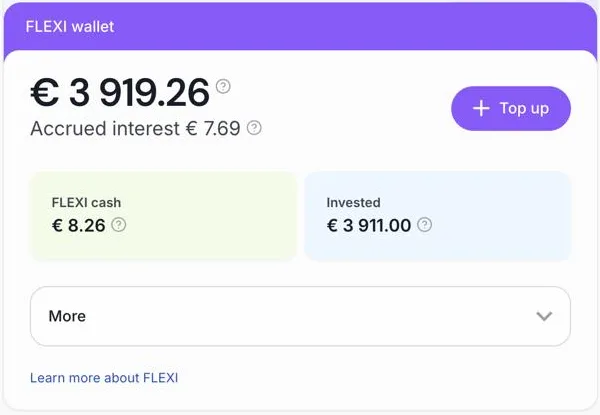
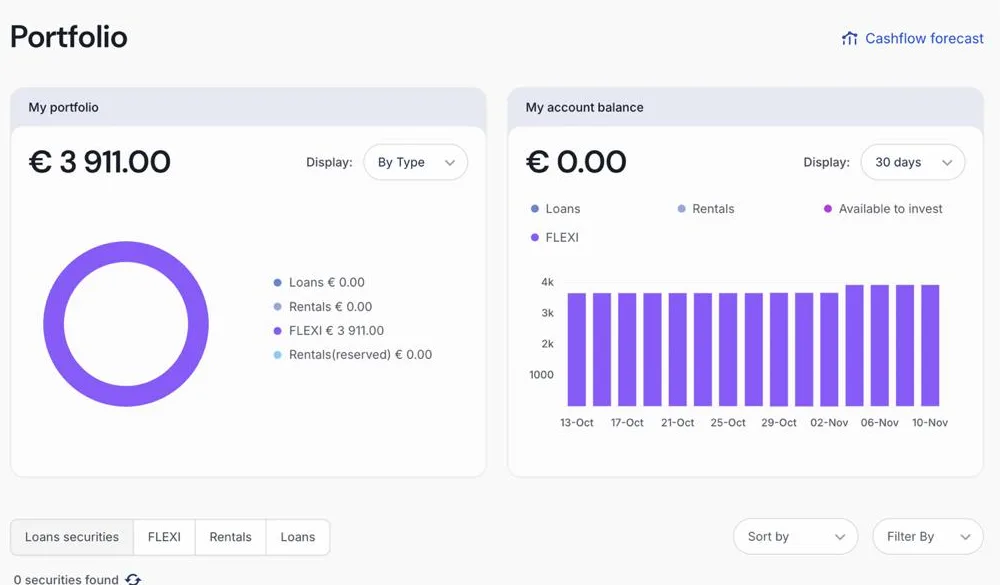
In our account, €3,911 is invested in FLEXI, and by 10 November 2026 the account had earned €58.03 in interest there, including €7.69 accrued and not yet paid out.
The wallet in the screenshot totals €3,919.26, of which €8.26 is FLEXI Cash.
How to Start With FLEXI
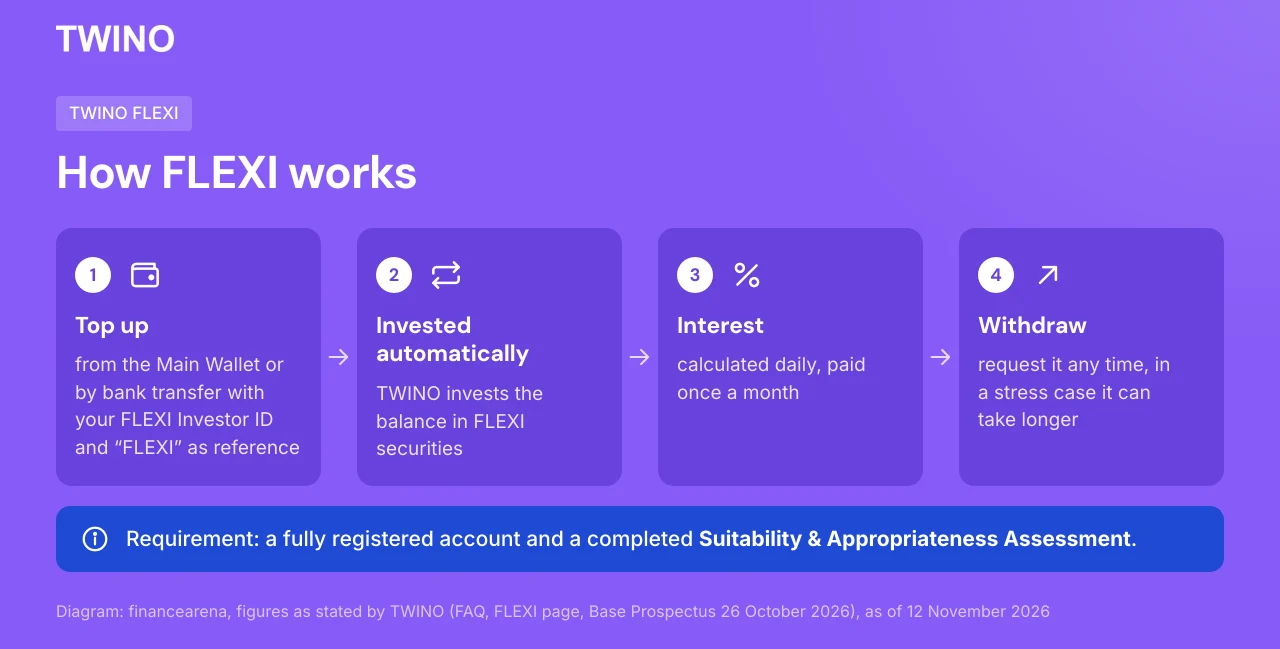
FLEXI needs a fully registered account and a completed Suitability & Appropriateness Assessment, which TWINO says it requires from all investors under MiFID II. Without it, you cannot invest in FLEXI, and the dashboard tells you when registration steps are missing.
Who can open an account? Per TWINO's FAQ, applicants must be EU/EEA residents aged 18 or older with full legal capacity, holding a payment account in their own name in an EU/EEA country. The FAQ suggests asking TWINO's client service if you cannot tell whether you qualify.
TWINO accepts deposits in euro only, and its T&C make FLEXI available only to clients whose client account base currency is EUR.
Technically, FLEXI runs as an Auto-Invest feature. Creating a FLEXI auto-invest portfolio means confirming that you have read the Base Prospectus and the Key Information Document (KID). Section 2.5.1 on liquidity is the part to read first.
The FLEXI wallet is separate from your Main Wallet. You can top it up in two ways:
- •From your Main Wallet, on the dashboard or in the mobile app.
- •By bank transfer, with your FLEXI Investor ID and the word “FLEXI” in the payment reference.
Without that reference, the money lands in your Main Wallet. A minor limitation sits in the app: the mobile app FAQ of 12 August 2026 said “Pay by bank” was not yet available there.
After the top-up, FLEXI invests the balance automatically, which can take up to 20 minutes.
In practice, auto-move helps keep repaid money from lying unused. You have to switch it on beneath the Main Wallet card. Once it is on, both options, interest and principal repayments from your ABS, are selected, and you can turn either one off. Deposits and funds withdrawn from FLEXI do not move automatically.
TWINO also runs a public FLEXI New Investor Cashback campaign. Per its terms, the Cashback is a one-off monetary reward paid after the holding period, and we explain its conditions in our TWINO bonus article.
Register, verify your identity, complete the assessment, then top up the FLEXI wallet.
The FLEXI Limit: €100,000 Cap and Your Personal Limit
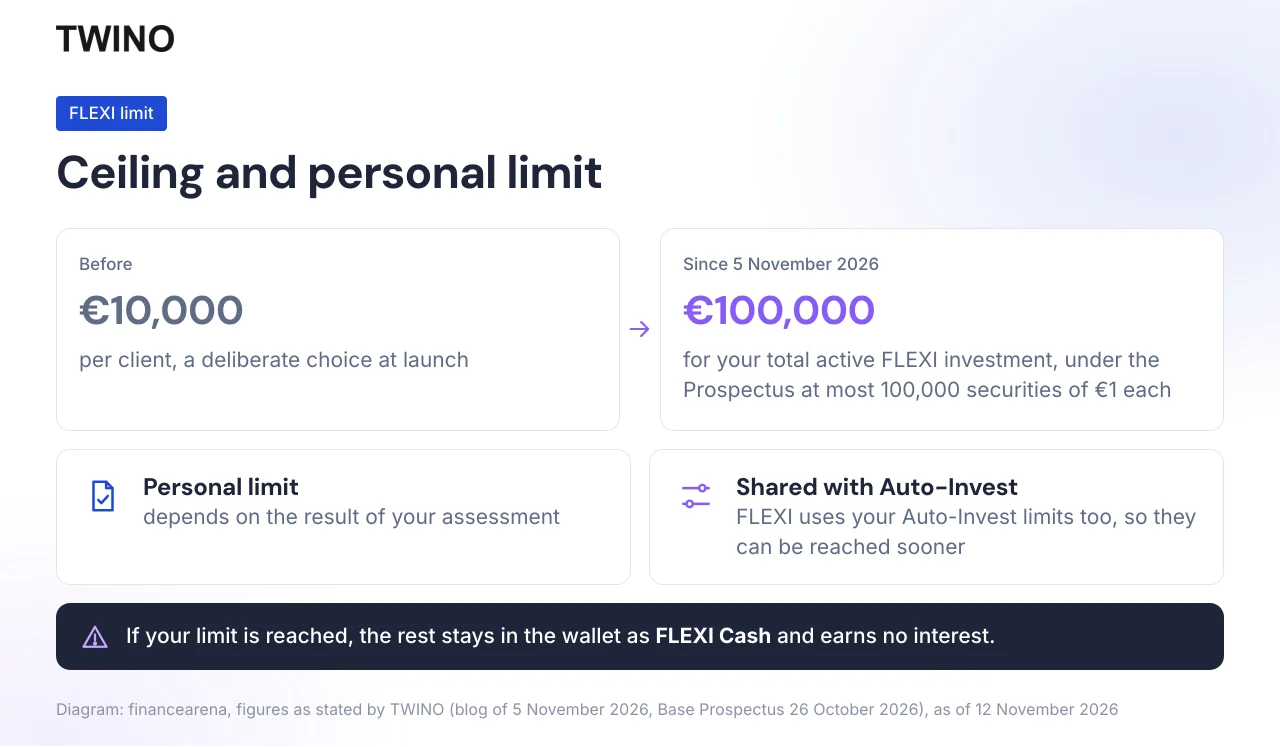
Since 5 November 2026, TWINO says you can invest up to €100,000 in FLEXI. The limit was €10,000 before, which TWINO's blog calls “a deliberate choice”, and the new limit applies to your total active FLEXI investment. The Base Prospectus draws the same line: an individual investor may hold no more than 100,000 securities of €1 each.
That said, the ceiling is not your personal limit. The product runs as an Auto-Invest feature, so it counts toward your overall Auto-Invest limits. In TWINO's words, “your limits are shared”, so they can be reached sooner. Your own Auto-Invest limit still depends on your Suitability & Appropriateness Assessment.
We found no TWINO text that spells out in numbers how the assessment tiers and the €100,000 ceiling combine, so we do not calculate it. Our guide on how to invest in TWINO shows the tiers themselves.
If you reach your limit, extra money stays in the wallet as FLEXI Cash without earning interest.
FLEXI Withdrawals in Normal Operation
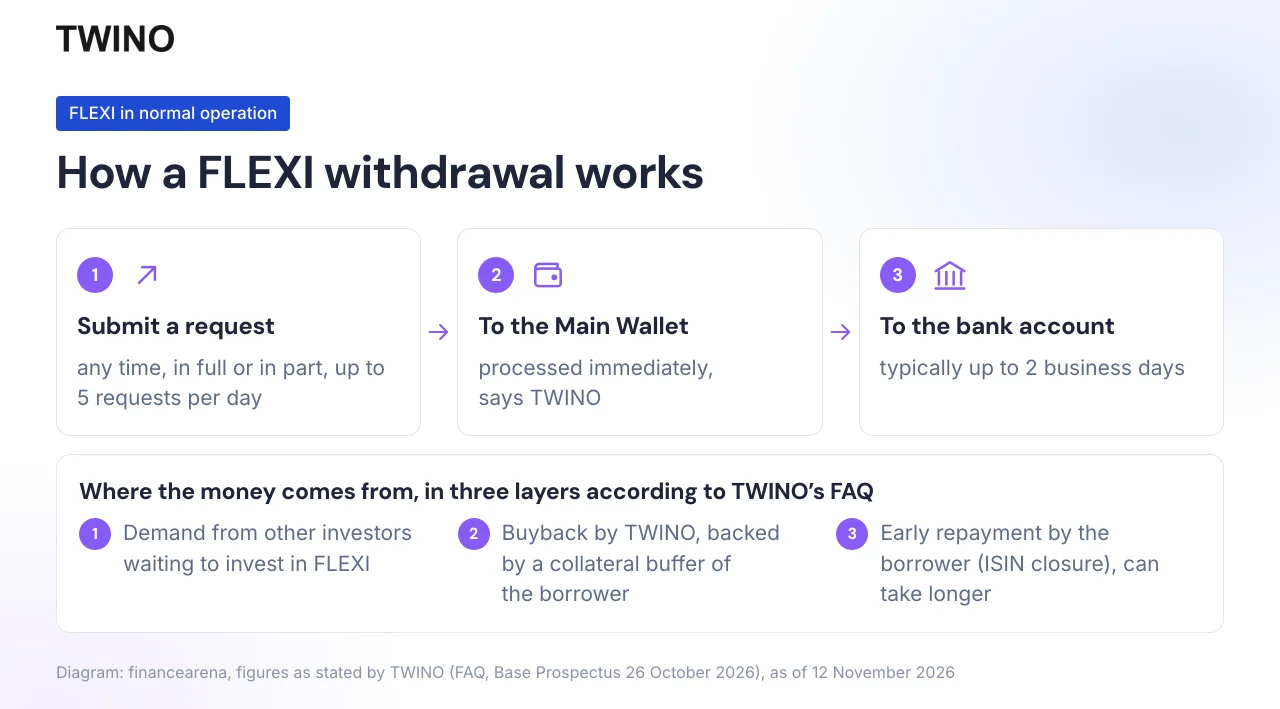
TWINO's FLEXI page advertises “instant liquidity”. The FAQ is more precise. You can request a withdrawal at any time, in full or in part, and TWINO's FAQ says a withdrawal to your Main Wallet is processed immediately after the request. A transfer on to your bank account typically takes up to 2 business days. You can submit up to 5 withdrawal requests per day, counting both destinations. On top of that, TWINO notes that processing depends on FLEXI liquidity and settlement timing.
Where does the money for a withdrawal come from? The FAQ describes three layers:
- •Investor demand. Other investors who are waiting to invest in FLEXI supply the money.
- •Buyback by TWINO. If demand is insufficient, TWINO buys the securities back, backed by a collateral buffer from the borrower.
- •Early repayment. If that does not cover it either, the borrower repays the underlying ABS early (an ISIN closure), which the FAQ says can take longer.
For ordinary days, section 2.5.1 of the prospectus states an assumption. The collateral the borrower has posted, together with its ability to repay early, “should suffice” to cover ordinary daily withdrawals.
The exit itself differs from single ABS. There, you sell on the secondary market yourself, while with FLEXI the exit runs inside the product and you do not look for a buyer.
When Many Investors Withdraw at Once
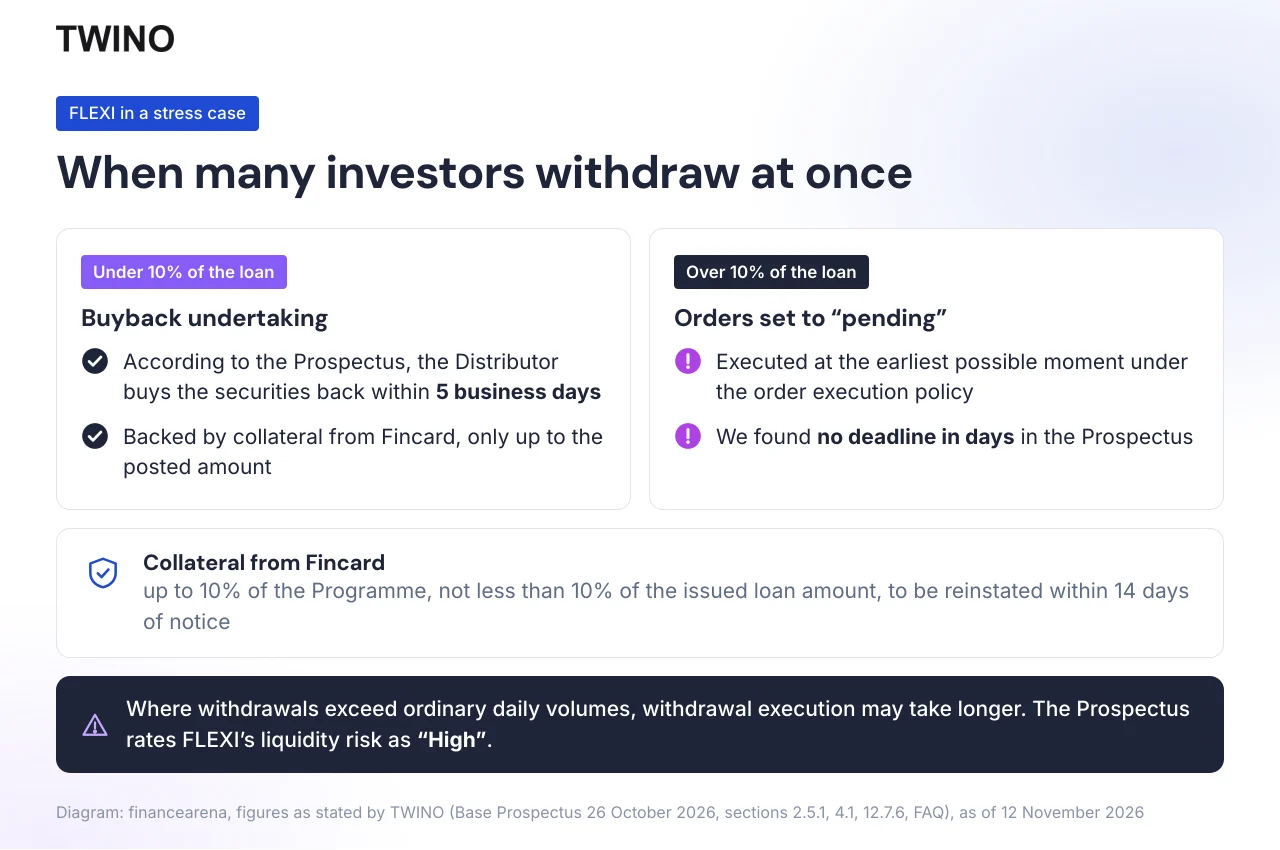
The real test of “any time” comes when many investors want out at once. For that case, section 12.7.6 of the prospectus sets a threshold.
Say all sell requests at a given time are worth less than 10% of the loan granted by the lender. Then the Distributor, which is AS TWINO Investments, “undertakes to buy” the securities within 5 business days of the request. If the Distributor buys, the price is set at par plus accrued interest.
Above 10%, the sell orders follow the Distributor's order execution policy. They are marked as pending and executed “at the earliest possible moment”. We found no deadline in days for this case in the prospectus.
The collateral buffer works like this. Under section 4.1.3, Fincard posts collateral of up to 10% of the programme, but not less than 10% of the issued loan amount. After a notice from the Issuer, Fincard must reinstate it within 14 days. Section 2.5.1 adds that the collateral absorbs withdrawals only up to the posted amount.
What if withdrawals exceed the ordinary daily volume? Section 2.5.1 says the liquidity “most likely” falls short of the traditional 14 days for the early repayment framework. According to TWINO's FAQ, withdrawal execution may take longer in such situations. The prospectus rates the liquidity risk of FLEXI “High” and calls FLEXI an “illiquid instrument”.
It ties this to the structure: no trading venue and no manual sale on a secondary market. TWINO's FLEXI page puts it more softly, saying processing may take longer when withdrawal demand rises, such as in a crisis.
The prospectus states this liquidity risk openly. FLEXI may therefore suit money you do not need on a fixed day, and it does not replace an emergency reserve in an account with a deposit guarantee.
Creating a FLEXI portfolio means confirming that you have read the Base Prospectus and the KID.
FLEXI, a Savings Account and 12-Month ABS Compared
The main difference to a savings account is protection. Under Directive 2014/49/EU, the EU deposit guarantee covers deposits at a bank up to €100,000 per depositor per bank (Articles 6(1) and 7(1)). The prospectus (section 2.5.4) says the securities fall outside any deposit protection or guarantee scheme, in Latvia or anywhere else.
The Latvian investor compensation scheme, which TWINO describes in its FAQ of 15 January 2026, does not close that gap. Per the FAQ, it compensates up to €20,000 per investor if the investment firm cannot meet its obligations, excluding losses from price changes and illiquid instruments. We found no sentence on borrower defaults, and in our understanding a borrower default is not a compensation case. Our article Is TWINO safe? covers the scheme.
Against 12-month ABS, FLEXI comes out weaker on rate and stronger on day-to-day flexibility. The trade-off sits in the ratings: the FLEXI prospectus rates liquidity risk High, while the ABS prospectus rates it Medium. A single ABS can be sold early only on the secondary market, to other platform investors, at a discount that the ABS prospectus caps at 29.9%, and nobody guarantees liquidity.
TWINO FLEXI | Savings account at a bank | TWINO 12-month ABS | |
|---|---|---|---|
| Interest | 6% a year, fixed, per TWINO | Set by the bank | Up to 12% a year per TWINO |
| Minimum | €10 | Set by the bank | €1 |
| Maximum | €100,000 per client at most, and your personal limit from the assessment applies as well | Set by the bank | No per-investor cap in the ABS prospectus, the assessment limit applies to Auto-Invest only |
| Term | Withdrawal request at any time, per the prospectus summary each series behind it runs 12 months from issue, extensions possible | Set by the bank | 12 months, the borrower may extend up to 3 times by 3 months |
| Exit | Withdrawal request, in a stress case it can take longer | Set by the bank's terms | Early exit only on the secondary market, discount up to 29.9%, no guaranteed liquidity |
| Protection | No deposit guarantee, investor compensation only in the cases the FAQ describes | EU deposit guarantee: €100,000 per depositor per bank | Same investor compensation scheme per the FAQ, in our understanding with the same limits as for FLEXI |
| Fees | No fee for investing or for withdrawals to EU/EEA SEPA accounts, inactivity fee only after more than six months without a purchase and only while free funds exceed 15% of your securities or €50, whichever is greater | Set by the bank | No fee for investing, secondary market trades or withdrawals to EU/EEA SEPA accounts, inactivity fee only after more than six months without a purchase and only while free funds exceed 15% of your securities or €50, whichever is greater |
Tip: scroll horizontally to see all columns
What Speaks for FLEXI
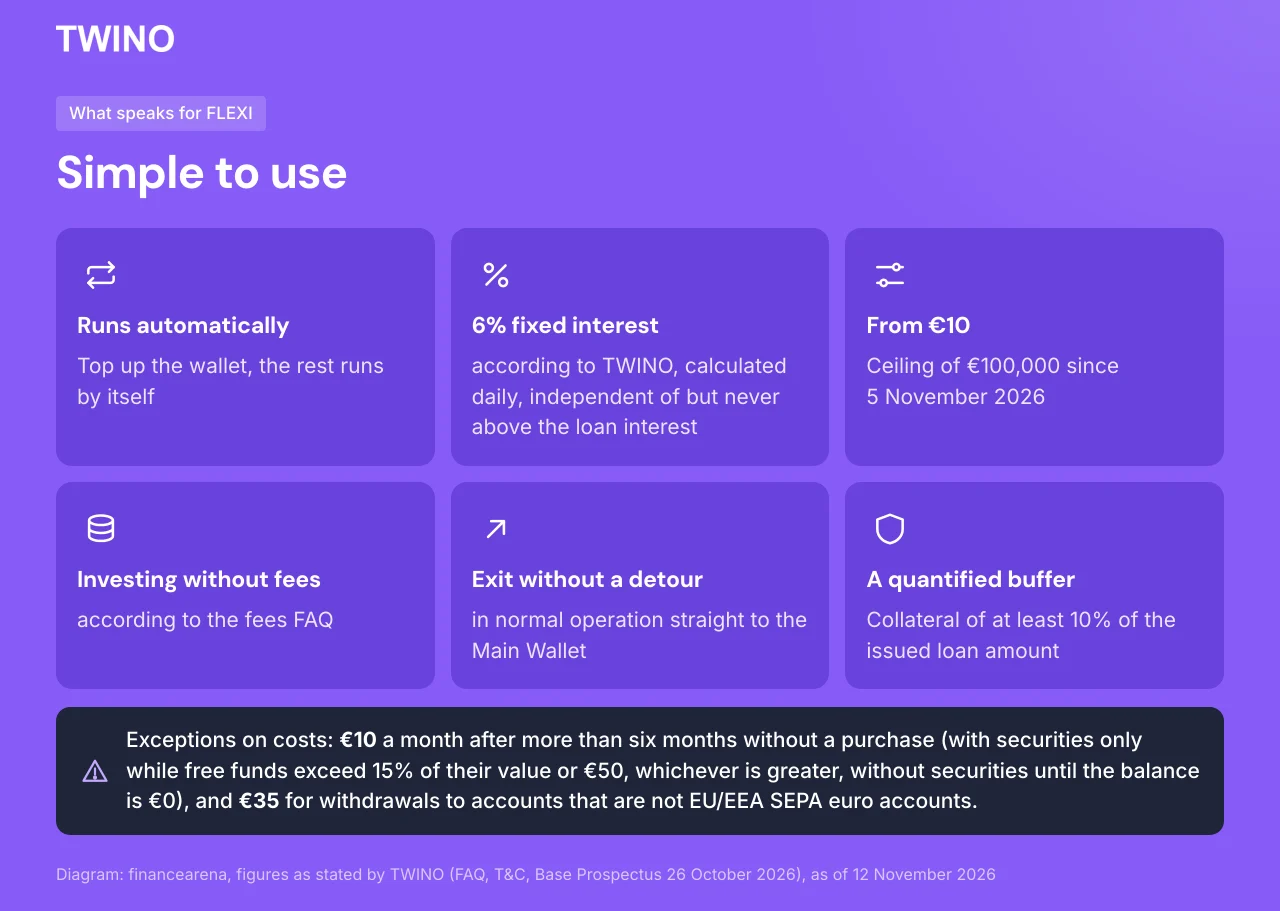
FLEXI asks little of you in practice: you top up the wallet, and TWINO's FAQ says the rest runs automatically. TWINO states a fixed 6% a year, calculated daily and, per Prospectus section 12.6, independent of the loan interest but never above it. The entry ticket is €10, and the ceiling has been €100,000 since 5 November 2026.
On costs, TWINO's fees FAQ lists no fees for investing in securities, secondary market trading or withdrawing funds from your account. Your own bank may still charge for transfers, and per TWINO's FAQ, withdrawals to EU/EEA bank accounts that support SEPA euro payments are free.
Two exceptions apply. The T&C allow an inactivity fee of €10 a month, but only after more than six months without a purchase, and with securities in the account only while the funds exceed 15% of their value or €50, whichever is greater. And per TWINO's FAQ, a fixed €35 applies to each withdrawal or refund to an account that is not an EU/EEA SEPA euro account, and such withdrawals must be at least €50. The FAQ names the United Kingdom and Switzerland as examples, even where those accounts support SEPA payments. We explain the inactivity fee in our 10 things to know before investing in TWINO.
The exit comes without detours: per TWINO's FAQ, a withdrawal in normal operation goes straight to your Main Wallet. Beyond that, the buyback logic has a buffer that the prospectus quantifies: collateral of at least 10% of the issued loan amount.
What You Need to Know About FLEXI
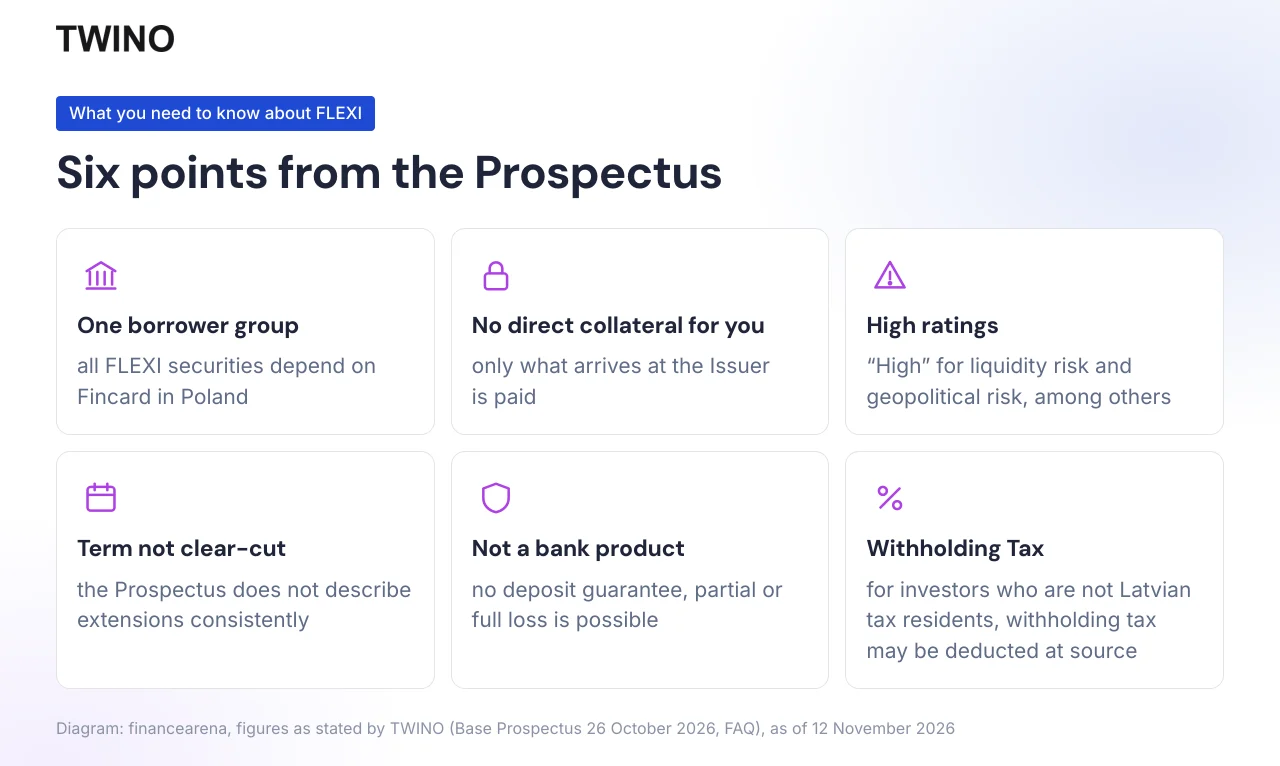
One borrower group in Poland. The FLEXI and ABS securities TWINO offers today depend on one borrower group in Poland: Fincard, which operates under the brands Netcredit and Halvo. TWINO's FAQ describes the backing as “a diversified portfolio of loans”. The loan behind the securities, however, goes to that single group. That makes the borrower the key question, and our article Is TWINO safe? looks at it.
No direct collateral for you. Section 4.1.1 states that “No collateral, pledge or other types of guarantees” are available to the securityholders. The same section adds that loan receivables back the securities and are to be secured by a pledge over Fincard's underlying loan portfolio, unless Polish law makes the pledge illegal. The Issuer pays only from the sums it receives on the loan receivables. This principle is called limited recourse.
High ratings. The prospectus rates liquidity risk High. It also rates three risks at the borrower High: geopolitical risk, compliance with regulatory enactments and dependency on third parties. The other eleven borrower risks are rated Medium.
A term that is not clear-cut. The prospectus summary gives a maturity of 12 months from the issue date, “not linked to or required to match” the maturity of the loan receivables. Section 12.1.5, by contrast, says the borrower's extensions “shall extend the Maturity Date of the Securities”. Section 12.7.1 adds that the term might change over time. We found no sentence that reconciles these statements.
Not a bank product. FLEXI has no deposit guarantee. Section 2.5.4 names delayed payments and partial or full loss of the amount invested. A total loss is therefore possible.
Tax at source. Under section 4.1.4, the Issuer withholds the tax that Latvian law requires and pays out the net amount. It does not compensate you if taxes rise (section 2.5.3). TWINO's FAQ of 16 September 2026 addresses investors who are not Latvian tax residents. It says withholding tax may be deducted, with the Latvian domestic rate of 25.5% generally applying without a valid Tax Residency Certificate. A certificate plus an applicable double-tax treaty can lead to a reduced rate. Per the FAQ on TWINO's homepage, investors are responsible for declaring income and complying with local tax regulations, so you declare the interest to your local tax authority. If you are unsure about your obligations, TWINO's withholding tax FAQ points to a qualified tax adviser or your local tax authority. We give no tax advice.
None of this is hidden, since the prospectus states each point itself.
Who FLEXI May Suit
FLEXI may suit you if you want funds to work between two decisions. A practical case: an ABS matures, your next investment is not decided yet, and auto-move, once you have switched it on, sends the repayment into FLEXI without further steps.
FLEXI fits less well if you expect a deposit guarantee or need the funds on a set date. Anyone wanting capital spread across many borrowers will find one borrower group in FLEXI. And if you are happy to lock it up for 12 months or longer, TWINO names higher rates for its 12-month ABS.
Overall, FLEXI is a straightforward building block, and the trade-off to weigh first is liquidity: per TWINO, withdrawals are typically processed quickly in normal operation, and in a stress case they may take longer. The single borrower group behind FLEXI and the missing deposit guarantee come right after it.
Our alternative investments comparison shows other options.
This article is not investment advice. Invest only money whose loss you can bear, because a total loss is possible with FLEXI.
FLEXI has no deposit guarantee, and a total loss is possible. Read the prospectus before you invest.
Frequently asked questions
You might also like

TWINO Review 2026: 6 to 12% Per TWINO, From €1, Latvian Licence
Who TWINO may suit: products, costs, risks and our own account in one overview.
Is TWINO Safe in 2026? Licence, Investor Protection and Limits
Licence, investor compensation, the borrower chain and where each protection layer ends.
How to Invest in TWINO: Sign-Up, Deposit and First Steps (2026)
Registration, ID check, suitability assessment, deposit and first FLEXI investment step by step.

10 Things to Know Before Investing in TWINO (2026): Limits, Fees
Limit tiers, interest start, inactivity fee, withholding tax and exit as a checklist.
Legal information
The content on this site has been researched carefully. Our sources are the providers' publicly available information and their terms and conditions. Despite regular checks we cannot warrant that the data is current, accurate or complete. Binding information on products and prices is only available on each provider's own website. Unless stated otherwise, the conditions shown apply to new customers.
Not financial advice
Our content is informational and comparative only. It is not financial, tax or legal advice, and it is neither a recommendation to buy nor an invitation to take out a financial product. Make your decisions based on your own situation and risk tolerance, and consult an independent adviser if you need one.
Risk warning
Every investment carries risk. Values can rise or fall, and past performance does not indicate future returns. You can lose part or all of the capital you invest. Crypto-assets are largely unregulated, are not covered by deposit guarantee or investor compensation schemes, and carry a high risk of total loss.
Advertising and affiliate links
Some links on this site are marked with an asterisk (*) and are affiliate links (advertising). If you take out a product through one of these links, we receive a commission from the provider at no additional cost to you. That is how you support our work.