Before you register with TWINO, check ten things: licence, products, limit, campaign, interest start, inactivity fee, exit, withholding tax, borrower and payouts, each checked against TWINO's own documents. No deposit guarantee applies to the securities, and a total loss is possible.
Before You Register With TWINO: The Short Version
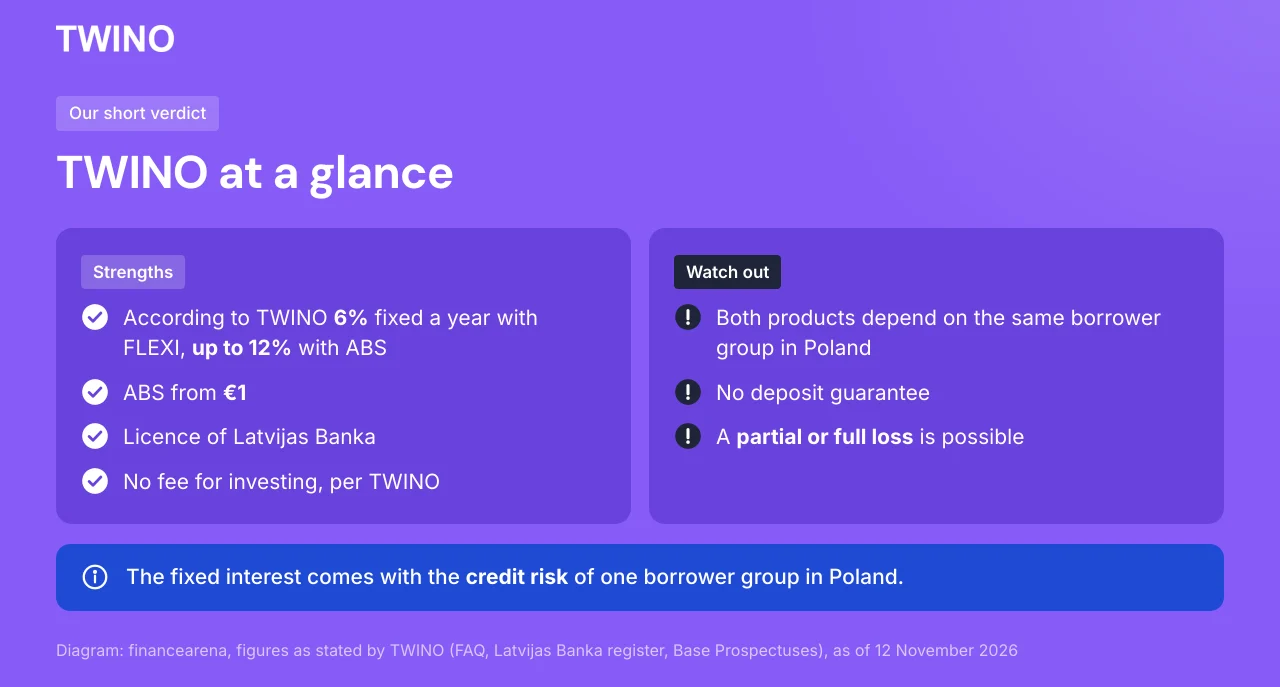
The set-up is straightforward. The operator holds a Latvijas Banka licence. According to TWINO's FAQ, the platform charges no fee for investing, and TWINO says it earns commissions from loan originators. Its asset-backed securities (ABS) start at €1. Per TWINO, FLEXI pays a fixed 6% a year, while ABS pay up to 12%.
The catch sits behind the products. The fixed interest comes with the credit risk of one borrower group in Poland, because FLEXI and ABS both depend on it. No deposit guarantee applies, and a partial or total loss is possible.
The Ten Points on Video
The video covers the topic of this article: ten things to know before you invest in TWINO. Here you also get the document references behind each point, a few calculations of our own and a checklist for your first deposit. For the full verdict, read our TWINO review.
The register entry is public, so you can check the licence before you sign up.
1. The Platform Holds a Latvijas Banka Licence
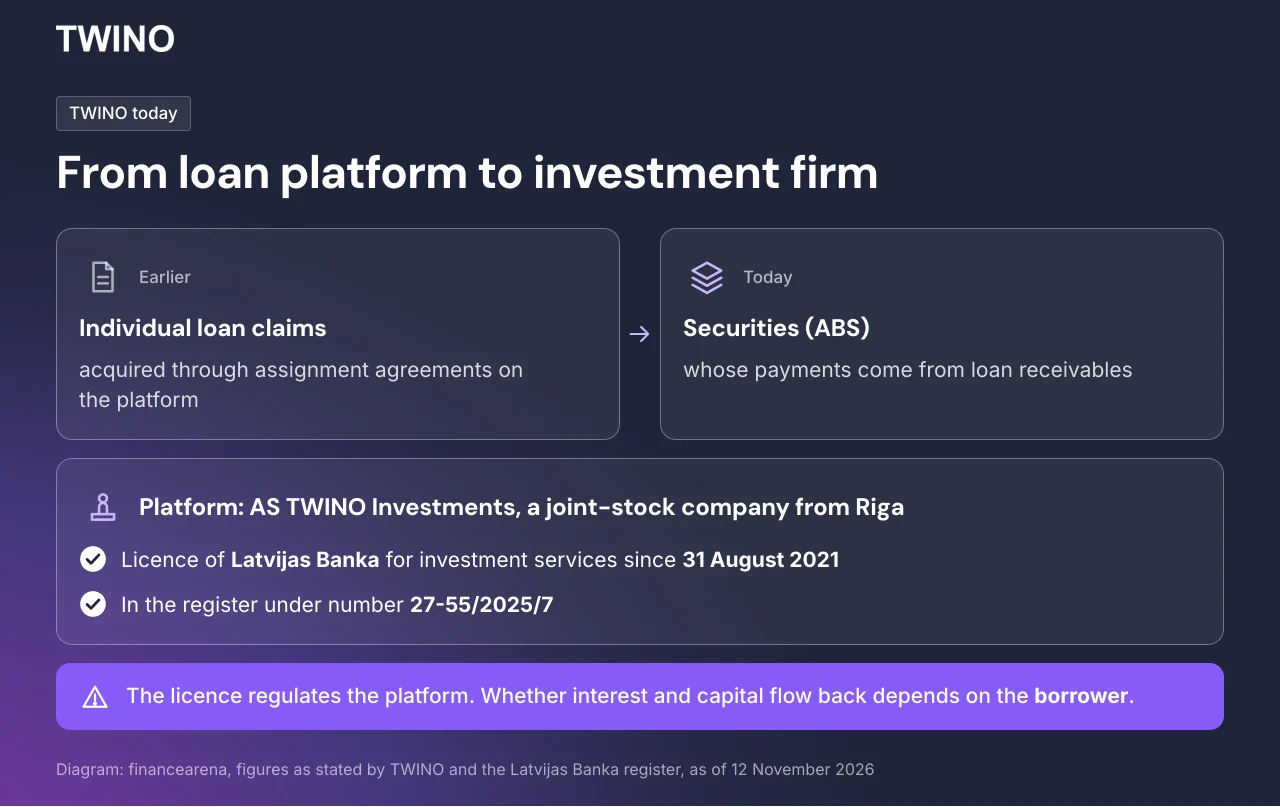
The platform is run by AS TWINO Investments, a joint-stock company in Riga. Latvijas Banka lists it under licence 27-55/2025/7 for investment and ancillary services, valid from 31 August 2021. The entry is public, so you can look it up in the official register.
According to that register, the firm may also provide services in 11 EEA countries on a freedom-to-provide-services basis (valid from 18 July 2023). They are Austria, Belgium, Czech Republic, Estonia, France, Germany, Italy, Lithuania, Netherlands, Portugal and Spain. If your country is missing, check the register.
The business model has shifted. According to a TWINO blog post of 5 August 2026, investors earlier bought individual loan claims on the platform through assignment agreements, which the post calls the “previous Assignment agreement model”. Today the operator sells asset-backed securities, or ABS, as an investment firm. A special purpose company, SIA TWINO Investments Poland, issues them, and the payments come from loan receivables. The licence concerns the platform, while repayment depends on the borrower, as point 9 shows.
2. Two Products, Two Purposes
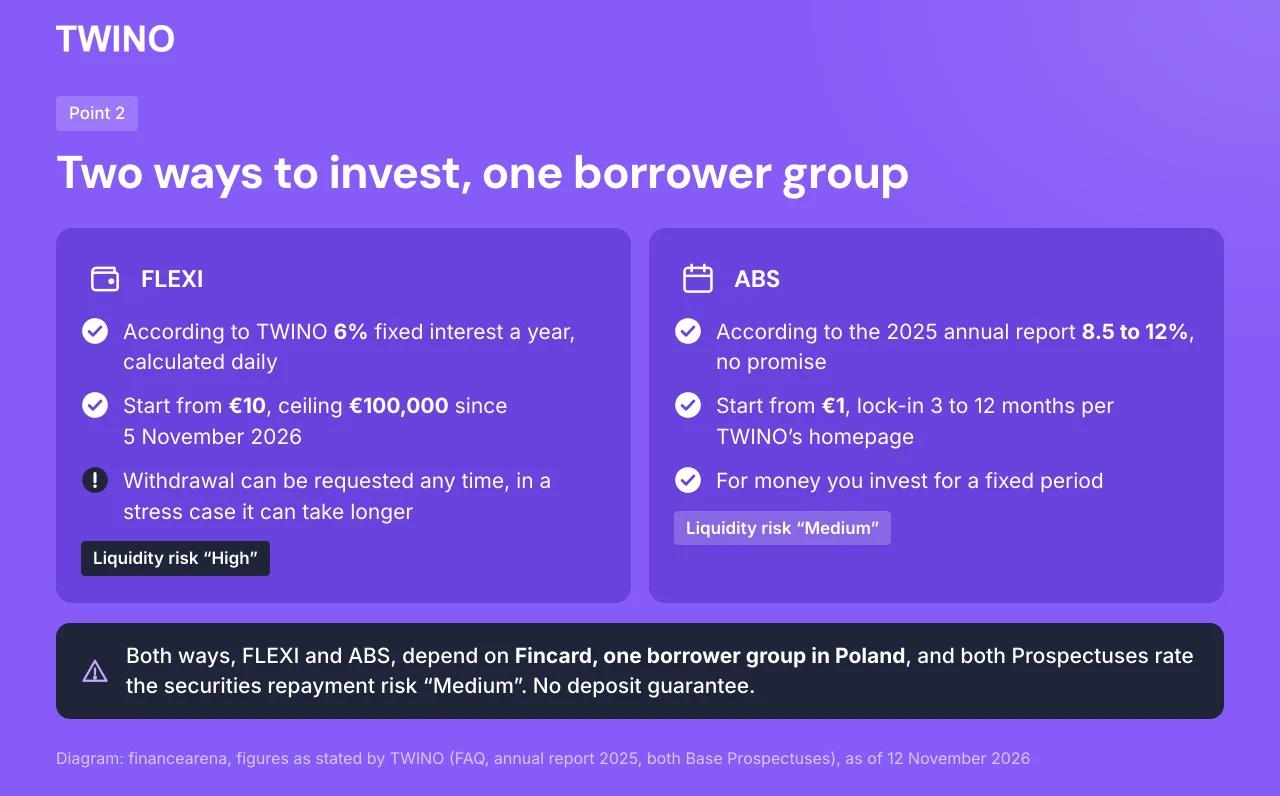
The platform offers two routes. FLEXI lets you request a withdrawal at any time, within the liquidity limits described below, while ABS tie up your money for a set period.
FLEXI pays a fixed 6% a year per TWINO, calculated daily. You can start from €10. Since 5 November 2026, the ceiling is €100,000 per client, up from €10,000 at the launch in April 2026.
Per TWINO's homepage, ABS have a lock-in period of 3 to 12 months and start at €1. According to the 2025 annual report, a series can also run 24 or 36 months. For 2025, the same report names fixed returns of 8.5% to 12% for the 3-, 6- and 12-month series. Read these as TWINO's figures, not as a promise.
“Withdraw any time” needs context. In normal operation, the FLEXI Base Prospectus of 26 October 2026 (section 2.5.1) assumes a buffer. Collateral posted by the loan originator plus early repayments should cover ordinary daily withdrawals. The same document calls FLEXI an “illiquid instrument” and rates its liquidity risk “High”. In a stress case, liquidity “most likely” falls short of the traditional 14 days for early repayment, so withdrawals can take longer. FLEXI is not a bank deposit, and no deposit guarantee scheme covers it. Our guide TWINO FLEXI explained covers withdrawals in detail.
In our view, FLEXI's lower rate is the trade-off for easier access in normal operation. Both routes, FLEXI and ABS, depend on Fincard, one borrower group in Poland. Section 2.5 of both Base Prospectuses (the ABS one dates from 12 May 2026) rates the securities' repayment risk “Medium”. On liquidity risk, the FLEXI prospectus says “High” and the ABS one says “Medium”.
3. Your Limit Comes From the Suitability Assessment
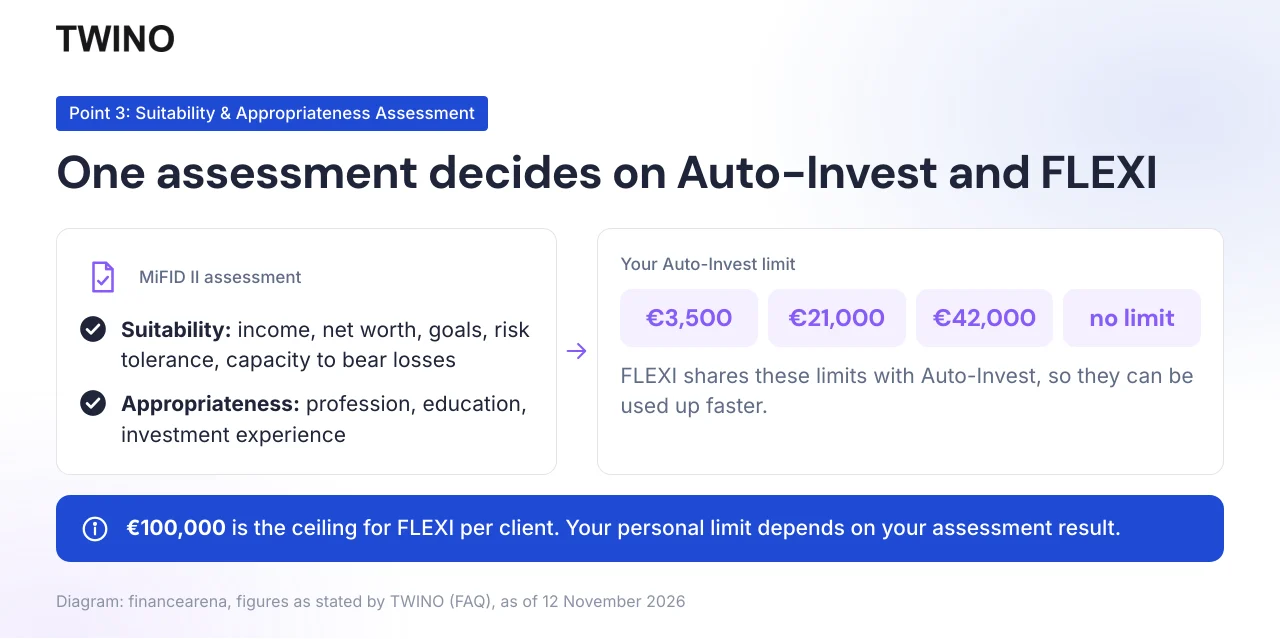
Before Auto-Invest and FLEXI comes a questionnaire. The platform requires the MiFID II suitability test from all investors, and without complete data it cannot offer certain services, including the Auto-Invest tool. Its own name for the test is Suitability & Appropriateness Assessment.
The assessment has two parts. Suitability covers income, net worth, goals, risk tolerance and capacity to bear losses. Appropriateness looks at profession, education and experience.
TWINO names four limit tiers: €3,500 (Getting started), €21,000 (Intermediate), €42,000 (Advanced) and No limit. In TWINO's words, the limit is a regulatory safeguard under EU financial regulation, including MiFID II, not a platform restriction.
One thing to flag: FLEXI hangs on the same assessment. FLEXI also shares the overall Auto-Invest limits, so they can be used up faster. Once you reach your limit, extra money stays in your FLEXI wallet as FLEXI Cash. The €100,000 from point 2 is only the ceiling per client, while your personal limit depends on your result. We found no TWINO sentence on how the tiers combine with that ceiling, so we do not calculate it.
To raise your limit, repeat the assessment on My Profile or, if you meet the required criteria, request Professional Investor status, which TWINO reviews separately. TWINO's investor-protection FAQ lists investors who have disclosed that they are professional investors among those not entitled to compensation. We found no TWINO text that links this to the status request, so ask TWINO before you apply. Our guide How to invest in TWINO shows the tiers as a table and walks through the click path.
After sign-up and the ID check, you fill in the questionnaire, because FLEXI and Auto-Invest need it.
4. You Enroll in the Campaign Yourself
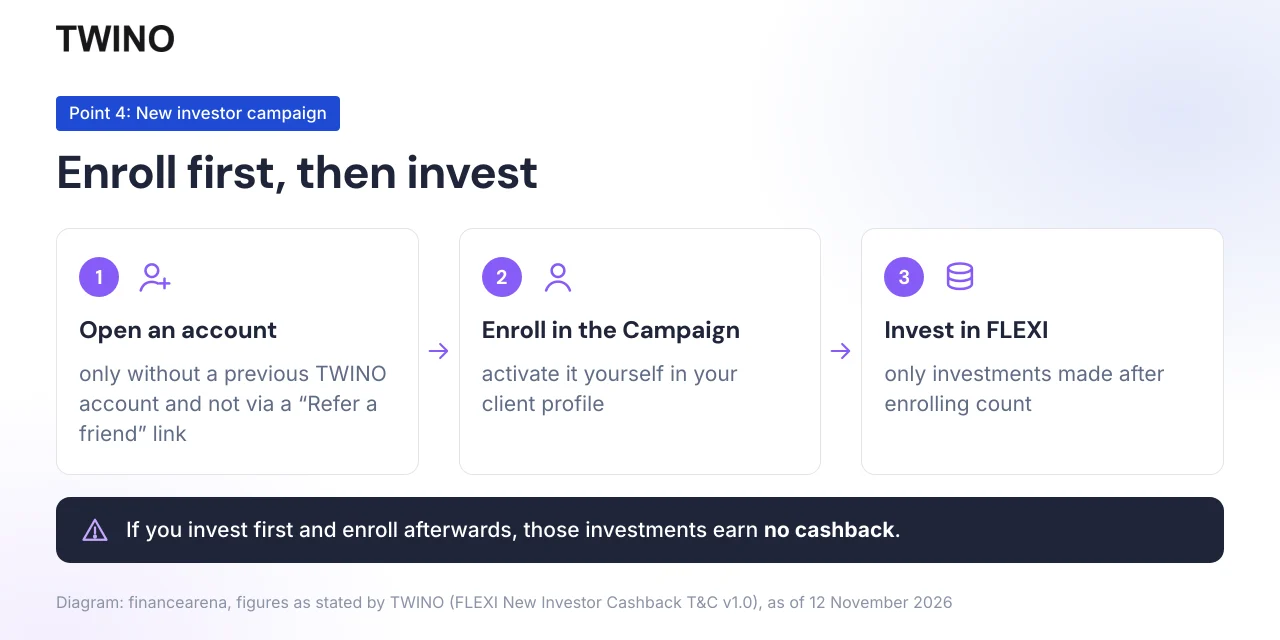
Per the FLEXI new-investor cashback T&C, only investments made after you enroll in your client profile count, so enroll first, then invest; earlier TWINO clients and “Refer a friend” sign-ups are excluded. Amounts and examples are in our TWINO bonus guide.
5. Interest Runs Only Once Your Money Is Invested
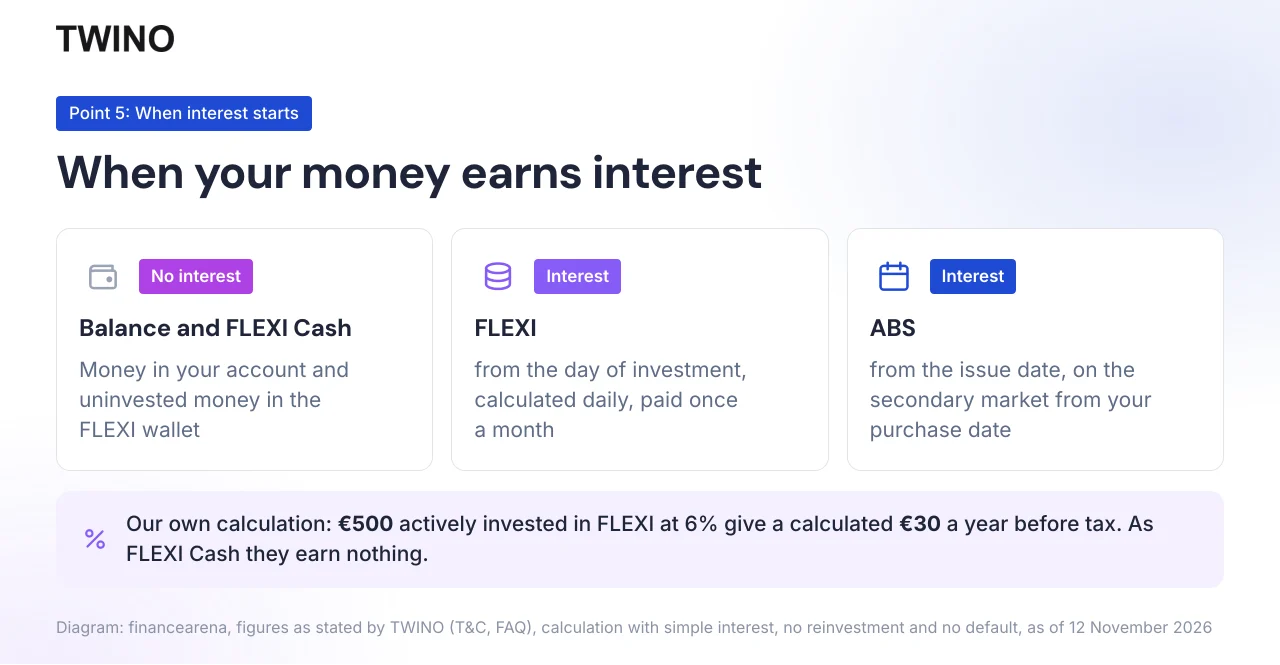
Money earns interest only while it sits in a security, and the start differs by product. On ABS, interest starts on the issue date for primary-market purchases and on your purchase date for secondary-market ones. According to the FAQ, it is paid monthly.
FLEXI starts on the day of investment, with interest calculated daily on the actively invested amount and paid out monthly.
In between sits a waiting zone called FLEXI Cash: uninvested money in your FLEXI wallet. The FAQ names four situations in which it arises:
- •You have just deposited, and Auto-Invest needs up to 20 minutes to process the money.
- •No FLEXI investment is available at that moment.
- •The amount is below the minimum investment of €10.
- •Interest has just been credited.
FLEXI Cash earns no interest, and it is invested automatically once an investment is possible and your limit allows it.
The same logic covers your account balance. The T&C (version 3.2, 29 June 2026) speak to this in clause 7.7. The client “may not request any interest payments from TWINO, including lawful interest or any other remuneration, for the balance of the Client’s Account”. We read this as no interest on money that sits uninvested.
A calculation of our own makes this concrete. €500 actively invested in FLEXI at 6% give €30 a year before tax. That uses simple interest, without reinvestment or default. The same €500 as FLEXI Cash earn nothing, so waiting costs interest.
ABS holders may find one feature useful: they can switch on Auto-move repayments to FLEXI beneath the Main Wallet card on the Dashboard. Once it is on, interest and principal are both selected, so those ABS repayments move into your FLEXI wallet. You can switch either type off at any time.
Registration runs online, and interest only starts once your money is invested.
6. The Inactivity Fee After Six Months
According to its FAQ, the platform charges no fees for investing in securities or for buying and selling on the secondary market. The fees page and the withdrawal FAQ add that withdrawals to EU/EEA bank accounts that support SEPA euro payments are free of charge.
One fee hits idle accounts: if you buy no financial instrument for more than six months, TWINO may deduct an inactivity fee. It is €10 from the seventh month (T&C clause 4.4), taken on the first day of each month.
How long the fee runs depends on your account. Without securities, it can run until the funds in your account reach €0.00. With securities, it applies only while the funds in your account exceed 15% of their value or €50, whichever is greater. We found no example in the T&C, so here is a calculation of our own. With securities worth €4,000, 15% is €600, which is more than €50. The fee then applies only while those funds are above €600. With securities worth €200, 15% is just €30, so the €50 threshold counts.
The inactivity-fee FAQ adds that the fee will never reduce your balance below €50.00. That reads differently from the clause above, and we follow the T&C wording. To avoid the fee, the FAQ names two routes: keep your funds invested, or withdraw unused funds.
Withdrawals and refunds to a bank account that is not an EU/EEA SEPA account cost €35 each, and for those withdrawals the minimum is €50. TWINO's withdrawal FAQ names accounts in the United Kingdom and Switzerland as examples, even if they may support SEPA payments. The costs at a glance:
Amount per TWINO | When | |
|---|---|---|
| Buying securities | €0 | every investment |
| Secondary market | €0 | buying and selling |
| EU/EEA SEPA withdrawal | €0 | to an EU/EEA account that supports SEPA euro payments |
| Other withdrawal/refund | €35 | each, to any other account; minimum €50 for these |
| Inactivity | €10 a month | from the 7th month without a purchase, thresholds above |
Tip: scroll horizontally to see all columns
7. Leaving Early: ABS Exit Only Through the Secondary Market
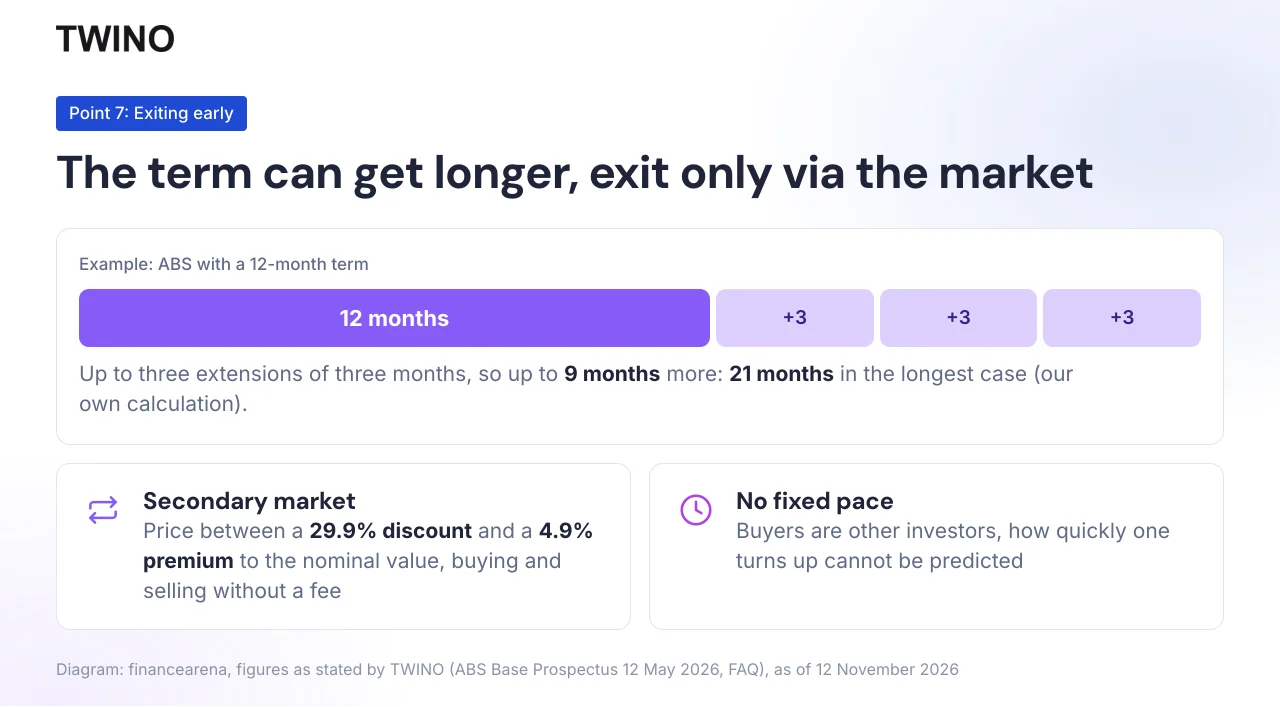
With ABS you have no right to early redemption. The ABS Base Prospectus (section 12.7) says redemption at the option of the securityholder is not applicable. The issuer, however, may redeem early without giving you notice.
If you want out early, you sell on the secondary market. According to section 2.5.1 of the ABS Base Prospectus, potential buyers are limited to other investors on the platform, and section 12.16 also names the Distributor. Buying and selling carry no fee per TWINO, and the ABS Base Prospectus caps the price at a 29.9% discount or a 4.9% premium to the nominal value. A sale can still happen at a discount, and the prospectus says there may be difficulties in selling. It also says neither the issuer nor any other person guarantees minimum liquidity, so we cannot tell you how quickly a buyer turns up or at what price.
A second right is easy to miss. The borrower may extend a loan up to three times by three months each, which adds up to 9 months. From a 12-month term, the longest case is 21 months, by our own calculation. In practice, the question is whether you could spare that money for months beyond the stated term.
FLEXI works differently. You file a withdrawal request and sell nothing on the secondary market. A transfer to your Main Wallet is processed immediately after the request. TWINO's FAQ adds that withdrawals are processed based on FLEXI liquidity and settlement timing, so in a stress case it can take longer.
8. Withholding Tax and the Tax Residency Certificate
According to TWINO's FAQ, if you are not a tax resident of Latvia, withholding tax (WHT) may be deducted at source, so the interest you receive is after tax.
What you pay depends on one document. Without a valid Tax Residency Certificate that supports treaty relief, the Latvian domestic rate generally applies. TWINO's FAQ of 16 September 2026 puts that rate at 25.5% for capital income, including interest. On €100 of interest, that would mean €25.50 withheld and €74.50 net. With such a certificate and an applicable double-tax treaty, a reduced rate may apply.
Your tax authority issues the certificate. It should show your name, the authority's confirmation and the tax year. It should also be in English or come with a translation. You upload it under “My profile”. Beyond that, the country of residence you enter in your account is not official proof of tax residence.
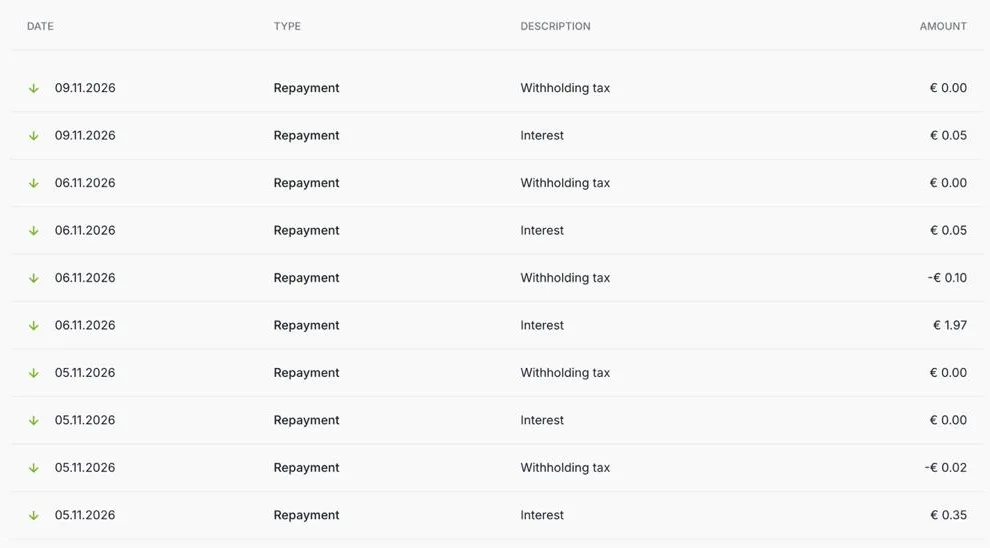
Our own statement shows the mechanism. On 6 November 2026, an interest line of €1.97 sits next to a withholding tax line of minus €0.10. By our own calculation, that is about 5%. It is one observation from one account, not a rule for your rate.
TWINO's homepage says investors are responsible for declaring income and complying with local tax regulations. Under Profile, Reports, Income Statement, you find the matching statement. We give no tax advice, so ask a qualified tax adviser or your local tax authority about your case. One tax risk remains: if tax rates rise, the issuer does not compensate you, according to the Base Prospectus.
9. FLEXI and ABS Rest on One Borrower Group in Poland
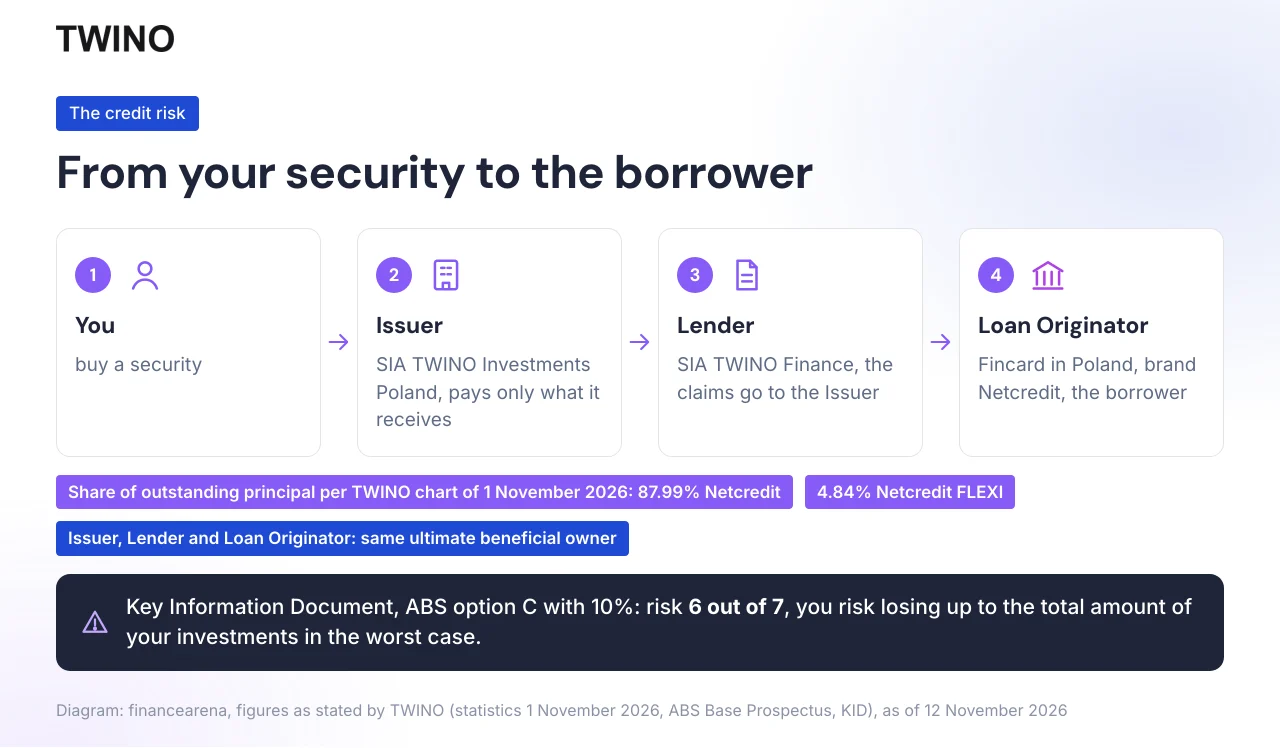
Fincard Sp. z o.o. of Warsaw, registered on 12 September 2019, is the borrower behind FLEXI and ABS. It operates mainly under two digital consumer brands, Netcredit and Halvo. Since November 2024, it has been entered in the Polish national payment institution register.
Section 4.1 of the FLEXI Base Prospectus lays out the payment path: Fincard repays its loan to the lender, SIA TWINO Finance, which passes the loan receivables on to the issuer, SIA TWINO Investments Poland. In section 5, the Base Prospectuses add that the issuer, the lender and the loan originator “all have the same ultimate beneficial owner”.
The structure holds up on one point. The Base Prospectus caps the loan at 95% of the pledged portfolio (section 4.1). Concentration is the weaker spot. In TWINO's statistics chart of the outstanding principal as of 1 November 2026, Netcredit accounts for 87.99% and Netcredit FLEXI for 4.84%. Real estate shows 3.4% and Vamo in Vietnam 3.77%. The current Base Prospectuses and TWINO's homepage name Fincard (Netcredit) as the loan originator, so the FLEXI and ABS securities TWINO offers today depend on one borrower group in Poland.
Payments follow a principle called limited recourse: the issuer pays only what it receives on the loan receivables. On the risk scale of the Key Information Document (KID, renewed 11 July 2025), ABS option C sits at 6 out of 7, the second-highest class. That option names an annual return of 10%. The KID says you risk losing up to the total amount invested, so a total loss is possible.
That said, the chain is transparent, because the prospectus names each link from issuer to borrower. Our alternative investments comparison shows how TWINO sits next to other options, and Is TWINO safe? covers the full chain.
Read the Base Prospectus and the KID before your first deposit, and use only money you can afford to lose.
10. Deposits, Withdrawals and the App
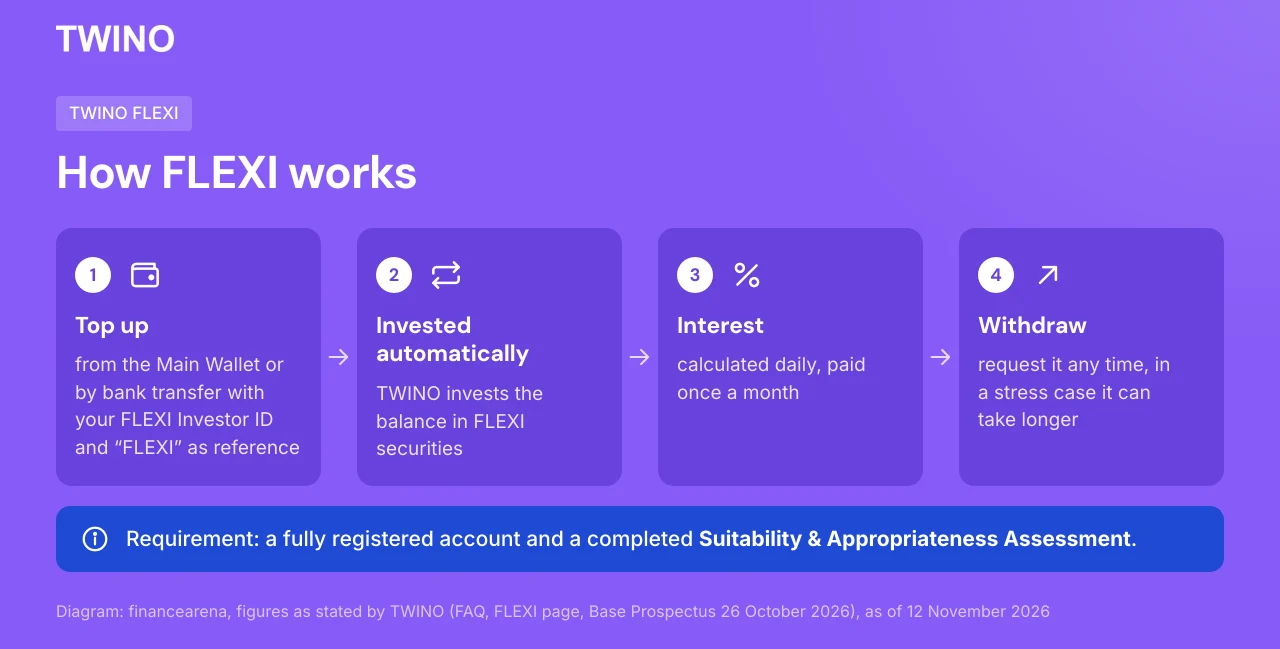
In daily use, the platform is practical. According to TWINO's FAQ, the app runs on iOS and Android in four languages. Inside it, you can also move money between the Main Wallet and FLEXI. The diagram above shows the four FLEXI steps: top up, automatic investment, interest and withdrawal. For a bank transfer, include your FLEXI Investor ID and “FLEXI” as the payment reference. Otherwise the money lands in your Main Wallet. FLEXI also needs a fully registered account and a completed assessment.
For the account itself, TWINO's FAQ says you need to be an EU/EEA resident, at least 18, with full legal capacity. You also need a payment account in your name in an EU/EEA country. Deposits come only from your own account and only in euro.
Plan a buffer for deposits, because two FAQ answers differ: one gives an average of 2 business days, and another says euro transfers within the EU/EEA usually arrive within one business day.
You can withdraw uninvested balance at any time under Profile and Withdraw funds. The money goes only to your linked bank account. The FAQ says requests are typically processed within 2 business days, and extra security checks can extend that. A stress case can slow FLEXI withdrawals (point 2).
Your Checklist Before the First Deposit
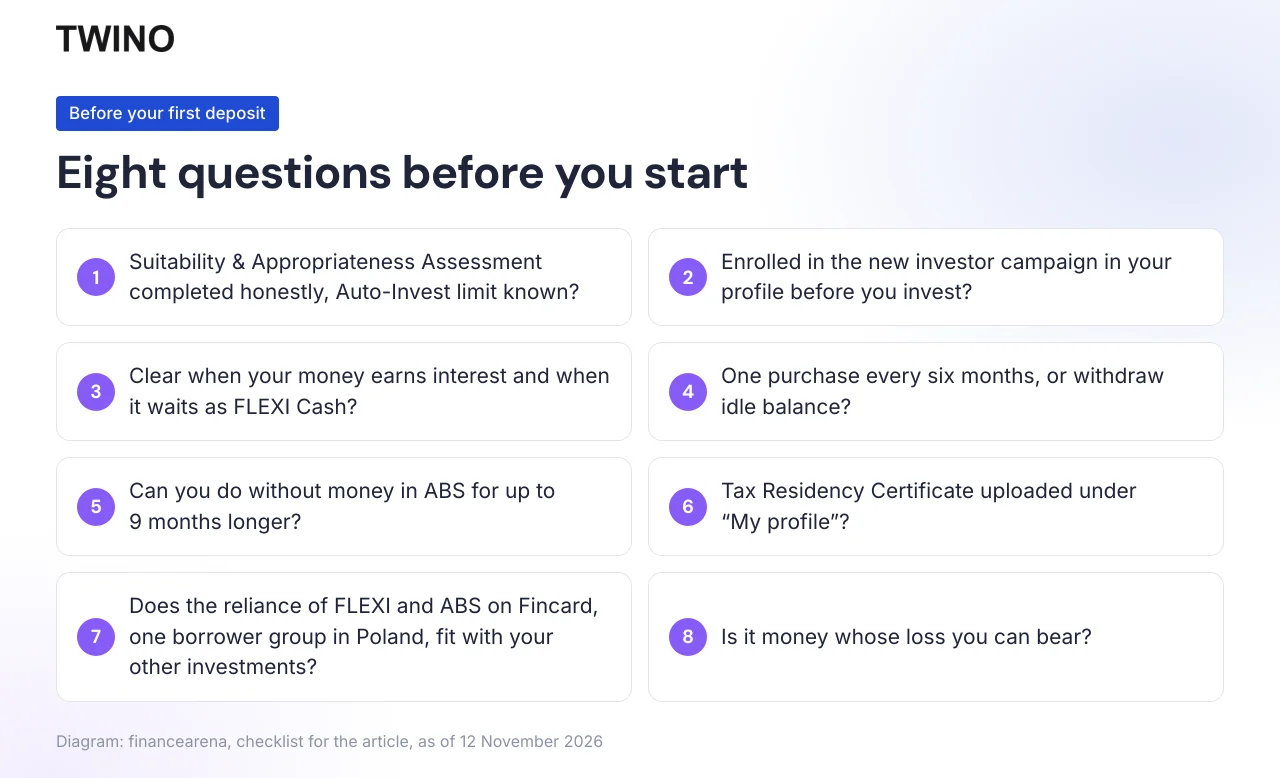
These ten points are easier to handle before the first deposit than after it. Work through these eight questions:
- •Have you completed the Suitability & Appropriateness Assessment honestly, and do you know your Auto-Invest limit?
- •Did you enroll in the new investor campaign in your profile before investing?
- •Do you know when money earns interest and when it waits as FLEXI Cash?
- •Will you make one purchase every six months, or withdraw idle balance?
- •Could you do without money in ABS for up to 9 months longer?
- •Have you uploaded your Tax Residency Certificate under “My profile”?
- •Does the reliance of FLEXI and ABS on Fincard, one borrower group in Poland, fit with your other investments?
- •Is it money whose loss you can bear?
Overall, the rules are transparent, and you can spot most stumbling blocks before you start. Point 6 lists the fees that apply. The main caveat is the borrower. The FLEXI and ABS securities TWINO offers today depend on Fincard, one borrower group in Poland. No deposit guarantee applies, and a total loss is possible.
A sensible first step is the assessment, because it sets your limit and FLEXI access. This article is not investment advice. Our overall verdict with a product comparison is in the TWINO review.
Use only money whose loss you can bear, because a total loss is possible.
Frequently asked questions
You might also like
TWINO Review 2026: 6 to 12% Per TWINO, From €1, Latvian Licence
Our overall verdict on TWINO: products, costs and who the platform may suit.
Is TWINO Safe in 2026? Licence, Investor Protection and Limits
Regulation, investor compensation, the borrower chain and the limits of each protection layer.
TWINO FLEXI Explained: 6% Per TWINO, €100,000 Limit (2026)
How FLEXI pays interest, how the limit works and what to expect on withdrawals.
How to Invest in TWINO: Sign-Up, Deposit and First Steps (2026)
Registration, ID check, suitability assessment with the limit table, deposit, FLEXI and withdrawal.
Legal information
The content on this site has been researched carefully. Our sources are the providers' publicly available information and their terms and conditions. Despite regular checks we cannot warrant that the data is current, accurate or complete. Binding information on products and prices is only available on each provider's own website. Unless stated otherwise, the conditions shown apply to new customers.
Not financial advice
Our content is informational and comparative only. It is not financial, tax or legal advice, and it is neither a recommendation to buy nor an invitation to take out a financial product. Make your decisions based on your own situation and risk tolerance, and consult an independent adviser if you need one.
Risk warning
Every investment carries risk. Values can rise or fall, and past performance does not indicate future returns. You can lose part or all of the capital you invest. Crypto-assets are largely unregulated, are not covered by deposit guarantee or investor compensation schemes, and carry a high risk of total loss.
Advertising and affiliate links
Some links on this site are marked with an asterisk (*) and are affiliate links (advertising). If you take out a product through one of these links, we receive a commission from the provider at no additional cost to you. That is how you support our work.