Is TWINO safe? The platform operator holds a Latvian licence from Latvijas Banka, and investor compensation covers up to €20,000 if the investment firm cannot meet its obligations. In our understanding, those layers address the platform, not a borrower that fails to pay. The FLEXI and ABS securities TWINO offers today depend on Fincard, one borrower group in Poland. No deposit guarantee applies, and a total loss is possible.
Is TWINO Safe? The Short Answer
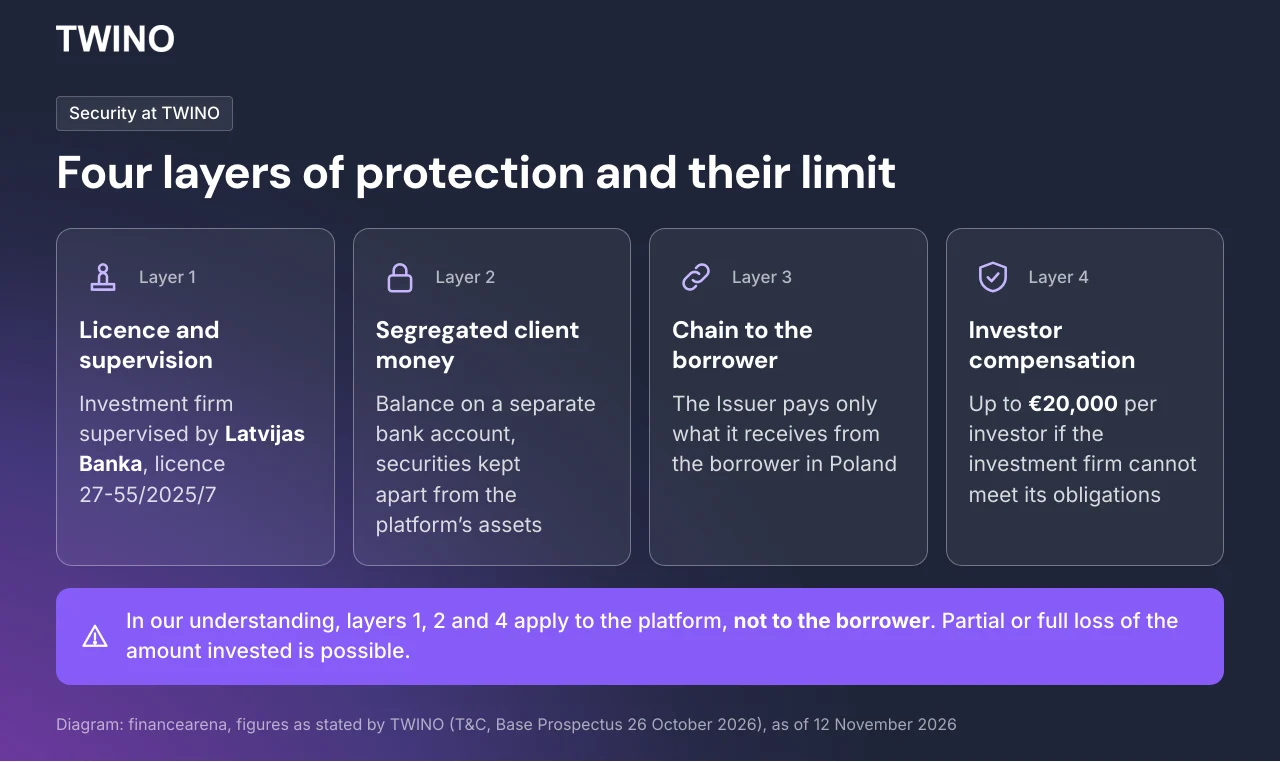
What speaks for TWINO: A public register lists the Latvian licence, and the Base Prospectus describes the structure section by section. TWINO also says client money sits on a separate bank account. Per TWINO's FAQ, investor compensation applies up to €20,000 when the investment firm cannot meet its obligations.
What to watch: In our understanding, licence, client money and compensation work at platform level, so none of them helps if the borrower cannot pay. The FLEXI and ABS securities TWINO offers today depend on one borrower group in Poland, namely Fincard. They fall outside any deposit guarantee scheme, and the Issuer pays only what it receives from the borrower side. A total loss of the amount invested is possible. TWINO also reported cyberattacks on its platform for 15 and 16 October 2026, which we summarise below.
In our TWINO account, €3,911 is invested in FLEXI, and by 10 November 2026 FLEXI had earned €58.03 in interest there, including €7.69 accrued and not yet paid out. This article is about structure, not returns.
TWINO Safety in Our Video
This article adds the sources behind the video.
The pre-start checklist lists what to check before a first deposit.
Registration, ID check and the suitability assessment are completed online.
Layer 1: Licence and Supervision in Latvia
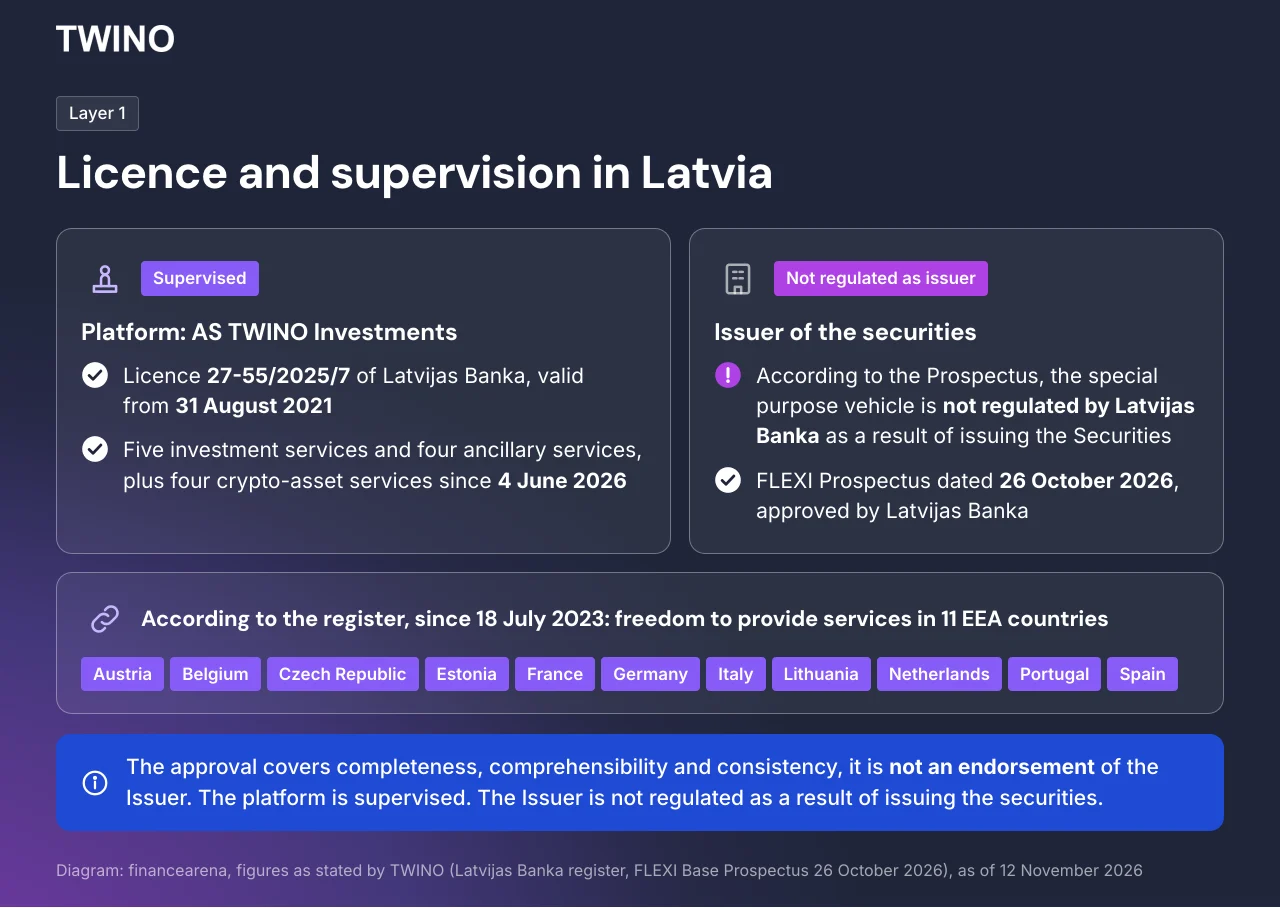
A joint-stock company in Riga, AS TWINO Investments, operates the platform. In the Latvijas Banka register it appears with a licence for investment and ancillary services, number 27-55/2025/7, valid from 31 August 2021.
The register entry lists five investment services and four ancillary services, plus four crypto-asset services since 4 June 2026. Per the register, TWINO may provide services in 11 EEA countries on a freedom-to-provide-services basis (valid from 18 July 2023): Austria, Belgium, Czech Republic, Estonia, France, Germany, Italy, Lithuania, Netherlands, Portugal and Spain. For other countries, we found no statement either way.
The notice on the first pages of the FLEXI Base Prospectus states the Issuer is not, and will not be, regulated by Latvijas Banka as a result of issuing the Securities. Section 10.2 says the approval only means the document meets the standards of completeness, comprehensibility and consistency under the Prospectus Regulation, and it should not be considered “an endorsement of the Issuer”. The Base Prospectus, approved by Latvijas Banka, gives its own date as 26 October 2026 on the cover page, and TWINO's Loan Originators page lists it as “Base prospectus (FLEXI) 26.10.2026”. We found no separate approval date in the document. So the platform is supervised, while the Issuer is not regulated as a result of issuing the securities.
Layer 2: Client Money Is Kept Apart, but Is Not a Bank Deposit
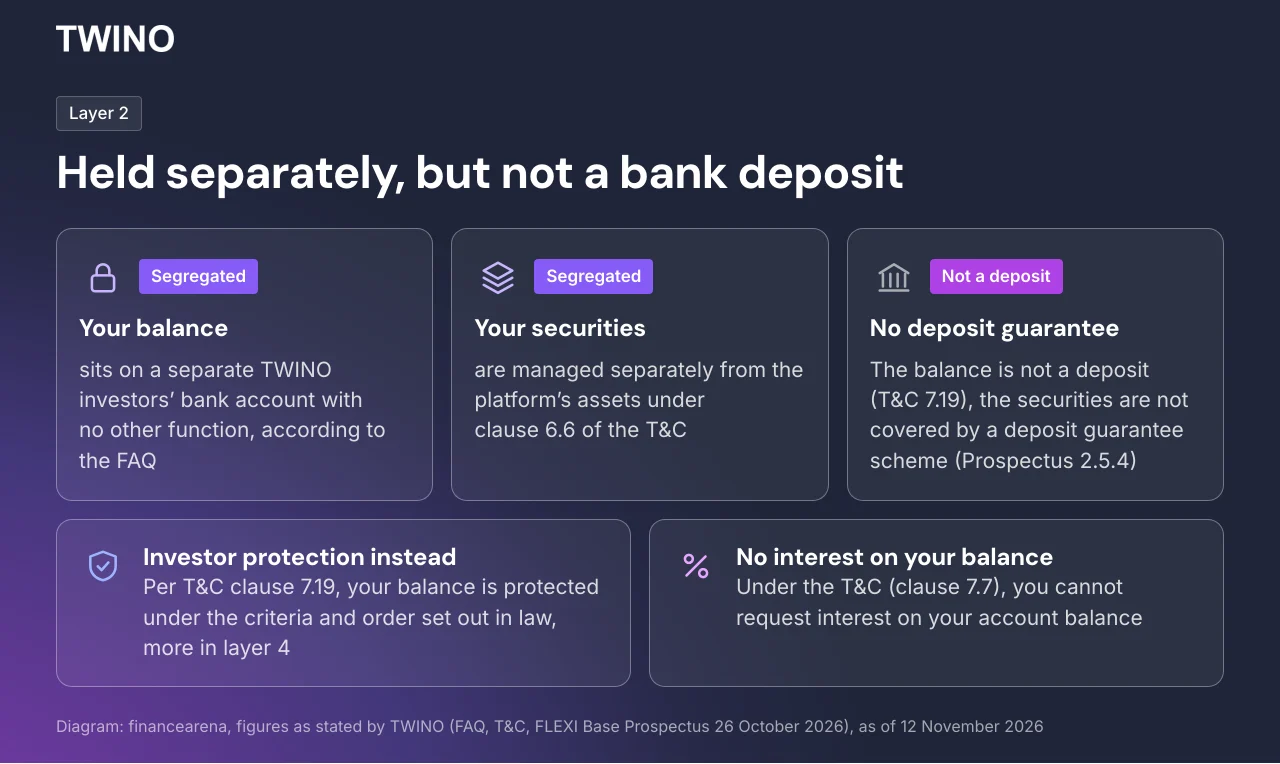
According to the FAQ, all money you transfer to your investor account sits in “a separate TWINO investors' bank account which has no other function”. Under clause 6.6 of the T&C, your securities are “managed separately from TWINO assets”.
Clause 7.19, however, says your balance “is not a deposit but is protected under criteria and order set out in applicable laws”. Layer 4 explains those criteria. Clause 7.7 adds that the client “may not request any interest payments from TWINO” on the balance of the client account. According to the FAQ, TWINO pays no interest on money in your account that is not invested.
For the securities, section 2.5.4 of the FLEXI Base Prospectus notes that they do not have the status of a bank deposit in Latvia or elsewhere, so no deposit guarantee scheme covers them.
Under Directive 2014/49/EU, Article 6(1), EU deposit guarantee schemes cover €100,000 per depositor, and Article 7(1) applies that limit per credit institution. The trade-off is that a security carries credit risk, and no deposit scheme absorbs it.
Layer 3: Who Owes You the Money
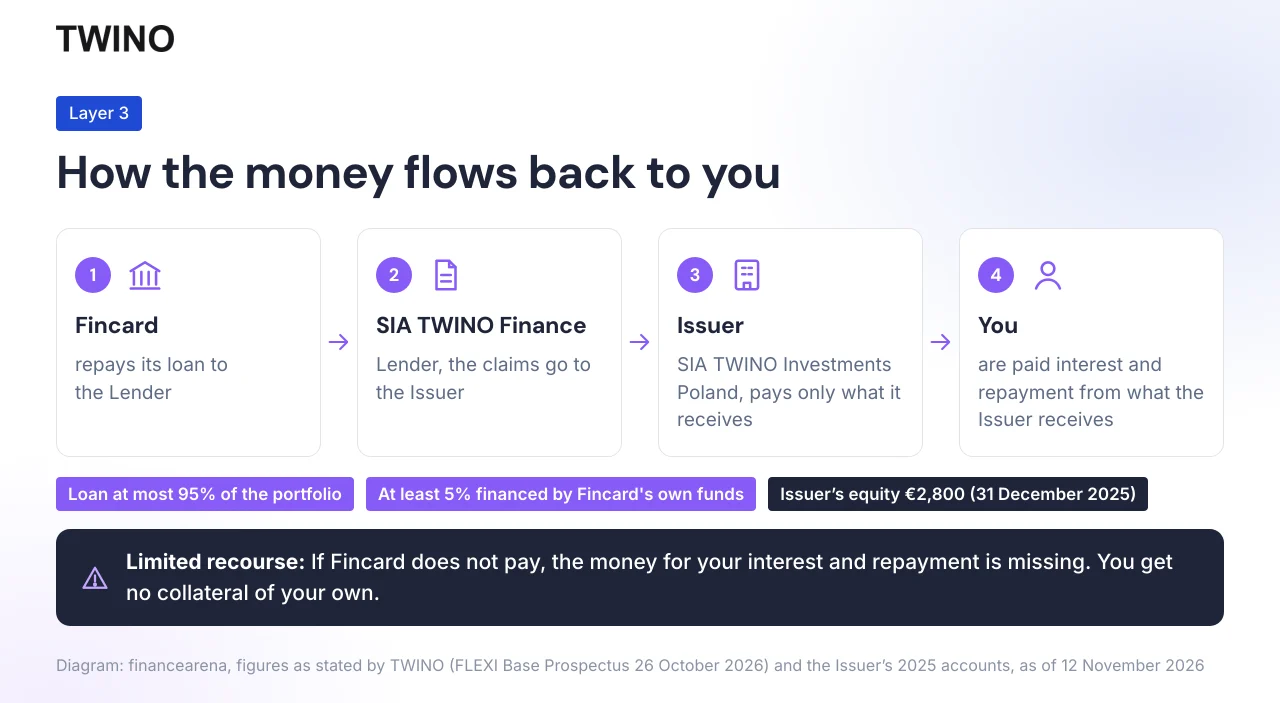
The Issuer of the securities is SIA TWINO Investments Poland, a special purpose company in Riga. Its equity was €2,800 on 31 December 2025, according to its 2025 accounts.
Two more names sit behind the Issuer. SIA TWINO Finance is the Lender. Fincard Sp. z o.o. in Warsaw is the Loan Originator, and it “operates primarily under two digital consumer brands, Netcredit and Halvo”.
Section 4.1 of the FLEXI Base Prospectus provides that Fincard repays its loan to the Lender, which passes the loan receivables on to the Issuer. The Issuer then repays the securities from those funds and any posted collateral. Under sections 4.1 and 12.2, payments to you are made “only from and to the extent of such sums received” by the Issuer. This principle is called limited recourse. If Fincard does not pay, the money for your interest and repayment is missing.
You do not get collateral of your own. Section 4.1.1 states: “No collateral, pledge or other types of guarantees will be available for the Securityholders.”
On the borrower side, the loan may not exceed 95% of the pledged portfolio, so Fincard finances at least 5% of it with its own funds. If it becomes illegal under Polish law for the pledge to remain in force, the Base Prospectus says the loan receivables are unsecured.
One thing to flag: the Base Prospectus is not consistent on ranking. Section 2.5.2 describes all claims from the securities as “subordinated to other claims of the Issuer”, while section 12.2 says the obligations rank pari passu with the Issuer's “unsubordinated and unsecured obligations”. We pick no reading here.
Is There a Buyback Guarantee at TWINO?
For the ABS, early redemption at your request is ruled out: “Redemption at the option of the Securityholder is not applicable.” Leaving early means a sale on the secondary market, where only other platform investors can buy. The ABS Base Prospectus (section 2.5.1) gives no liquidity guarantee there. The same section warns that a sale may only be possible at a discount, which it caps at 29.9% of the nominal value.
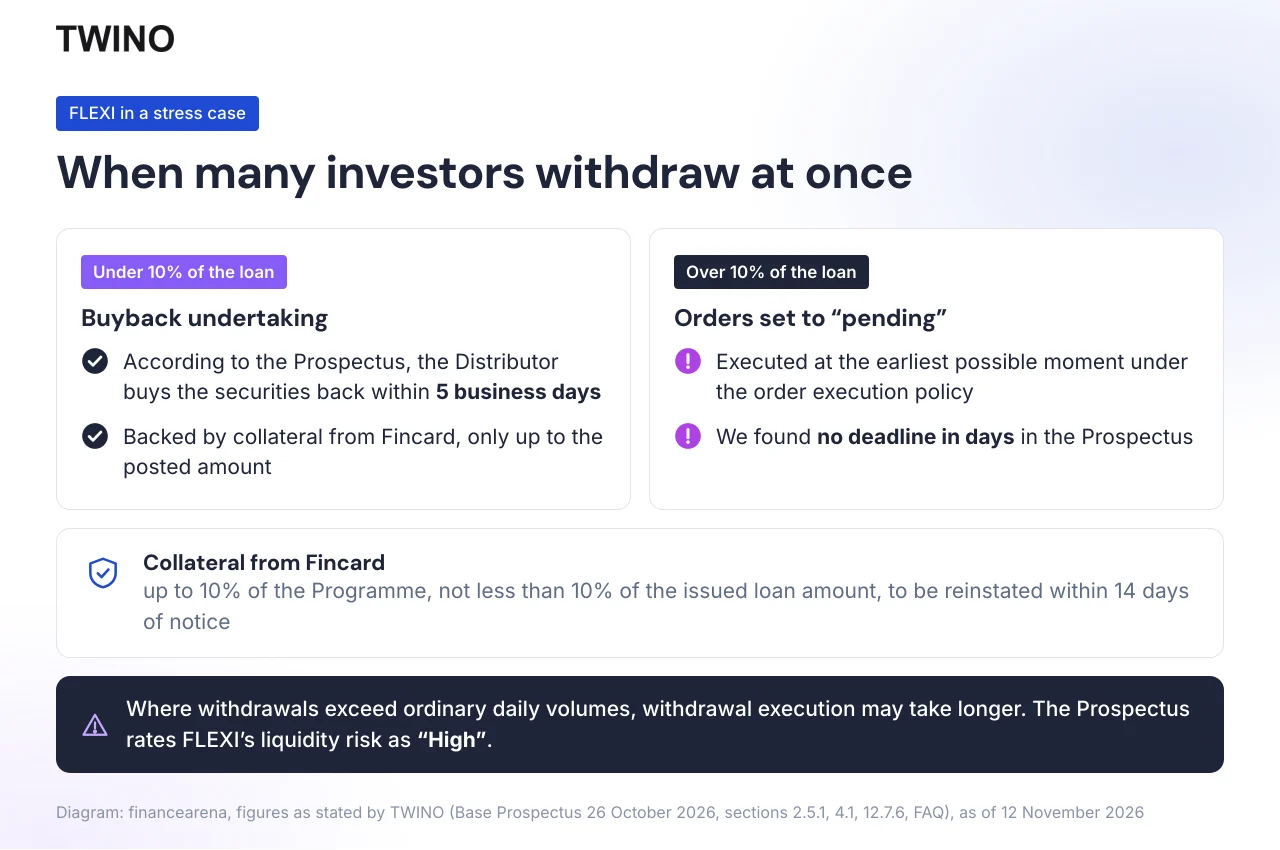
FLEXI works differently. Under section 12.7.6 of the FLEXI Base Prospectus, the Distributor, which is the platform operator, “undertakes to buy from the Securityholder the Securities within 5 (five) business days”. That applies if all sell requests stay under 10% of the loan. Above that level, orders follow the Distributor's order execution policy and are “marked as pending on the Platform and executed at the earliest possible moment”. We found no deadline in days for that case in the Prospectus.
Fincard backs the commitment with collateral of up to 10% of the Programme, but not less than 10% of the issued loan amount, which it must reinstate within 14 days of notice (section 4.1.3). The FLEXI Base Prospectus (section 2.5.1) adds that this collateral absorbs withdrawals only up to the amount posted, and in normal operation it and early repayments “should suffice”.
In a stress case, that section expects withdrawals to exceed the ordinary daily rate and states “the liquidity most likely will fall short of the traditional 14 (fourteen) days for the early repayment framework”. TWINO rates the liquidity risk High and calls FLEXI an “illiquid instrument”. The FAQ says withdrawals can take longer when many investors ask at once: where they exceed both investor demand and the collateral, “withdrawal execution may take longer in such situations”. The mechanics are in our FLEXI article.
Layer 4: Investor Compensation of up to €20,000
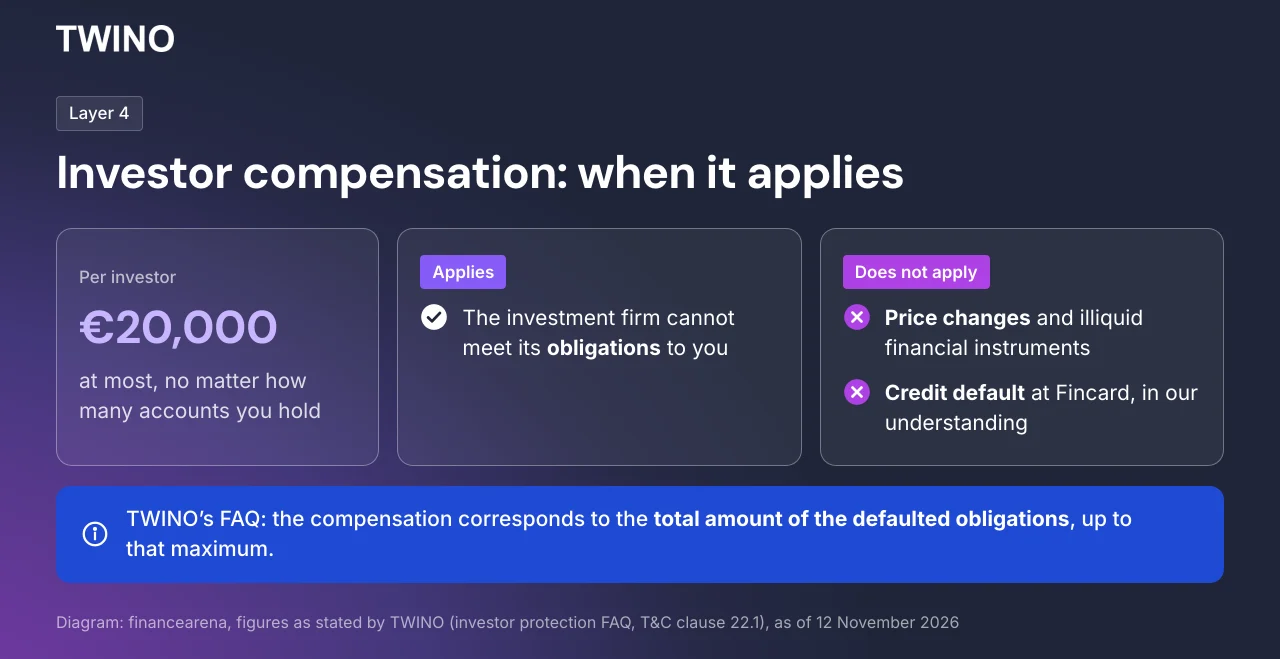
The FAQ describes the Latvian investor protection mechanism: the investor “shall be entitled to compensation corresponding to the total amount of the defaulted obligations, up to a maximum of EUR 20 000”. The cap applies per investor, whatever the number of accounts. The Latvijas Banka page uses similar wording. Clause 22.1 of the T&C adds that clients are entitled to compensation if TWINO cannot fulfil its obligations in full and on time.
According to the FAQ, the scheme does not cover losses from price changes of financial instruments or from instruments that have become illiquid. The FAQ also lists exclusions, among them professional investors, board members and holders of more than 5% of the firm's capital. We found no sentence on loan defaults in that FAQ. In our understanding, a borrower default is not a compensation case, because the scheme looks at the obligations of the investment firm.
Beyond that, read the application rules on the Latvijas Banka page before you rely on any claim. The sources we read describe the time limits differently, so we give no deadline here. An older FAQ entry and the data behind TWINO's homepage also mention compensation of 90% of the lost value. We follow the current FAQ of 15 January 2026, which names the €20,000 cap and no percentage.
The Protection Layers Side by Side
The layers side by side: what each one protects against, and what stays with you.
Protects against | Does not protect against | |
|---|---|---|
| Licence (Latvijas Banka) | Platform operator supervised under licence 27-55/2025/7, valid from 31 August 2021 | The Issuer of the securities, which is not regulated by Latvijas Banka as a result of issuing them |
| Separate client money | Balance on a separate bank account and securities managed separately from TWINO assets, per TWINO | No deposit guarantee: the balance is not a deposit, and the securities fall outside any scheme |
| Chain and recourse | Base Prospectus sets out the chain and the risks and caps the loan at 95% of the pledged portfolio | A borrower that fails to pay: the Issuer pays only from sums it receives, and investors get no collateral |
| FLEXI buyback commitment | Buyback within 5 business days while all sell requests stay under 10% of the loan | Heavy withdrawals: above 10%, orders stay pending, we found no deadline in days in the Prospectus, and TWINO rates liquidity risk High |
| Investor compensation | Failure of the investment firm: up to €20,000 per investor if it cannot meet its obligations | Price changes, illiquid instruments and, in our understanding, borrower defaults |
| Deposit guarantee | None applies to the securities (Base Prospectus, section 2.5.4) | A loss of up to 100% of the investment in the worst case, per the Key Information Document for ABS option C |
Tip: scroll horizontally to see all columns
The Platform Is Supervised, the Credit Risk Stays With You
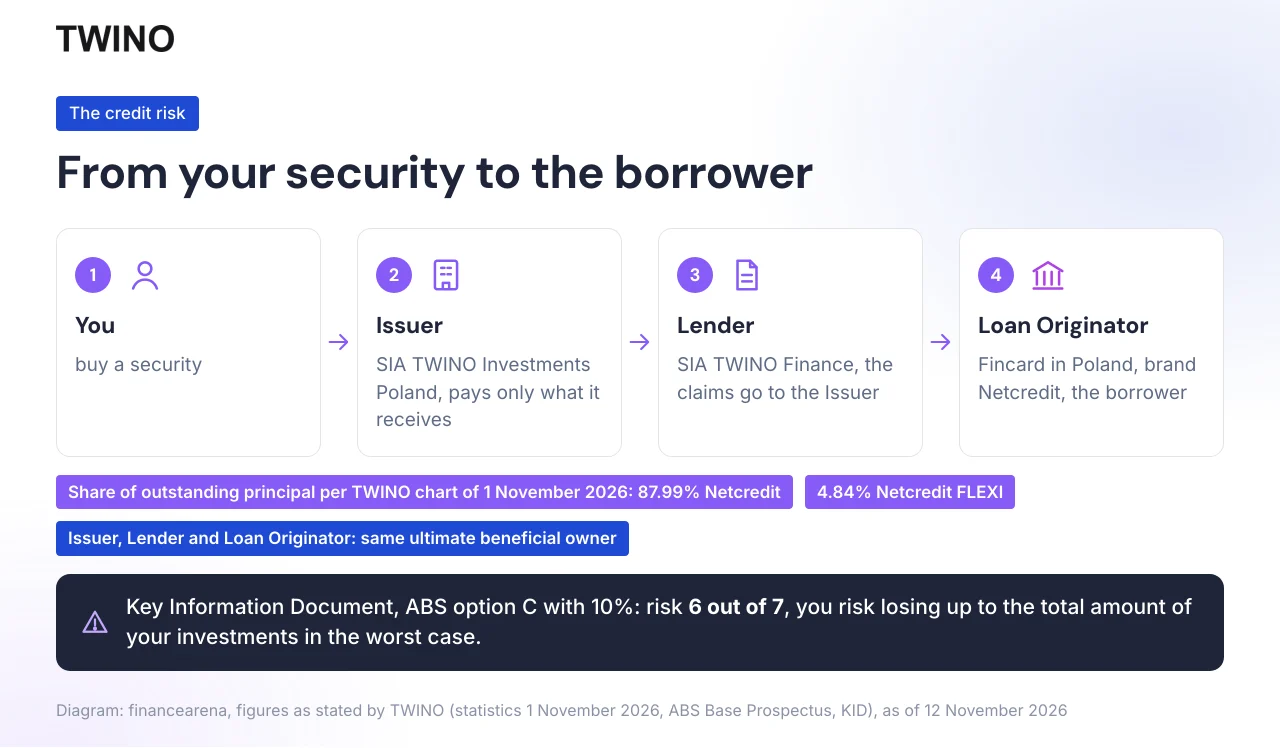
As we read it, licence, separated client money and compensation all concern the platform, while your repayment depends on the borrower side, which concentrates on Fincard. On 1 November 2026, 87.99% of the outstanding principal shown in TWINO's chart (segments sum to about €42.8 million) sat with Netcredit, plus 4.84% under Netcredit FLEXI. Real estate accounts for 3.4%, and Vamo Vietnam, covered below, for 3.77%. Netcredit is a brand of Fincard, and the FLEXI and ABS securities TWINO offers today depend on Fincard, one borrower group in Poland.
The FAQ describes FLEXI as “backed by a diversified portfolio of loans”. The Prospectus names one Loan Originator for it: the portfolio can hold many loans, but one group stands behind all of them.
Ownership links the chain as well. Section 5 of both Base Prospectuses, ABS and FLEXI, states that “The Issuer, the Lender and the Loan Originator all have the same ultimate beneficial owner”.
One practical point: there is one borrower group to follow, and section 8 of the Base Prospectus describes Fincard.
On top of that, the platform's income ties it to the same borrower. Per the ex-ante cost statement for ABS of 29 June 2026, the Loan Originator pays a commission of €210,000 on a fixed monthly basis. In 2025, €2,532,231 of the platform's €2,560,234 commission income came from related parties. TWINO discloses these figures itself, which is transparent.
The 2025 accounts of AS TWINO Investments show a capital adequacy ratio of 206% and equity of €2,406,316. That said, profit fell to €92,309 from €362,385 in 2024.
The Key Information Document for ABS option C, the series with a 10% annual return per TWINO (renewed 11 July 2025), states the risk plainly. It classifies the product as “6 out of 7 on the risk scale, which is the second-highest risk investment”. It adds: “You risk losing up to the total amount of your investments (100% of the investment) if the worst-case scenario realizes, and the Loan Receivables default.” For FLEXI, section 2.5.4 of the Base Prospectus links the lack of specific securitisation rules in Latvia to possible delayed payments, or partial or full loss of the amount invested. In plain words, a total loss is possible.
Poland and the Borrower: What Is Still Open
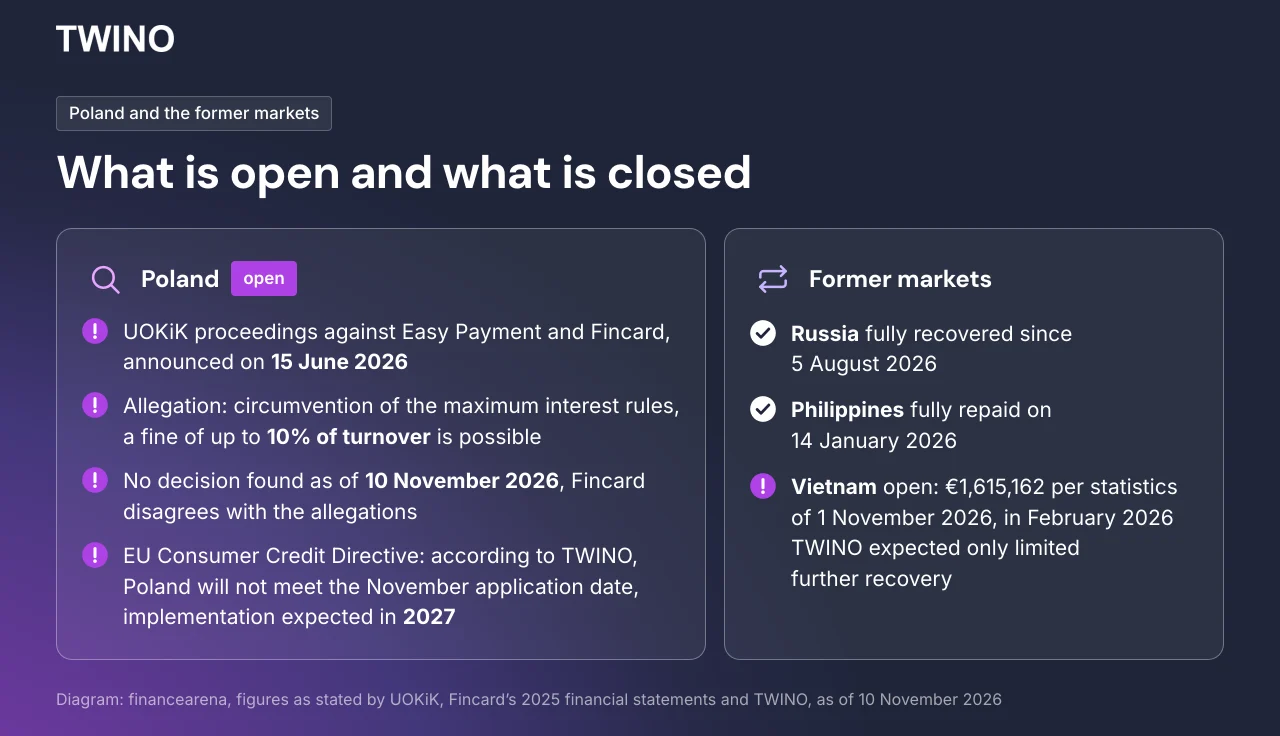
On 15 June 2026, Poland's consumer protection office UOKiK published a press release about proceedings against Easy Payment and Fincard. The English version says they concern “the circumvention of regulations on the maximum interest rate for consumer credit”. A fine of up to 10% of turnover is possible. The release names Fincard's credit cards issued under the Netcredit or Halvo brands. These are allegations, and we found no decision up to 10 November 2026.
Fincard's own accounts add a timeline. Note 27 of its 2025 financial statements describes proceedings that the Polish consumer protection office (OCCP, UOKiK) opened against Fincard on 16 May 2025. The note does not name the subject of the allegations, and we read it as the same case. Fincard disagreed with the allegations in its response of 16 June 2025, and “the proceedings remain ongoing”.
Beyond that, Fincard's auditor, BDO in Warsaw, issued a qualified opinion on those accounts because no provision was booked for possible administrative penalties from the ongoing UOKiK proceedings. BDO said it was not practically feasible to estimate the amount.
In its CEO update for October 2026, dated 2 November 2026, TWINO says its Fincard team expects Poland to miss the 20 November 2026 application date for CCD II, the EU consumer credit directive. According to the update, implementation is expected to move into 2027. The FLEXI Base Prospectus of 26 October 2026 (section 2.4.2) rates the risk of complying with regulatory enactments “High”, citing CCD II and the UOKiK proceedings. It says CCD II could bring national APR caps “which could significantly impact the pricing and business model of the Loan Originator”.
TWINO also reports on three markets outside Poland, and two of them are settled. Its blog post “TWINO completes recovery of all Moneza RU loan claims”, published on 5 August 2026, says TWINO “has completed the recovery of all outstanding investor funds” related to Moneza, its former Russian loan originator, and that “the outstanding balance is zero”. A TWINO Telegram post of the same day says the funds “have been fully recovered”. For the Philippines, a TWINO news post dated 14 January 2026 reads: “All investments previously linked to VAMO Philippines have now been fully repaid.”
Vietnam remains open. TWINO's statistics show €1,615,162 outstanding there on 1 November 2026, or 3.77% of the outstanding principal in its chart. In that CEO update, TWINO reports the court accepted the documents for liquidation proceedings and is “now awaiting formal confirmation” of their opening. An earlier update of 25 February 2026 said that “expectations for additional recovery remain limited”. Later updates report only the status of the process and neither repeat nor revise that expectation.
The Base Prospectus and the Key Information Document carry the risk ratings quoted here.
Cyberattack in October 2026: What TWINO Says
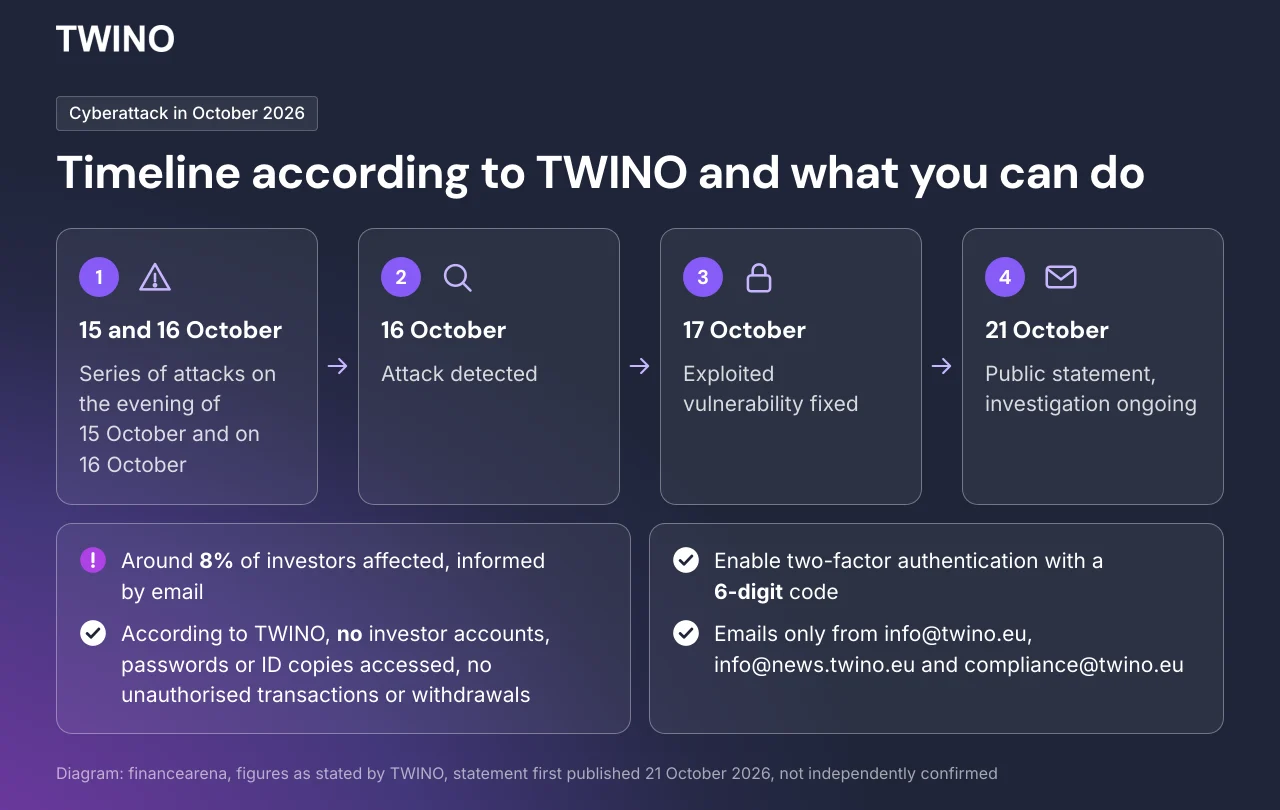
According to TWINO, a series of cyberattacks hit its platform on the evening of 15 October and on 16 October 2026. An unauthorised third party accessed a limited amount of investor personal data. TWINO says around 8% of current investors are affected, and it informed them by email.
TWINO also states that the attackers did not access investor accounts, passwords or copies of identity documents, and that no unauthorised transactions or withdrawals were made. It detected the attack on 16 October. On 17 October it identified the affected data and users and fixed the vulnerability. It notified the Data State Inspectorate of Latvia, Latvijas Banka and other relevant authorities.
Its preliminary findings point to an autonomous AI tool, and the investigation was still running when the statement was published. In the sources we read, all of these details come from TWINO's own statement, first published on 21 October 2026, so we treat them as TWINO's account.
What you can do:
- •Switch on two-factor authentication (2FA). The FAQ describes setting it up under My Profile with an authenticator app such as Google Authenticator. The app then generates a 6-digit code for each login.
- •Never share passwords or codes. TWINO says it never asks for them by email, SMS or phone.
- •Check the sender. TWINO states that it only sends emails from info@twino.eu (customer support), info@news.twino.eu (news and marketing) and compliance@twino.eu (compliance and AML).
- •Stay vigilant. TWINO recommends this to all users, whether or not their data was affected.
Our sign-up guide shows where 2FA fits into the registration steps.
Two-factor authentication is set up under My Profile, with a 6-digit code at each login.
How to Check TWINO Yourself
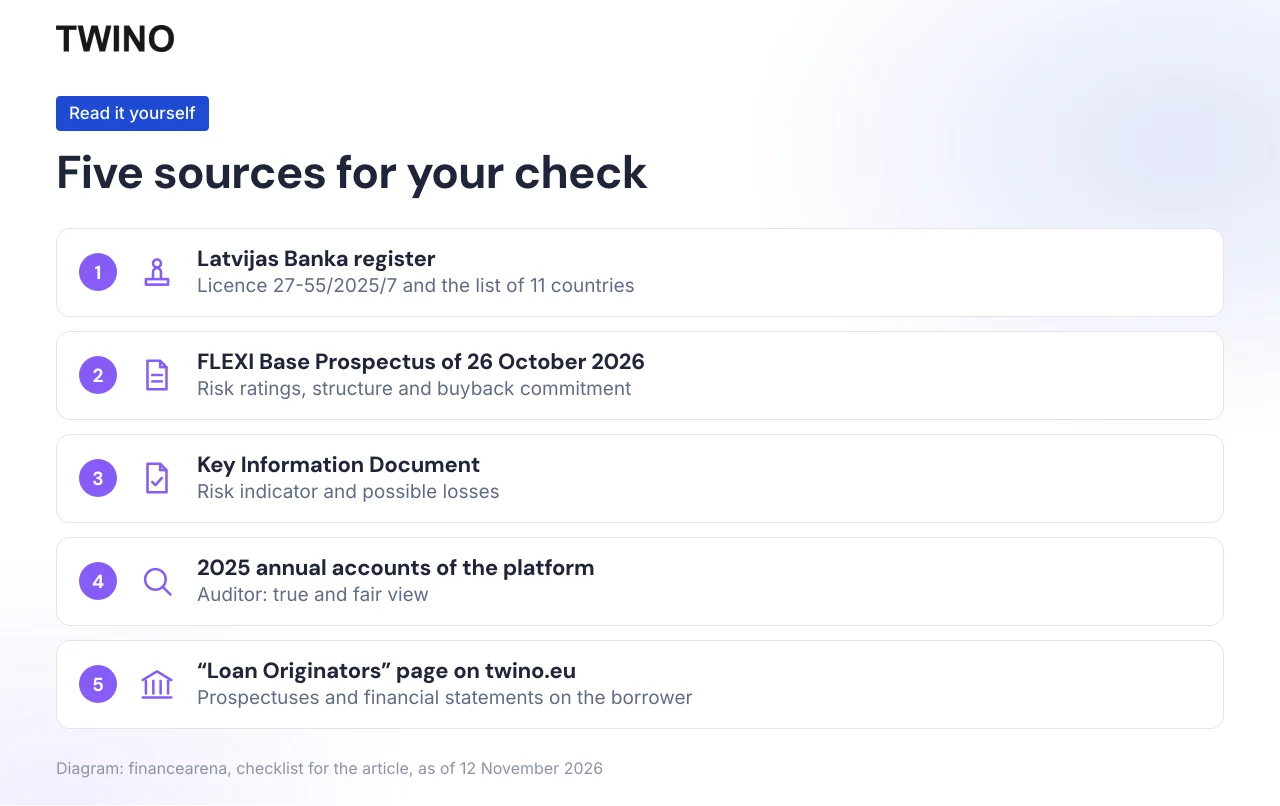
Five sources make a straightforward start for your own check:
- •Latvijas Banka register: licence 27-55/2025/7 and the list of 11 countries.
- •FLEXI Base Prospectus of 26 October 2026: risk ratings in section 2, the structure in section 4.1 and the buyback commitment in section 12.7.6.
- •Key Information Document: the risk indicator and the possible losses.
- •2025 annual report of AS TWINO Investments: commission income, profit and equity of the platform operator, which we used for its figures. The auditor, BDO Assurance SIA, states that the accounts “give a true and fair view of the financial position of the Company as at 31 December 2025”. We found no qualification or emphasis-of-matter paragraph there.
- •TWINO's page on loan originators: base prospectuses and financial statements on the borrower, plus what TWINO says about Fincard and the Netcredit brand.
On 1 November 2026, TWINO's separate statistics card showed a total outstanding portfolio of €41,384,157, close to the chart total without the real-estate segment. A summary never replaces the original text. TWINO asks for the same step: creating a FLEXI auto-invest portfolio means confirming that you have read the Base Prospectus and the Key Information Document.
Our Verdict on Safety
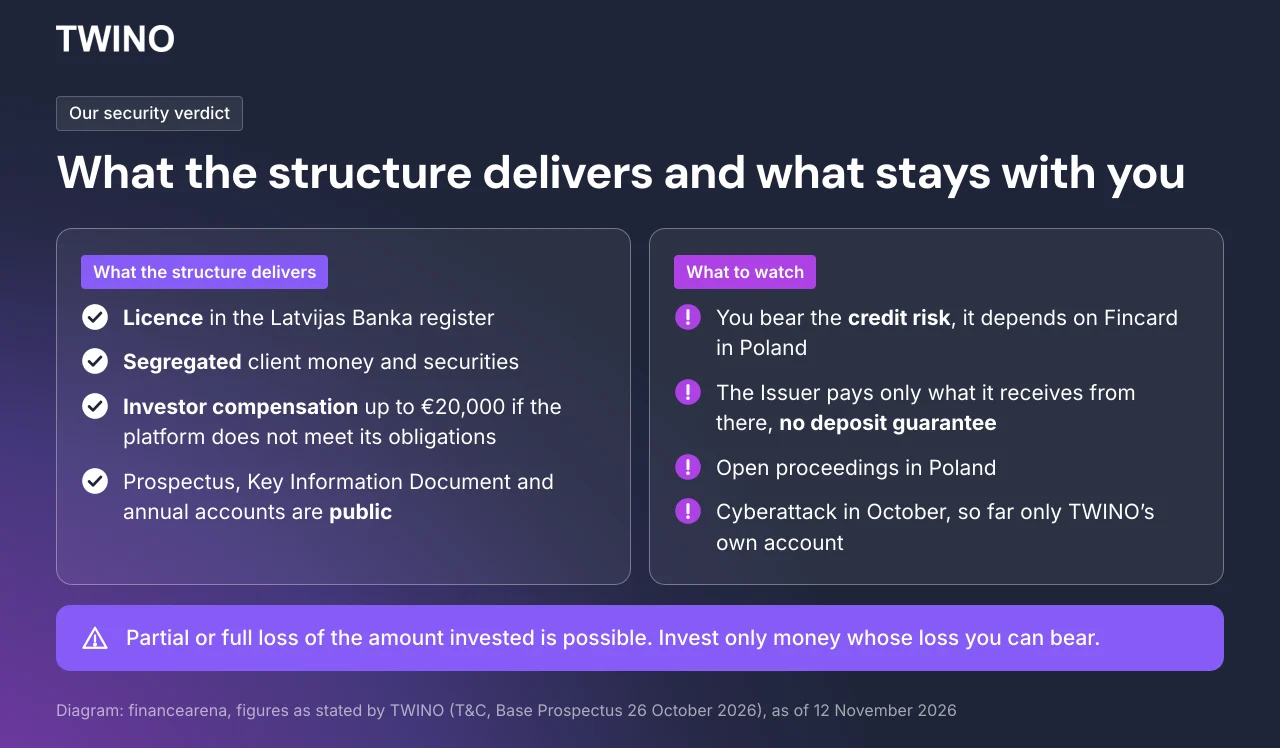
Overall, the structure holds up in the parts TWINO controls itself. The licence is in the register, and TWINO says it keeps client money and securities apart. Per TWINO's FAQ, compensation of up to €20,000 applies if the platform cannot meet its obligations.
That said, the points to watch are real. The credit risk is yours, and for the FLEXI and ABS securities TWINO offers today it hangs on Fincard, one borrower group in Poland. The Issuer pays only what it receives, no deposit guarantee applies, and proceedings in Poland are open. The details of the cyberattack come from TWINO's own statement. A total loss is possible.
The deciding factor is whether you accept depending on one borrower group. TWINO may suit you if you want securities with a documented structure and can carry that risk. This article is not investment advice. Only money whose loss you could bear belongs in an investment like this.
For products, fees and our own account, read the TWINO review. The current new-investor campaign has its own page, our bonus article. More options beyond bank accounts and brokers are in our alternative investments comparison.
Only invest money whose loss you could bear, because a total loss is possible.
Frequently asked questions
You might also like

TWINO Review 2026: 6 to 12% Per TWINO, From €1, Latvian Licence
Who TWINO may suit, the products, the costs and our own account.

10 Things to Know Before Investing in TWINO (2026): Limits, Fees
Limit tiers, interest start, inactivity fee, withholding tax and exit.

TWINO FLEXI Explained: 6% Per TWINO, €100,000 Limit (2026)
How FLEXI works, where the limit sits and how normal and stress withdrawals run.
How to Invest in TWINO: Sign-Up, Deposit and First Steps (2026)
Registration, ID check, suitability test, deposit and first investment.
Legal information
The content on this site has been researched carefully. Our sources are the providers' publicly available information and their terms and conditions. Despite regular checks we cannot warrant that the data is current, accurate or complete. Binding information on products and prices is only available on each provider's own website. Unless stated otherwise, the conditions shown apply to new customers.
Not financial advice
Our content is informational and comparative only. It is not financial, tax or legal advice, and it is neither a recommendation to buy nor an invitation to take out a financial product. Make your decisions based on your own situation and risk tolerance, and consult an independent adviser if you need one.
Risk warning
Every investment carries risk. Values can rise or fall, and past performance does not indicate future returns. You can lose part or all of the capital you invest. Crypto-assets are largely unregulated, are not covered by deposit guarantee or investor compensation schemes, and carry a high risk of total loss.
Advertising and affiliate links
Some links on this site are marked with an asterisk (*) and are affiliate links (advertising). If you take out a product through one of these links, we receive a commission from the provider at no additional cost to you. That is how you support our work.