Mintos is a licensed EU investment firm from Latvia with more than 700,000 registered users and over €800 million under management. Before your first euro goes in, ten points matter more than the headline rate. A buyback obligation is not a guarantee. The 10.27% average rate is a snapshot rather than a promise. Latvian withholding tax starts at 25.5% until you file your tax number, loans open at €50, and a dormant account now costs €4.90 a month.
What Mintos Actually Is in 2026
Most people meet Mintos through a headline rate. That is the wrong place to start.
Mintos is run by AS Mintos Marketplace, registration number 40103903643, based at Skanstes iela 50 in Riga, Latvia. It holds an investment firm licence from Latvijas Banka, the Latvian central bank, and operates under MiFID II. The company reports more than 700,000 registered users and over €800 million in assets under management. Its own loan statistics show €13 billion invested in total since launch and a current average interest rate of 10.27%.
We invest on Mintos ourselves, and this list is the version of the platform we would have wanted on day one. It is not a summary of the marketing pages. Every point below either changes how much you earn, how fast you can leave, or what happens when something breaks.
One thing applies to all ten. P2P lending is not a savings product, no deposit guarantee scheme covers it, and losing part or all of your capital is possible.
Loans, bonds, real estate, ETFs and crypto ETPs in one account, with loans starting at €50
Mintos in Video
We walked through the same ten points on camera, with the platform open in front of us.
1. A Buyback Obligation Is Not a Guarantee
This is the point that surprised us most, and it is worth getting right before anything else.
Loans on Mintos often carry a buyback obligation. If a borrower falls more than 60 days behind, the lending company repurchases the claim. Read casually, that sounds like a safety net with no holes in it.
It has one. The buyback is a promise from the lending company, not from Mintos and not from an insurer. Mintos says so plainly in its own help centre: insolvency or bankruptcy of a lending company "may significantly influence or even dismiss the ability of the lending company to service issued loans and to execute the undertaken buyback obligation". If the lender goes under, the promise goes with it.
What you actually own depends on the structure. Under a direct structure, your claim is against the borrower, and Mintos steps in to manage it if the lending company fails. Under an indirect structure, your claim is against the lending company itself, with the underlying loans pledged as security. You can filter by investment structure on both the primary and the secondary market, and each lending company's structure is listed on the Lending Companies page.
In practice this means the lending company matters more than the interest rate. The Mintos Risk Score exists for exactly this reason. Treat the buyback as a cushion against borrower default, not against lender default.
2. Mintos Is No Longer a Pure P2P Marketplace
We signed up expecting loans. What we found was a broader shop.
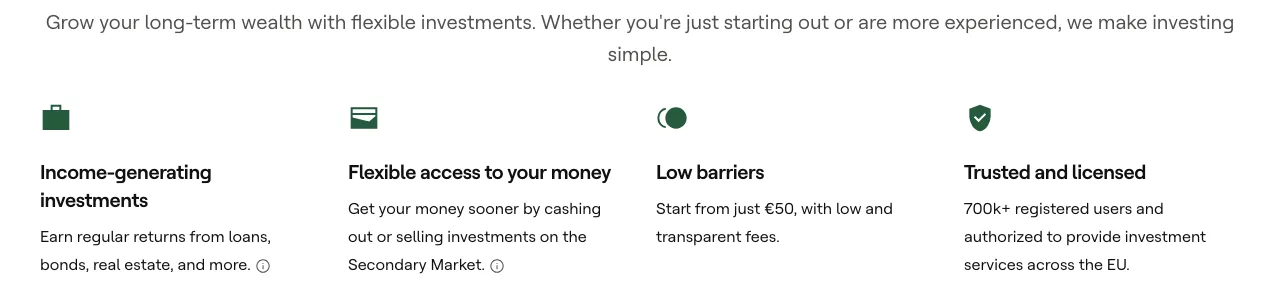
Mintos now runs six asset classes side by side: loans, bonds, real estate, ETFs, crypto ETPs and Smart Cash. Smart Cash is a money-market construction with daily access rather than a lending product. ETFs sit next to consumer loans in the same account.
That breadth is genuinely practical if you want one login instead of five. It also changes what the platform is. A single account can now hold a growth sleeve, an income sleeve and a cash sleeve, which is a very different proposition from a loan marketplace.
One thing to flag, and it is a personal call rather than a criticism: we hold our ETFs at a broker instead. Not because Mintos handles them badly, but because we would rather not concentrate a long-term equity position on the same platform as our lending exposure. The trade-off is a second login against a second point of failure.
Beyond that, the breadth has a quiet side effect on fees. Automated loan portfolios cost 0.39% a year, custom loan portfolios 0.29%, Smart Cash 0.19% a year, and crypto ETPs 0.49% per transaction. Manual loan, bond, ETF and real estate investments carry no Mintos investing fee at all.
3. A High Rate Is the Price of Risk

The number on the front page is an average, and averages hide the interesting part.
Mintos publishes a current average interest rate of 10.27%, weighted across the whole outstanding loan book. It moves. It was 10.30% in late August and it will read differently next month. Any article quoting a fixed Mintos rate is quoting a photograph.
More useful is what sits underneath it. Rates on individual listings run above and below that average, and the spread is not random. A lending company offering noticeably more than the rest is being priced by the market as more likely to disappoint. That is the whole mechanism, and it works the same way in every credit market.
So the question is never whether 12% beats 9%. It is whether the extra three points pay you enough for the extra chance of a lender failing. Nobody can answer that for you, and the Mintos Risk Score is an input rather than an answer.
What stands out is how honest the presentation is here. The rate sits next to the loan statistics, the outstanding book and the overdue figures, on a page anyone can open without an account.
4. Getting Out of a Loan Needs Someone to Step In
Automated loan portfolios feel like a savings account. They are not one.
When you withdraw from a loan portfolio, you are not closing a position with the platform. You are handing your slice of the loan to another investor, and the money reaches your account when someone takes it. Mintos is liquid enough that this usually feels instant, which is exactly what makes the mechanism easy to forget.
The one caveat is that it is a matching process, and matching processes slow down when the crowd moves the same way. On a normal Tuesday you will not notice. In a week where everyone wants out, you will.
Smart Cash is the product built for this problem, with daily availability and a 0.19% annual fee. If a chunk of your balance is money you might genuinely need at short notice, it belongs there rather than in a loan portfolio.
5. The Secondary Market Can Get Thin
The secondary market is the exit route for individual loans, and it has carried real volume: €467 million of loans sold cumulatively, according to the Mintos statistics page.
Two things are worth knowing before you rely on it. Selling costs 0.85% of the investment, charged to the seller. And a listing is an offer, not a sale. You need a buyer at your price.
In calm conditions that is a formality. Under stress it is the opposite. If sellers outnumber buyers, the way to move a position is to discount it, and the discount can be steep. Mintos publishes this split openly in its secondary market statistics, broken down into sales with a discount, at par value and with a premium.
That said, panic-selling into a thin market is a decision, not an accident. The position that was worth holding on Monday is not worth dumping on Friday just because the queue got longer. Everyone is responsible for their own money here, and this is not investment advice.
Loans, bonds, real estate, ETFs and crypto ETPs, with a secondary market for early exits
6. Automation Quietly Builds Concentration
Automated investing is the feature that makes Mintos passive. It is also the feature that builds a portfolio you never consciously chose.
Set a strategy, fund it, and it keeps buying. Six months later your holdings can lean heavily on two lending companies or one country, simply because those were the listings available when your cash landed. Nothing malfunctioned. The filter did what you told it to.
The fix is unglamorous: open the portfolio breakdown every few weeks and look at the split by lending company and by country. If one name has quietly grown into a large share of your book, that is a concentration decision you made by not looking.
This is where the lesson from point one lands. The buyback obligation is only as good as the lender behind it, so having a third of your money behind a single lender is the same bet made three times.
We apply the same logic one level up, across platforms rather than within one. Our own P2P exposure sits on several providers, which is also why we cover others, such as Maclear, in the same detail.
7. Tax Sits With You, and 25.5% Is the Default
This is the point that costs real money, and it is the one most people find out about late.
Mintos does not settle your taxes for you the way a domestic broker often does. You download the reports and declare the income yourself, in your own country of tax residence. For anyone living outside their home country, that is one more return to think about rather than one less.
On top of that sits Latvian withholding tax, deducted at source on certain products. The standard rate is 25.5%. It applies by default, before your local tax bill even enters the picture.
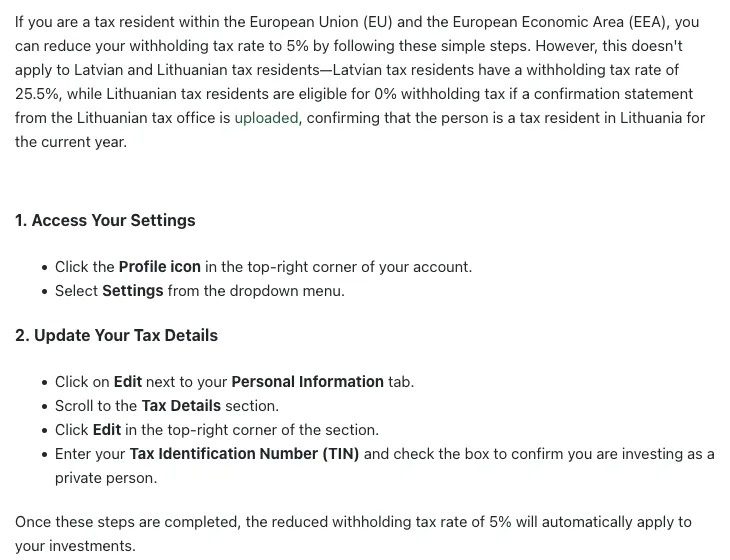
The part that matters: EU and EEA tax residents can bring that down to 5%. Mintos documents the route in two steps. Open Settings, then Personal Information, scroll to Tax Details, enter your Tax Identification Number and tick the box confirming you invest as a private person. The reduced rate then applies automatically to your investments.
Two exceptions sit inside that rule. Latvian tax residents stay at 25.5%. Lithuanian tax residents can reach 0%, but only by uploading a confirmation from the Lithuanian tax office for the current year.
A reduced rate at source is not the end of the story. Whether a double taxation treaty lets you credit Latvian withholding tax against your local bill depends on where you live. That is a question for a tax adviser in your country rather than for us.
8. Fifty Euros Is Enough to Start
We expected a wall. There is a step instead.
Plenty of European platforms want a few hundred euros before they let you look around. On Mintos, loans on the primary market open at €50, which is small enough to run the whole process once with money you can afford to write off. Registration, verification, a deposit, a first investment, a first interest payment: for €50 you get to see all of it before committing anything serious.
Here are the minimums Mintos publishes per asset class.
Primary market | Secondary market | |
|---|---|---|
| Loans | €50 | €1 |
| Bonds | €50 | €1 |
| Real estate | €50 | €1 |
| ETFs | €50 | not applicable |
| Smart Cash | €1 | not applicable |
Tip: scroll horizontally to see all columns
9. The Licence Covers the Platform, Not the Loans
Regulation reassured us more than we expected, and it protects less than the word suggests.
What it does cover is real. Mintos is a licensed and supervised investment firm under MiFID II. Client funds and financial instruments are held separately from the company's own assets, and Mintos runs a suitability assessment on investors rather than letting anyone buy anything.
It is also a member of the Latvian investor compensation scheme under Directive 97/9/EC. Mintos states the boundary in its own footer: the scheme pays out if Mintos fails to return financial instruments or cash to investors. It "doesn't compensate for losses due to changes in the price or liquidity of financial instruments". The maximum payout is 90% of the net loss, capped at €20,000, not a flat €20,000 figure.
Read that twice, because it is the whole distinction. Platform failure is covered, partially. Loan default is not covered at all. If a lending company collapses and takes your capital with it, the compensation scheme does nothing, because nothing went wrong with Mintos holding your assets.
One thing to flag for anyone comparing this with a bank account: this scheme is a different instrument from the €100,000 deposit guarantee you know from savings accounts, and it only pays out a share of the loss rather than the full balance. The two are not interchangeable. The same boundary question comes up on every platform. That is why we ran it separately for Maclear, and why we gave Mintos its own dedicated safety deep-dive covering the buyback mechanism and loan originator risk in full.
10. Two Fees That Catch People Out
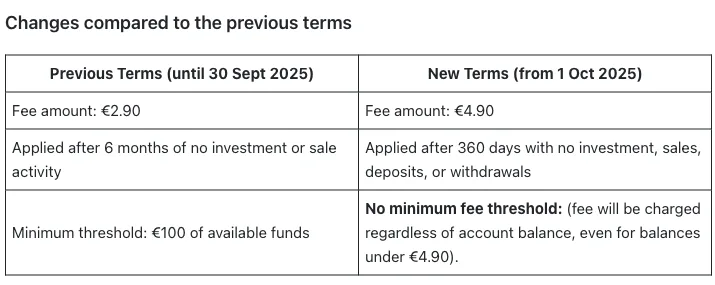
Mintos is cheap to use if you use it the obvious way. Two items on the price list are where money leaks.
Card deposits cost 2%. That covers card payments, Apple Pay and Google Pay. Deposit €5,000 by card and €100 is gone before the first euro earns anything. Bank transfers are free, and the difference is pure margin for a few minutes of convenience.
A dormant account costs €4.90 a month. The terms changed on 1 October 2025, and the current version is stricter than the one many older articles describe. The fee applies after 360 days with no investment, sale, deposit or withdrawal, and there is no minimum balance threshold any more. A single deposit or withdrawal resets the clock for another 360 days.
There is a second escape hatch worth knowing. The fee does not apply if the account holds ETFs, bonds, real estate, Mintos stock, crypto ETPs or funds in Smart Cash, or if an automated portfolio is actively investing. An account holding only loans with nothing happening is the case that gets charged. An account with no investments and no available funds is not charged either.
Bank transfers, withdrawals and account servicing cost nothing, while card deposits carry a 2% charge
What Mintos Charges in Full
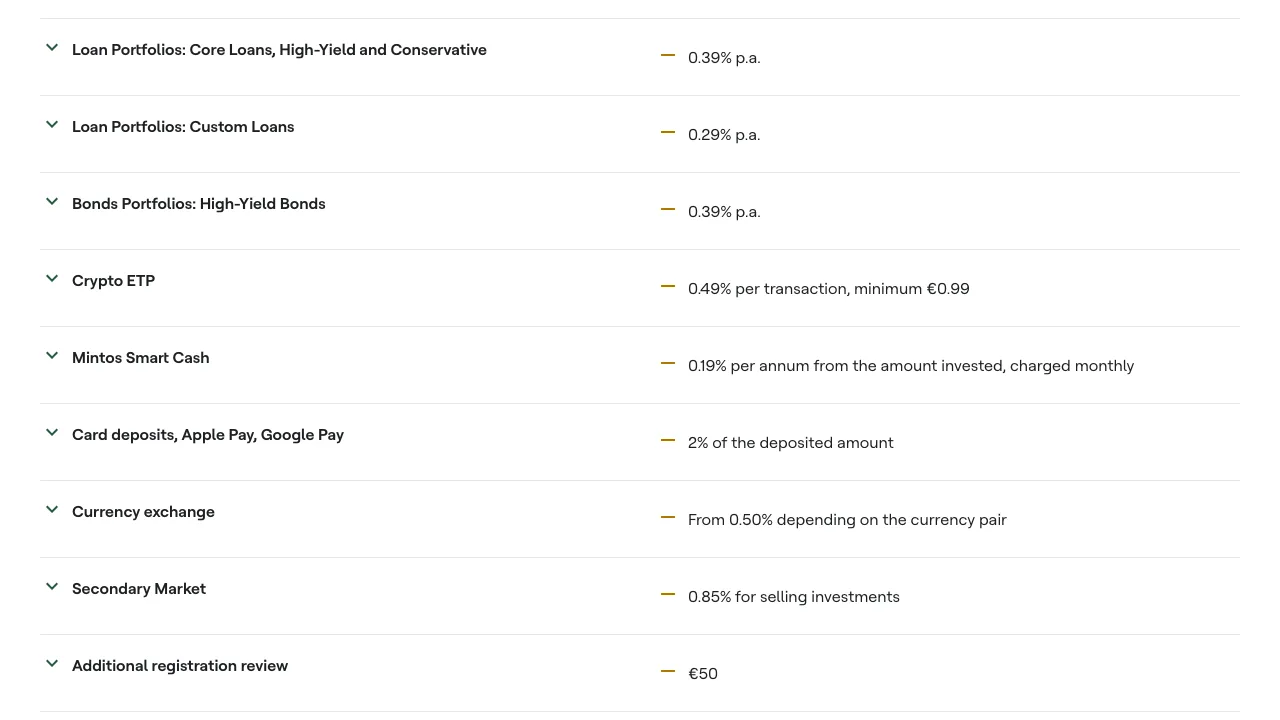
The full price list is short, which is a good sign in this corner of the market.
Investing in ETFs, real estate, manual loans and manual bonds is free. Depositing by bank transfer, withdrawing money, account servicing and investor support are free. What costs money is automation, convenience and speed.
Two items on that list rarely appear in reviews. Currency exchange starts at 0.50% depending on the pair, which matters if you fund a euro account from a non-euro one. And an additional registration review costs €50, a charge Mintos lists without explaining what triggers it. We have not been able to establish the conditions, so treat it as an open question rather than a hidden trap.
Recovery charges round out the list. They apply when Mintos pursues distressed claims, they depend on the individual case, and Mintos caps them at the amount actually recovered and says it informs investors before withholding them.
Pros and Cons Before Your First Investment
Ten points compress into a fairly clear balance.
What works well
- Licensed investment firm under MiFID II, supervised by Latvijas Banka
- Six asset classes in one account, from loans to ETFs and Smart Cash
- Loans open at €50, secondary market from €1
- Free bank transfers, free withdrawals, free account servicing
- Loan statistics, overdue figures and secondary market splits published openly
- Withholding tax drops from 25.5% to 5% for EU and EEA residents with a TIN on file
What to weigh up
- A buyback obligation depends on the lending company staying solvent
- Investor compensation covers platform failure, not loan defaults
- Leaving a loan position needs a buyer, and the secondary market costs 0.85%
- Automated strategies build concentration unless you check the split
- Tax reporting is entirely on you, in your own country of residence
- Card deposits cost 2% and dormant accounts cost €4.90 a month after 360 days
Overall the picture is of a platform that has grown up. The regulatory setup and the published statistics are stronger than the P2P sector average. The risks that remain are credit risks, and no licence removes those.
Who Mintos Suits, and Who It Does Not
Mintos works well if you want breadth and are willing to look at what you own. Several asset classes, a large lender roster, a functioning secondary market and open statistics give you enough to build something deliberate. The deciding factor is whether you will actually check the concentration in your portfolio every few weeks, because the automation will not do it for you.
It works less well as a set-and-forget cash home. Exiting loans depends on a buyer, tax reporting lands on your desk, and the fee list rewards people who read it. If what you want is a single passive rate with daily access and no admin, a simpler product is a better fit. We put that case side by side in our Mintos vs Monefit SmartSaver comparison.
Whatever you decide, the sizing rule matters more than the platform choice. Consumer lending is a satellite holding, not a core one, and it is not the place for money you would need at short notice. In the P2P community a small single-digit share of a portfolio is the figure most often mentioned, and where your own line sits is a question for you or your adviser. The same discipline applies on every platform in this category, which is why our Mintos mistakes to avoid and the equivalent list for Maclear repeat almost word for word.
Registration, verification and a first investment take one sitting, and €50 is enough to see the whole process
P2P-Kredite im direkten Vergleich
Wie schlägt sich diese Plattform gegen Mintos, Bondora, Debitum und Co.? In unserem P2P-Kredite Vergleich stehen 9 Plattformen nach Rendite, Regulierung, Rückkauf und Risiko nebeneinander.
Frequently asked questions
You might also like
Mintos vs Monefit SmartSaver 2026
Two very different P2P platforms compared over five rounds, from yield and liquidity to regulation and fees.
Is Mintos Safe?
Regulation, the buyback mechanism, investor compensation and the honest risks of investing in Mintos.
Is Maclear Safe?
Swiss regulation, audits and what actually happened when the first loan defaulted.
Legal information
The content on this site has been researched carefully. Our sources are the providers' publicly available information and their terms and conditions. Despite regular checks we cannot warrant that the data is current, accurate or complete. Binding information on products and prices is only available on each provider's own website. Unless stated otherwise, the conditions shown apply to new customers.
Not financial advice
Our content is informational and comparative only. It is not financial, tax or legal advice, and it is neither a recommendation to buy nor an invitation to take out a financial product. Make your decisions based on your own situation and risk tolerance, and consult an independent adviser if you need one.
Risk warning
Every investment carries risk. Values can rise or fall, and past performance does not indicate future returns. You can lose part or all of the capital you invest. Crypto-assets are largely unregulated, are not covered by deposit guarantee or investor compensation schemes, and carry a high risk of total loss.
Advertising and affiliate links
Some links on this site are marked with an asterisk (*) and are affiliate links (advertising). If you take out a product through one of these links, we receive a commission from the provider at no additional cost to you. That is how you support our work.