Is Maclear safe? The Swiss P2P platform runs under PolyReg SRO supervision, not a banking licence, has no deposit guarantee and no EU ECSP passport. Its 2024 accounts show negative equity of CHF 87,026, its provision fund covers interest only, and its first default (Vibroedil, 2025) ended with 100% of principal repaid. We go through every protection layer with Maclear's own documents and say where each one ends.
Is Maclear safe? The short answer
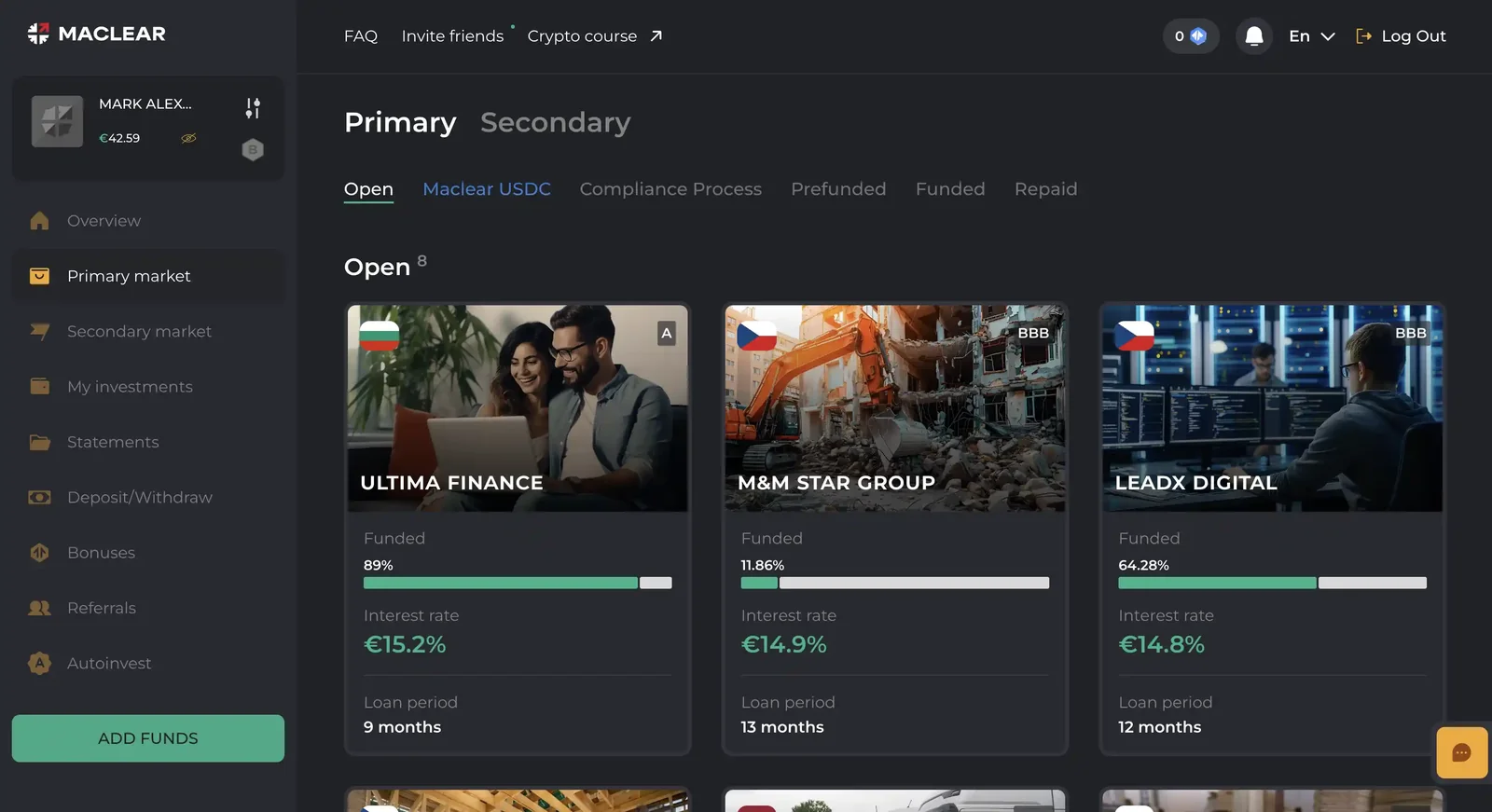
Maclear is a Swiss P2P platform for secured business loans paying 14 to 16% a year depending on the project (the homepage headline says up to 15.6%). Over 52,000 investors have funded more than €145 million since the first project in 2023, over €50 million has been repaid, and the platform counts one default and zero late loans. That default, Vibroedil in 2025, ended with 100% of principal returned.
So is Maclear safe? Not in the sense a savings account at a regulated bank is. No deposit guarantee scheme applies, the operator's 2024 balance sheet shows negative equity, and the collateral behind a loan can be worth less than the loan. What Maclear does have is a layered structure: Swiss self-regulation under PolyReg, an audited provision fund, a published loan-to-value on every project, and a collection protocol tested once in practice.
For returns, fees and bonuses see our Maclear review. Here the only question is: what protects your money, and where does that protection end?
3% cashback on primary-market investments in your first 90 days, plus a €15 welcome bonus on a first investment of €50 or more within 7 days of registration
Maclear safety in our video
The video covers the same ground: Swiss framework at 01:41, audits at 02:56, negative equity at 03:43, collateral and LTV at 04:00, provision fund at 04:49, the default at 05:37, honest risks at 07:20.
More P2P checks are on our channel.
The minimum is €50 per project, and the 3% cashback for your first 90 days runs automatically via our link
What Swiss regulation means for Maclear
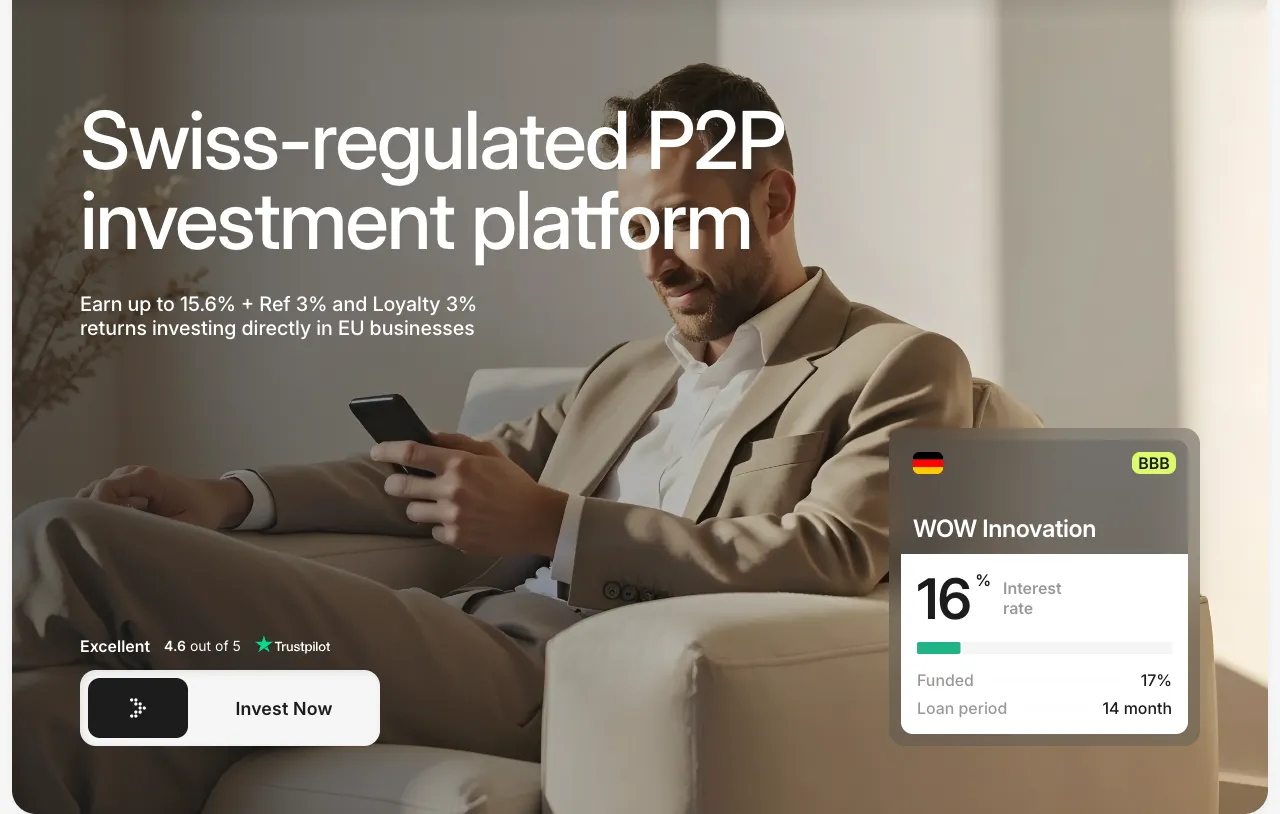
Maclear is operated by Maclear AG, a Swiss stock corporation registered in Wallisellen, canton of Zurich. Since May 2022 it has been a member of PolyReg, a self-regulatory organisation (SRO) for financial intermediaries outside the banking sector. FINMA, the Swiss financial market supervisor, approves and supervises PolyReg, and PolyReg supervises Maclear.
Read that chain in the right direction, because it is easy to shorten to "FINMA supervises Maclear", which is not what it says. FINMA supervises the SRO. The SRO supervises its members. Membership of an SRO is not a FINMA licence, and Maclear is not directly supervised by FINMA.
It is also not a banking licence, and Maclear's own regulation FAQ says so: Maclear AG is a financial intermediary, not a bank, it does not accept deposits in the legal sense, and it is not covered by Swiss deposit insurance (esisuisse, up to CHF 100,000). SRO membership obliges Maclear to verify every investor's identity and screen transactions against anti-money-laundering rules. It does not put a supervisor between you and a bad loan, and no deposit guarantee scheme of any kind applies.
Switzerland is also a third country outside the EU. Maclear holds no ECSP licence under the EU crowdfunding regulation and is not registered with any EU supervisor. Maclear argues that the PolyReg regime is analogous to ECSP in structure and function. Analogous is not the same as passported, and in a dispute you deal with Swiss law.
Who audits Maclear, and what the 2024 accounts show
This is worth getting right, because the frequency is where most reviews start guessing. Maclear's own transparency post says Swiss regulation does not require it to undergo mandatory audits and that it is implementing voluntary and regular ones. Its regulation FAQ names regular audits plus one dated compliance audit in November 2024, and its provision fund FAQ names Grant Thornton AG as the auditor of the fund account. No Maclear page we found puts a number on how often that happens. Separately, Maclear AG publishes an annual financial statement under Swiss company law.
The publication record is where the criticism starts. The 2024 report followed on 3 June 2026, roughly 17 months after year end. Maclear names business growth, a change of accountant and the appointment of an audit firm as reasons, and adds that as a private company under Swiss law it is not obliged to publish its accounts at all and does so voluntarily.
The content is the harder part. For 2024 Maclear AG reports a net loss of CHF 122,941 (2023: CHF 118,379) and equity of CHF 87,026 below zero, for the second year running. The provision for expected losses on non-performing loans rose from CHF 14,572 to CHF 195,049, the company had fewer than ten full-time employees, and shareholders injected CHF 55,000 of fresh capital.
Maclear did not bury this. CFO and co-founder Aleksandr Lang published a letter alongside the report that opens on growth and then addresses the equity gap in a section of its own, headed by the line "Let us put it plainly". His argument: EBITDA was close to zero, negative by CHF 7,188, the loss sits below the operating line in depreciation and financial expenses, and the shareholders deliberately fund growth until the platform reaches critical mass. Maclear expects positive equity by the end of 2025, which is not audited yet.
One more number from the same letter explains the bonus system. In 2024 borrowers paid CHF 464,322 in interest while Maclear paid CHF 827,849 to investors in interest and bonuses, covering the gap from its own commission income. The bonuses are financed by the platform, not by the loans.
Our reading: an established audit firm on the fund account, audits that Maclear runs voluntarily rather than under a legal obligation, slow reporting, and a thin 2024 balance sheet. Size your exposure accordingly and put the 2025 report on your watch list.
What stands behind each loan: collateral, LTV and rating
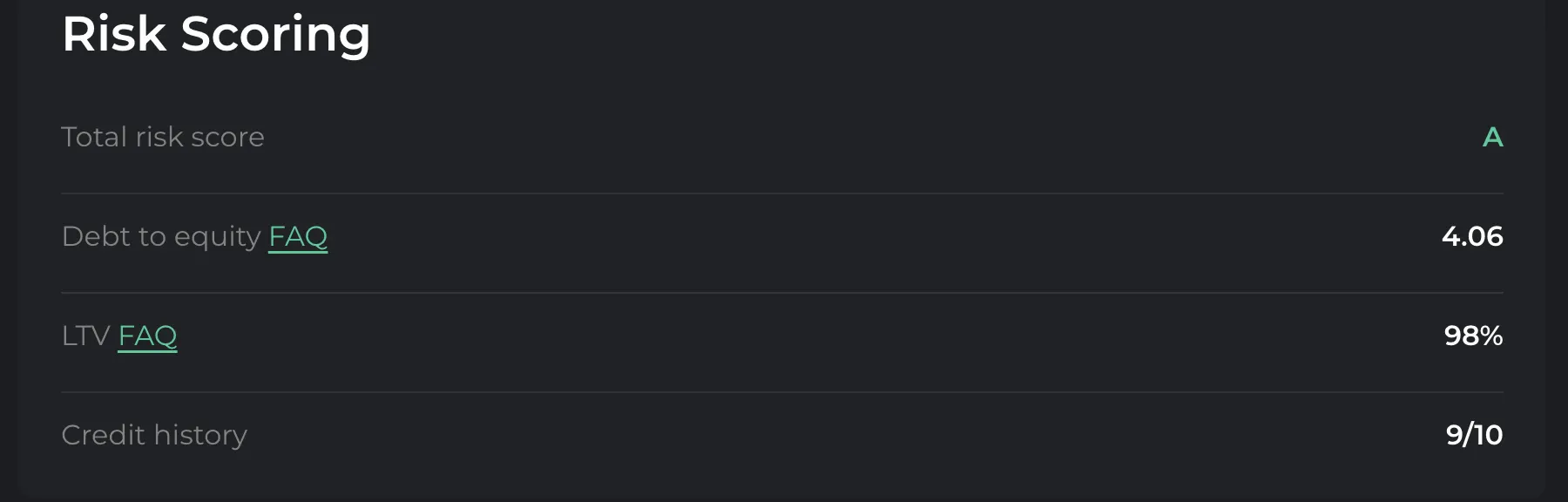
Every Maclear loan is secured. The sentence is true and says nothing about how far the security reaches. The number that does is the loan-to-value (LTV) on every project page, defined by Maclear as loan amount divided by collateral value, with four published bands:
- •40 to 80%: low risk, collateral significantly exceeds the loan
- •80 to 120%: moderate, collateral roughly covers the loan
- •120 to 160%: elevated, limited buffer
- •160 to 200%: high risk. In Maclear's words, enforcement may not fully cover principal if asset values decline
Above 100% the loan is bigger than the collateral, and Maclear lists such loans as a regular category. Accepted collateral includes real estate, business equipment, machinery, vehicles, inventory and personal guarantees from the company owners.
Alongside the LTV sits the borrower rating, AAA to D in ten grades, weighted across financial risk, qualitative risk and coverage and liquidity, reviewed quarterly. The conflict of interest belongs here: Maclear performs the due diligence, assigns the rating, lists the project and earns a 3 to 6% commission from the borrower per listing. Nobody outside Maclear checks the rating.
Legally, Maclear acts as collateral agent and holds the security on behalf of all investors. When you click Invest you sign a claim purchase and assignment agreement, so the loan claim belongs to you, not the platform, and during the funding phase your money sits on segregated trust accounts at partner banks.
Identity check via Sumsub, typically up to 10 minutes, deposits within minutes via SEPA Instant, first project from €50 with 3% cashback via our link
Read the LTV band and the rating together before the interest rate. Both sit on every project page.
How the provision fund works, and what it does not do
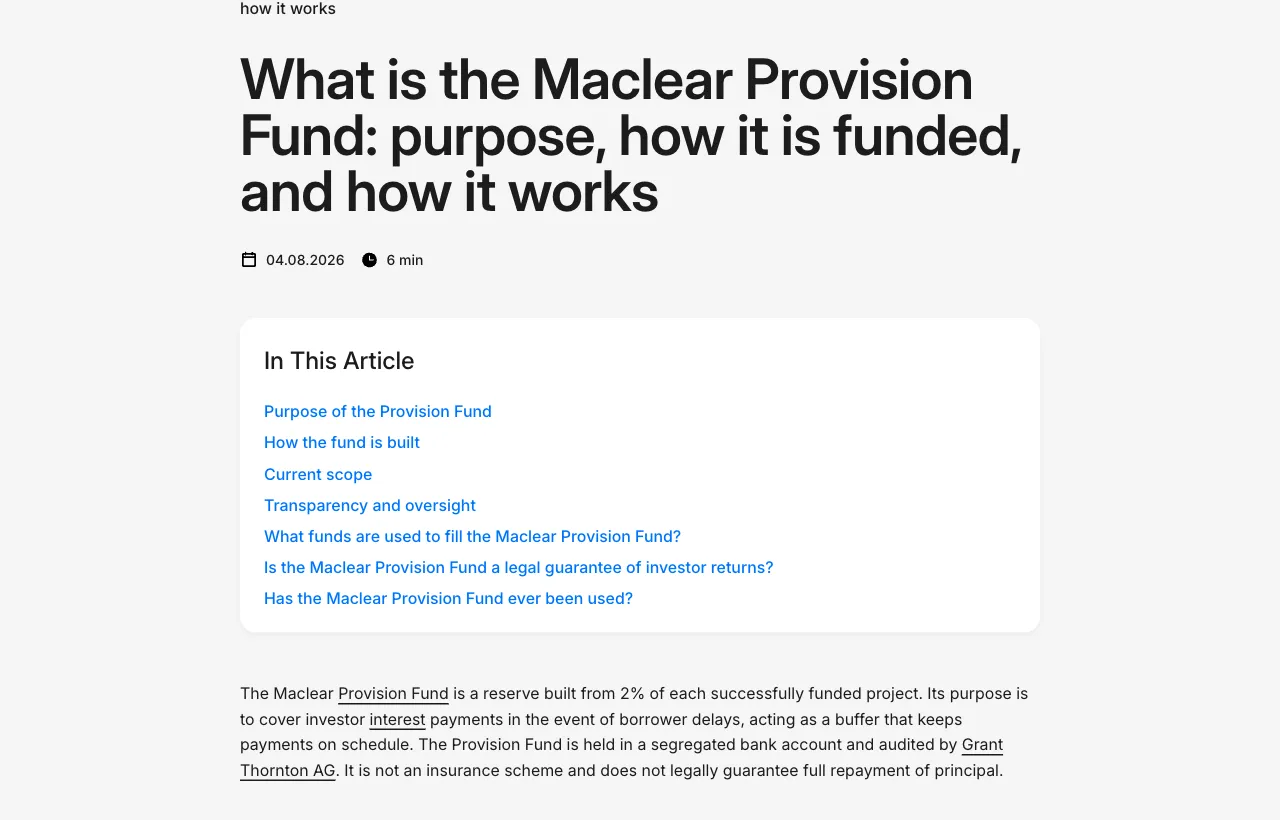
The provision fund is the layer most often misread as a guarantee, and Maclear itself says it is not one. 2% of every successfully funded project goes into the fund, which sits on a separate bank account away from Maclear's operating assets and is audited by Grant Thornton AG. Maclear states that secondary-market commissions are to flow into it going forward.
It covers interest payments from day 3 of a borrower delay, to the extent funds are available. As things stand it does not cover principal, and Maclear writes that as the fund grows over time its coverage is expected to extend to principal repayments as well. Expected, not promised: today capital protection runs through the collateral, not through the fund. Maclear's debt collection agreement puts the limit in one sentence: the reserve fund is not an insurance scheme and does not guarantee full payment. One conclusion here is ours rather than Maclear's wording: a buffer fed by 2% of funded volume is not built to absorb capital losses from several simultaneous total defaults.
Two details matter. The fund has never been activated, not even for Vibroedil. And the balance is published: Maclear's FAQ says the figure is shown on the platform and updated regularly, while its own blog post put the fund at €2 million in May 2026 on a page it last updated in July 2026. One more point deserves precision, because reviews tend to overstate it in both directions. Your loan claims are project-specific and there is no cross-project loss sharing between investor claims, but the fund itself is a shared pool that pays out only to the extent funds are available, so what happens elsewhere on the platform is not irrelevant to you.
What happens when a borrower is late
Maclear publishes a fixed escalation protocol, counted from the missed payment.
What Maclear does | |
|---|---|
| Day 3 | Provision fund covers the interest payment, Maclear investigates |
| Day 30 | Out-of-court collection starts, interest keeps coming from the fund |
| Day 60 | Legal proceedings and enforcement of collateral by Maclear as collateral agent |
| Day 90 | Claims are transferred to Maclear, which becomes main creditor and distributes proceeds pro rata |
Tip: scroll horizontally to see all columns
What you give up as an investor
The day-90 step means creditor status passes from you to Maclear. The debt collection agreement behind it, in force since 5 July 2022, holds two more clauses that rarely appear in reviews.
You may not act against a borrower yourself: unless Maclear expressly authorises the investor to do so, the investor may not take direct action against the borrower. And Maclear may extend loan terms without asking you; its listed powers include concluding a prolongation or deferral agreement with the borrower regarding the repayment terms.
Both are normal in collateral-agent models, because one bundled enforcement beats hundreds of individual lawsuits. The flip side: in a dispute you have no lever of your own and cannot prevent a term extension. The same agreement makes Maclear liable with its own business assets for defaulted payments; given the equity figure above, treat that as a bonus, not your main line of defence.
What happens if Maclear itself closes
Maclear's FAQ on platform closure is explicit. Active loan claims belong to you and keep running on the original schedule; only the administrator changes. Uninvested balance is returned to your verified bank account.
Then comes the clause almost nobody knows. If Maclear cannot transfer your money and you do not provide updated bank details within 30 calendar days of being asked, Maclear may dispose of those funds and your claim against the platform lapses. Keep the IBAN in your account current and watch the email address you registered with. Unlike the borrower default below, this mechanism is untested.
The first default: Vibroedil step by step
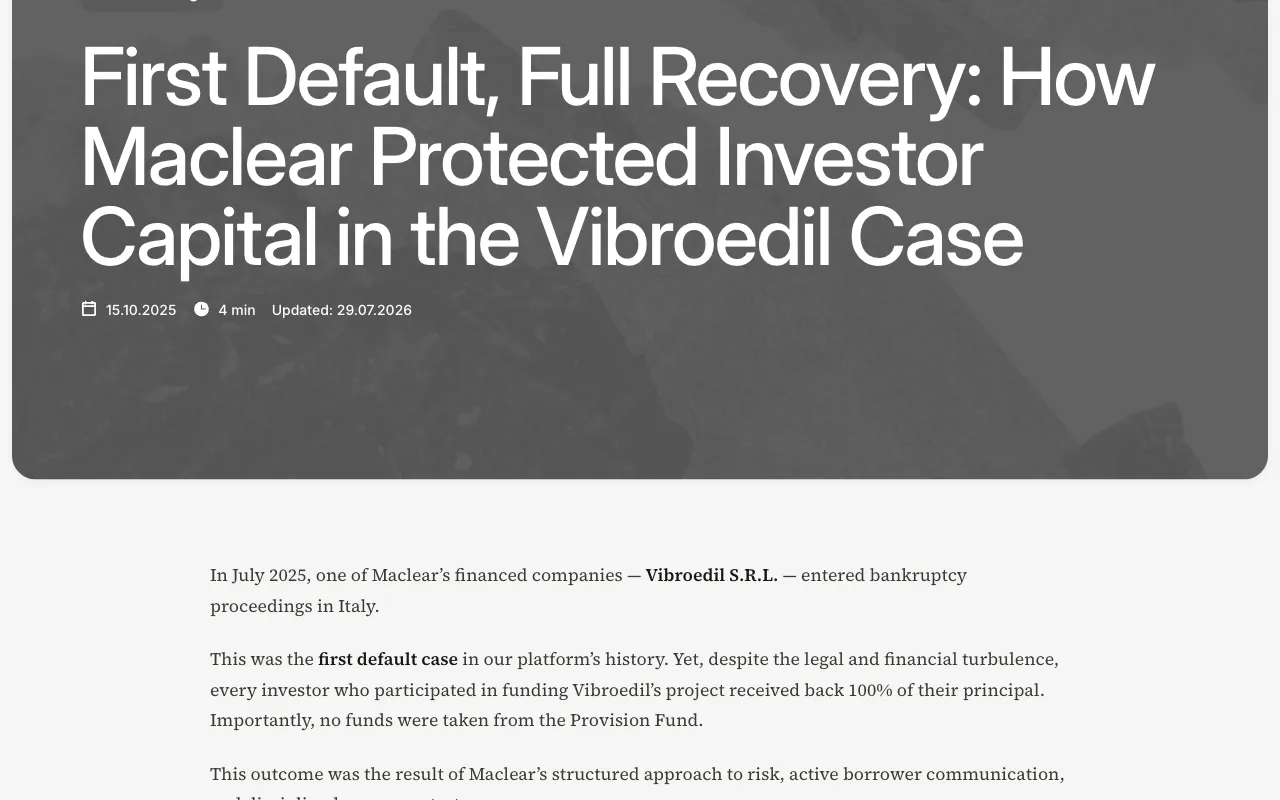
In July 2025 the system had its first real test. Vibroedil S.R.L., an Italian company, had borrowed €150,000 through Maclear in three stages of €50,000. It entered insolvency proceedings and kept paying interest for several weeks afterwards. Maclear did not join a lengthy insolvency process and did not force the sale of the collateral; it negotiated a private repayment agreement directly with the borrower.
Investors were informed once the legal status was confirmed, then after each repayment stage, and the public write-up followed on 15 October 2025. The result: 100% of principal returned to every investor, no money taken from the provision fund, no forced liquidation. Maclear's account is in its first-default blog post.
What this proves: Maclear can handle a distressed borrower and communicates the outcome. What it does not prove: that collateral enforcement works in practice, because it was never needed. One recovered default across 1,967 funded projects since 2023 is a good record that is also statistically young, without a full economic cycle in it.
What the critics say
Search for a Maclear review in English and one of the first results is titled "Why You Should Avoid It". That headline is as much of the critic's case as we can honestly report: the page blocked our request, so we did not read the reasoning behind it and will not put words in anyone's mouth.
What we can do is lay out the critical case ourselves, from documents Maclear published: negative equity at the operator, more paid out to investors in 2024 than borrowers paid in interest, no ECSP licence and no EU supervisor, the 2024 accounts published roughly 17 months after year end, and a provision fund that covers interest rather than principal and has never been activated. Each of those points is above in this article with the source it came from.
That every one of them comes out of Maclear's own reporting counts for its transparency even as it counts against its balance sheet. Maclear's answers are on record too: growth financed by shareholders, EBITDA near zero, an expected return to positive equity for 2025, voluntary publication of accounts it is not required to file, a fund balance published on the platform and updated regularly. We would not call that list a reason to avoid Maclear, and we would not call it noise. It is the list to re-check when the 2025 report lands.
The honest risks
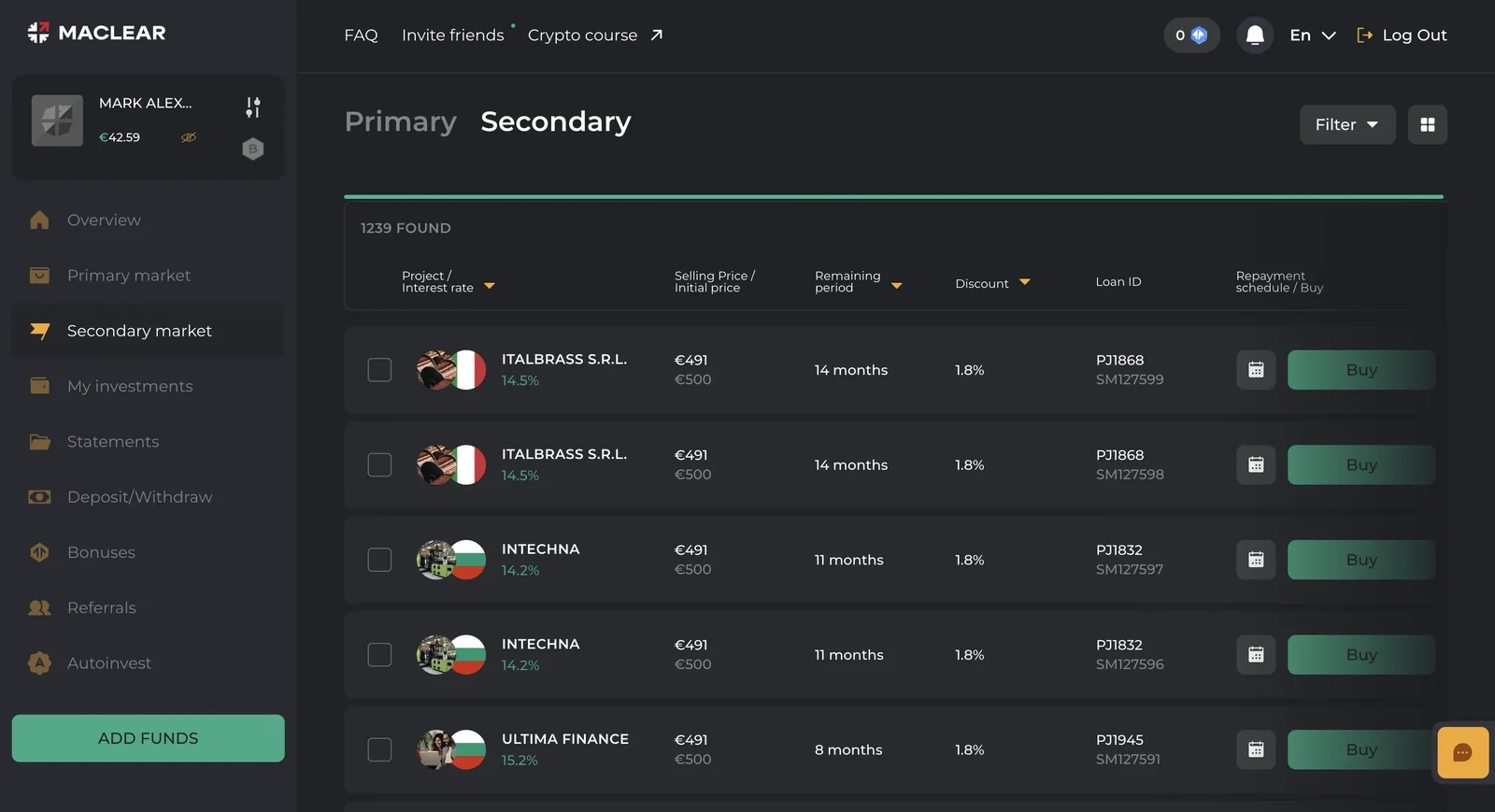
Two risks get less attention than the security layers, and neither is fixed by them. The first is liquidity. Maclear runs a secondary market and publishes strong numbers for it: a median of roughly three hours from listing to sale and 97% sold within seven days, measured over the six months to 11 May 2026 across 45,530 listings sold. Those are Maclear's own figures, they cover one window in a phase when the platform was growing quickly, and Maclear states that it does not guarantee a listed position will sell. Two structural limits matter more than the averages: only investments in funded projects that are keeping to their repayment schedule can be listed, so a position already in default or enforcement cannot be sold at all, and bonus positions from the €15 welcome bonus and the €30 per €500 bonus can never be listed either. Selling costs the seller 2.5% of the transaction, buyers pay nothing, and the minimum transaction is €30.
The second is concentration. In July 2026 a single project, ULTIMA FINANCE, made up 36.24% of the month's funding volume (€5.0 million of €13.8 million). Watch how much of your own portfolio ends up with one borrower.
What speaks for the structure
- Swiss AG, member of the PolyReg SRO since May 2022 (PolyReg itself is supervised by FINMA)
- Grant Thornton AG named as auditor of the provision fund account, with Maclear running audits voluntarily
- LTV and AAA-to-D rating published on every project page
- Loan claims legally belong to the investor
- First default 2025 resolved with 100% of principal repaid
- Trustpilot 4.6 out of 5 from over 950 reviews (claimed profile, paid Trustpilot subscription)
What to watch
- No banking licence, no deposit guarantee, no EU supervisor or ECSP passport
- Negative equity of CHF 87,026 at end of 2024, 2025 report pending
- LTV bands up to 200% listed as a regular category
- Provision fund covers interest rather than principal, is a shared pool and has never been activated
- No guaranteed early exit: a defaulted position cannot be listed, bonus positions never can
- Investor cannot act against a borrower, Maclear may extend loan terms
- Bonus stack subsidised from platform income, not loan interest
Total loss of an individual investment is possible on Maclear, and so is loss through failure of the operator. Nothing above changes that.
Verdict: is Maclear safe?
Not in the sense a savings account at a regulated bank is. The structure is well thought out, and its weak points are equally clear: negative equity at the operator, no EU supervision, a fund that today covers interest and not principal, and LTV bands in which the collateral is worth less than the loan.
Our verdict: a legitimate platform that publishes its own weak spots, with a real platform risk on top of the usual credit risk, and losing the full amount you put into a project remains a possible outcome of either. A rule of thumb often quoted in the P2P community is to keep P2P at no more than 5 to 10% of a portfolio and a single young platform at 1 to 2%, spread across at least 10 to 15 projects, with the emergency fund never in P2P. Read the LTV before the rate, keep your bank details current, and watch for the 2025 annual report.
If you decide to try it, our link gives you the 3% cashback for 90 days that any referral link unlocks (without a link you do not get it), plus the €15 welcome bonus. How those two stack with the €30 per full €500 is in the bonus guide. The sign-up guide walks through KYC and Form A, the mistakes article covers the first weeks, and the 10 things to know fill the gaps.
3% cashback in your first 90 days, €15 welcome bonus on a first investment of €50 or more within 7 days, €30 for every full €500 you invest in a project
Frequently asked questions
You might also like
Maclear Review 2026
The full picture: returns, fees, bonuses, security and who Maclear suits.
Maclear Mistakes to Avoid
What goes wrong in the first weeks, from missed bonus blocks to cash drag.

Maclear: 10 Things to Know First
The practical points that get lost in the standard overview.
How to Invest in Maclear
Registration, KYC, Form A, deposit and first investment step by step.
Legal information
The content on this site has been researched carefully. Our sources are the providers' publicly available information and their terms and conditions. Despite regular checks we cannot warrant that the data is current, accurate or complete. Binding information on products and prices is only available on each provider's own website. Unless stated otherwise, the conditions shown apply to new customers.
Not financial advice
Our content is informational and comparative only. It is not financial, tax or legal advice, and it is neither a recommendation to buy nor an invitation to take out a financial product. Make your decisions based on your own situation and risk tolerance, and consult an independent adviser if you need one.
Risk warning
Every investment carries risk. Values can rise or fall, and past performance does not indicate future returns. You can lose part or all of the capital you invest. Crypto-assets are largely unregulated, are not covered by deposit guarantee or investor compensation schemes, and carry a high risk of total loss.
Advertising and affiliate links
Some links on this site are marked with an asterisk (*) and are affiliate links (advertising). If you take out a product through one of these links, we receive a commission from the provider at no additional cost to you. That is how you support our work.