Mintos pays a current average interest rate of 10.27% across loans, bonds, real estate, ETFs, crypto ETPs and Smart Cash. Six beginner mistakes cost part of that return: assuming Mintos files your taxes, chasing a high rate without asking why, and trusting the buyback obligation blindly. Add to that ignoring currency risk, panic-selling after a downgrade, and reading the Risk Score as a final answer. We go through all six, plus the disadvantages in the platform itself.
Mintos Mistakes at a Glance

Mintos runs six asset classes on one licensed platform. The current average interest rate sits above 10% a year. That headline number is not the risk. The six mistakes below are, and every one is easy to make without noticing, however experienced an investor already feels.
AS Mintos Marketplace is licensed and supervised by Latvijas Banka under MiFID II, a dependable regulatory anchor for a platform this size. It lists 39 active lending companies carrying outstanding volume, and the current average interest rate stood at 10.27% in late September 2026. Over €13 billion has moved through the platform since launch, and the secondary market has processed roughly €468 million in total. What stands out is that none of this changes what a beginner still gets wrong on the first few investments.
This article covers six mistakes in order. We look at assuming Mintos files your taxes, chasing a high rate without asking why, and trusting the buyback obligation blindly. Then comes ignoring currency risk, panic-selling after a downgrade, and reading the Mintos Risk Score as a final answer. Our 10 things to know before investing and safety breakdown cover the wider picture. Our Mintos vs Monefit SmartSaver comparison is the place to look if a simpler alternative is on the table.
Loans, bonds, real estate, ETFs, crypto ETPs and Smart Cash, supervised under MiFID II
Mintos Mistakes in Our Video
We recorded these six mistakes on camera, in the order beginners tend to make them.
Mistake 1: Assuming Mintos Handles Your Tax for You
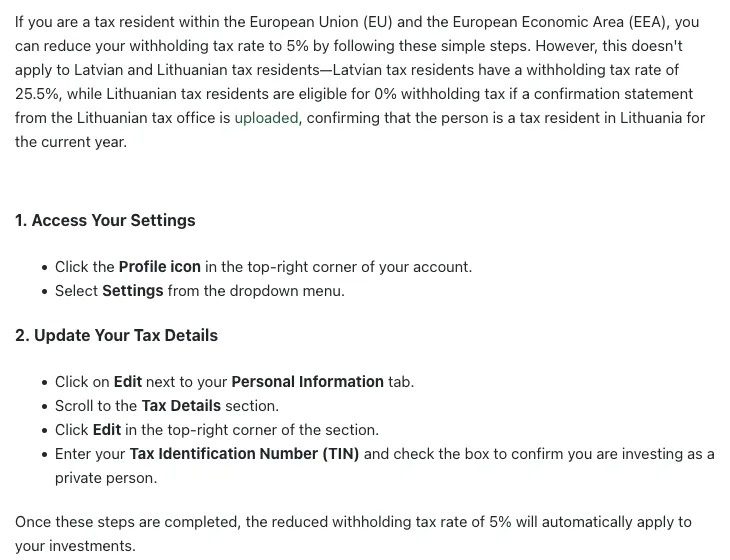
Mistake one is assuming Mintos takes care of tax the way a domestic broker might. It does not, in any country you invest from.
Mintos does not file or settle your taxes for you. You download your own reports and declare the income yourself, in your country of tax residence. That already surprises beginners who are used to a broker deducting tax automatically before a payout lands in the account.
The mechanic worth knowing is straightforward. Withholding tax applies to interest from Notes and Fractional Bonds specifically, not to every product Mintos offers. The default rate is 25.5%. Most EU and EEA tax residents can bring it down to 5%. Mintos names two exceptions explicitly: Latvian residents stay at 25.5% regardless, and Lithuanian residents can reach 0% instead, with an extra confirmation statement from the Lithuanian tax office. For everyone else, the reduction is not automatic. It needs a Tax Identification Number entered and the private-person box ticked, inside account settings. Skip the step, and nothing changes. The standard rate keeps applying, quietly, on every interest payment.
Mintos does not report your interest income to your local tax office either. That responsibility sits entirely with you, on whatever schedule your own country uses. When exactly interest becomes taxable, on accrual or on withdrawal, depends on local rules. That is a question for a tax adviser where you live, not for a platform based in Latvia.
Client funds held separately from Mintos' own balance sheet, with tax statements available in your account
Mistake 2: Chasing High Rates Without Asking Why
Mistake two is picking a loan package for its rate and skipping the next question: why is this one paying more than the rest?
Mintos publishes one current average interest rate, and it stood at 10.27% in late September 2026. That number is a weighted average across the whole outstanding loan book. Individual listings sit above and below it for a reason. A lending company offering noticeably more than that average is being priced by the market as more likely to disappoint. Higher advertised interest is compensation for higher expected risk. It is not a free bonus.
Beyond that, Mintos' own numbers show what that risk can look like once it shows up. Mintos publishes realised net returns for each calendar year, and three recent years landed well below the average rate on offer. Net return came in at 4.3% in 2020, a year Mintos attributes to the pandemic. It reached 6.1% in 2021, then fell to minus 1.2% in 2022, an actual loss that Mintos links to the war in Ukraine. Over a rolling five-year window, net return sits at 6.1%, comfortably below the current 10.27% headline. That gap between a rate on offer and a rate actually realised is exactly what chasing the number skips over.
The one caveat is that a high rate on its own is not automatically a red flag. It is a prompt to check the lending company and country behind it, not a verdict either way. Before adding a package for its rate, it is worth seeing whether that combination has shown up in Mintos' own overdue or default figures.
Mistake 3: Blindly Trusting the Buyback Obligation
Mistake three is treating the buyback obligation as if Mintos itself stands behind it. Mintos does not. The lending company does, and only for as long as it can pay.
Many loans on Mintos carry a buyback obligation. Once a borrower falls more than 60 days behind, the lending company that issued the loan is meant to repurchase the claim. Mintos is direct about the limit in its own help centre. Insolvency or bankruptcy of a lending company, it states, "may significantly influence or even dismiss the ability of the lending company to service issued loans and to execute the undertaken buyback obligation." If the lending company itself goes under, the promise disappears with it. That is the risk behind every buyback promise.
That makes the lending company behind a package more important than the rate on it. Mintos currently lists 39 active lending companies carrying outstanding volume. The three largest between them hold 34.0% of everything outstanding on the platform. Spreading a portfolio across a meaningful share of that roster, rather than concentrating in two or three names, holds up as the practical answer. A single buyback obligation turning out to be worthless then costs far less. That kind of concentration risk shows up on almost every P2P platform, not just this one.
The buyback obligation is still worth having. It shifts the first line of risk from the individual borrower to a company with more to lose. What it does not do is remove that risk from the investor altogether, and no feature on Mintos changes that.
Mistake 4: Ignoring Currency Risk on Non-Euro Packages
Mistake four is investing in a loan package outside the euro without factoring in what happens to the exchange rate.
Not every loan package on Mintos is denominated in euros. When one is not, two things move independently: the interest the loan pays, and the exchange rate between that currency and the euro. A package can run exactly as advertised in its own currency and still convert back to fewer euros than expected, if that currency weakens against the euro in the meantime. That said, the same movement can also work in an investor's favour. Risk cuts both ways.
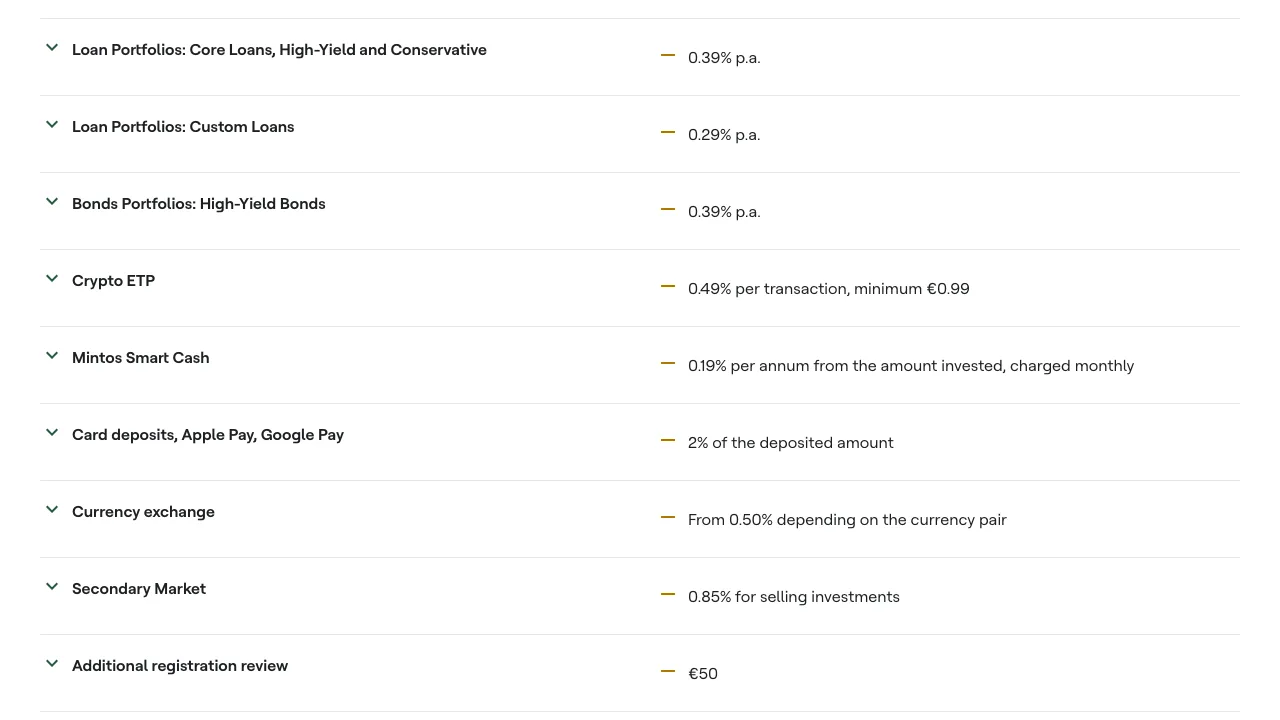
Mintos charges its own fee on top of that exposure, and that is the trade-off for holding a package outside the euro. Currency exchange costs from 0.50%, with the exact rate depending on which currency pair is involved. That is a cost on every conversion, separate from whatever the exchange rate itself does to the value of the position.
None of this shows up in a portfolio that stays in euro-denominated packages only. It becomes relevant the moment a package outside the eurozone gets picked for its rate, without a look at what currency it actually settles in.
0.29% to 0.39% a year on automated portfolios, free manual investing in loans, bonds, ETFs and real estate
Mistake 5: Panic-Selling the Moment a Lending Company Is Downgraded
Mistake five is listing a position on the secondary market the moment a lending company's status changes, without asking what actually happened first.
Selling early on Mintos means finding a buyer and paying a fee. The seller pays 0.85% on the sale. Beyond the fee, a seller in a hurry usually has to accept less than face value to attract a buyer quickly. In Mintos' own secondary market figures, roughly 37% of everything sold went at a discount, against about 11% sold at a premium and the rest at par. Speed costs money on a forced sale. A patient sale typically comes out ahead of a rushed one.
In practice, a change in status does not automatically mean a lending company is heading toward default. Some downgrades reflect a genuinely worsening problem. Others reflect a temporary issue, a piece of news still being processed, or a lender working through a rough patch that resolves within a few months. The two can look identical in the first hour after a downgrade lands.
What tells them apart is not visible from a status change alone. It takes reading what has actually been reported about that lending company, rather than reacting to the fact that something on a dashboard just moved. Selling immediately locks in whatever discount the market demands right now. Waiting a few days to read the news costs nothing extra, and it often clarifies which situation is actually playing out.
Mistake 6: Trusting the Risk Score Without Checking the News
Mistake six is opening a project, seeing a comfortable Mintos Risk Score, and stopping there.
The Mintos Risk Score is a real tool, not a marketing label, and a practical starting point for judging a lending company. The only real limitation is timing. A score reflects the moment it was last calculated, not the moment you read it. Treating it as the final word, instead of a starting point, is where the mistake happens.
The safer habit is pairing the score with a quick check of anything published about that lending company recently, its country, and the sector it lends into. A comfortable score sitting next to genuinely bad news is a mismatch worth noticing before adding to a position, not after. It is the same discipline that applies to a downgrade in mistake five: a number on a dashboard is a starting point for a question, not a substitute for asking it.
None of this means the Risk Score is not useful. It condenses a lending company's profile into something comparable across the whole platform, which is exactly what makes it easy to lean on too heavily. Used alongside a five-minute look at recent news, it does what it is meant to do. Used instead of that look, it becomes the blind spot this mistake is named after.
Outstanding volume, delinquency figures and secondary market activity published on the statistics page
The 6 Mistakes and What to Do Instead
Each mistake in one line, with the fix next to it. All six get the full explanation in the sections above.
The mistake | What to do instead | |
|---|---|---|
| Tax | Assuming Mintos reports your interest to your tax office | Download your own report, add a TIN for 5% withholding, declare it yourself |
| Chasing rate | Picking a package for the highest number on it | Check the lending company and country behind that rate first |
| Buyback trust | Assuming the buyback always pays out | Spread positions across lending companies, not just projects |
| Currency risk | Ignoring which currency a package settles in | Weigh the exchange-rate move and the conversion fee together |
| Panic-selling | Listing at any price right after a downgrade | Read what actually happened before selling at a discount |
| Risk Score | Treating the score as a final verdict | Pair it with a quick check of recent news |
Tip: scroll horizontally to see all columns
Disadvantages of the Platform Itself
Mistakes are about how an investor uses Mintos. Some limits sit in the platform itself, regardless of how carefully anyone invests.
Investor compensation covers less than the headline figure suggests. Mintos is a member of the Latvian investor compensation scheme under Directive 97/9/EC. The maximum payout is 90% of a net loss, up to a ceiling of €20,000, never an automatic flat €20,000 regardless of the actual loss. That scheme applies only if Mintos itself fails to return assets or cash. It explicitly does not cover losses tied to the price or performance of the loans themselves, which is the risk every mistake above is actually about.
On top of that, two items on the fee list are easy to overlook because they do not apply to most investors. A one-time €50 additional registration review is charged for enhanced compliance checks. Mintos limits it to individual accounts with residency or tax residency outside the EU, EEA or Switzerland, plus all company accounts, so most private EU-based investors never see it. Recovery charges apply when Mintos pursues a distressed claim, capped at whatever gets recovered rather than a fixed rate set in advance. Both are real costs for the accounts they apply to, and worth checking before assuming they do not apply.
Running costs still erode a return that looks clean on the surface. Card, Apple Pay and Google Pay deposits cost 2%, against nothing for a bank transfer. A dormant account costs €4.90 a month. Neither is hidden, and both are easy to avoid: a minor limitation rather than a trap, for anyone who reads the fee page once.
Conclusion: How to Avoid These Mistakes
Overall, six mistakes share one thread: none of Mintos' safeguards do the thinking for an investor. The licence, the buyback obligation, the Risk Score and the fee table all do exactly what Mintos says they do. What goes wrong is skipping the extra step each one still asks for.
Filing your own tax return is the price of a platform that does not settle it for you. A high rate is a question about the lending company behind it, not a reason on its own. A buyback obligation is only as solid as the company that owes it. That is why spreading a portfolio across a meaningful share of the 39 active lending companies matters more than any single number. Currency exposure and a downgrade both reward a pause before acting, not a reflex. And the Risk Score works well as a starting point for a five-minute check, not as a replacement for one.
None of this is investment advice, and we are not licensed financial advisors. In the P2P community, a small single-digit share of a portfolio is the figure most often mentioned as a starting point for this asset class. Where that line sits is a personal call. We apply the same sizing discipline across every P2P platform we hold, including Bondora Go & Grow. The beginner traps above repeat, in slightly different form, on Maclear as well.
For the wider safety picture, our Is Mintos safe? breakdown goes through the regulation and the buyback mechanism in full. 10 things to know before investing covers the fees and tax details these six mistakes only touch on.
Loans, bonds, real estate, ETFs, crypto ETPs and Smart Cash in one licensed account
P2P-Kredite im direkten Vergleich
Wie schlägt sich diese Plattform gegen Mintos, Bondora, Debitum und Co.? In unserem P2P-Kredite Vergleich stehen 9 Plattformen nach Rendite, Regulierung, Rückkauf und Risiko nebeneinander.
Frequently asked questions
You might also like
Is Mintos Safe? Regulation, Risks and Protection in 2026
Regulation, the buyback mechanism, investor compensation and the honest risks of investing in Mintos.
Mintos: 10 Things to Know First
Buyback obligations, the average rate, withholding tax and two fees people miss before their first Mintos investment.
Mintos vs Monefit SmartSaver 2026
Two very different P2P platforms compared over five rounds, from yield and liquidity to regulation and fees.
Legal information
The content on this site has been researched carefully. Our sources are the providers' publicly available information and their terms and conditions. Despite regular checks we cannot warrant that the data is current, accurate or complete. Binding information on products and prices is only available on each provider's own website. Unless stated otherwise, the conditions shown apply to new customers.
Not financial advice
Our content is informational and comparative only. It is not financial, tax or legal advice, and it is neither a recommendation to buy nor an invitation to take out a financial product. Make your decisions based on your own situation and risk tolerance, and consult an independent adviser if you need one.
Risk warning
Every investment carries risk. Values can rise or fall, and past performance does not indicate future returns. You can lose part or all of the capital you invest. Crypto-assets are largely unregulated, are not covered by deposit guarantee or investor compensation schemes, and carry a high risk of total loss.
Advertising and affiliate links
Some links on this site are marked with an asterisk (*) and are affiliate links (advertising). If you take out a product through one of these links, we receive a commission from the provider at no additional cost to you. That is how you support our work.