Bitvavo is a Dutch crypto exchange with a MiCA licence from the AFM, more than 400 assets and a base trading fee of 0.15% for makers and 0.25% for takers. The licence covers trading, custody and transfers, but not everything around them. The standard terms give the euro balance no deposit guarantee, four services sit outside MiCA, and several rules only appear in the small print. Here are ten catches to check before you sign up.
What Bitvavo Is and Who Can Use It
Bitvavo is a crypto exchange run by Bitvavo B.V., a company based in Amsterdam and founded in 2018. Orders normally run on an order book where buyers and sellers meet. Price guarantee orders are the exception. The platform also holds your coins in custody.
In June 2025 Bitvavo announced a licence under MiCA, the EU's Markets in Crypto-Assets Regulation, from the Dutch Authority for the Financial Markets, the AFM. It covers three services: custody and administration of crypto-assets, operating a trading platform and transfer services. For anyone in the EU that licence is a sensible starting point. What stands out is how much sits outside it.
Short verdict: a licensed exchange with published base fees, but no deposit guarantee on the euro balance under the standard terms and several catches in the small print. One point applies to all ten catches: crypto prices can fall sharply, and a total loss of the money you put in is possible.
You need to live in a supported SEPA country to open an account. The help centre lists 24, from Austria and Belgium to Spain and Sweden, while the countries page on the website lists 25 by adding Hungary. A short list of additional regions, among them the Canary Islands, Madeira and the Azores, can register too, but verification then needs an ID or IBAN from a fully supported country. Payment methods differ by country.
Verification matters more for expats than the country list. Bitvavo accepts a passport, a plastic ID card or a residence permit issued in the EEA, Switzerland or the UK, and a residence permit must be valid for at least three months. Documents issued outside those regions are not accepted. Here is the short version of what Bitvavo states about itself.
What Bitvavo states | Where it says so | |
|---|---|---|
| Operator | Bitvavo B.V., Amsterdam, founded 2018 | About page, fee page footer |
| Licence | Crypto-asset service provider under MiCA, supervised by the AFM | User Agreement, help centre |
| Assets | More than 400 digital assets | Homepage |
| Base trading fee | 0.15% maker and 0.25% taker on EUR pairs | Fee page |
| SEPA deposits | Free of charge | Fee page |
| Who can join | Residents of the listed SEPA countries (24 in the help centre, 25 on the website) and a few additional regions | Help centre, countries page |
| Verification | Passport, plastic ID card or residence permit issued in the EEA, Switzerland or the UK | Help centre |
| Support | Live chat and email, human agents 07:00 to 23:00 CET every day | Help centre |
Tip: scroll horizontally to see all columns
Bitvavo in Video
Nine of these ten catches appear in our video, which serves as the quick version. The article adds sources and figures, corrects outdated points, and swaps the video's tenth point, about changes at the company in 2025, for a catch about moving coins out.
1. Deposit Fees Depend on How You Pay
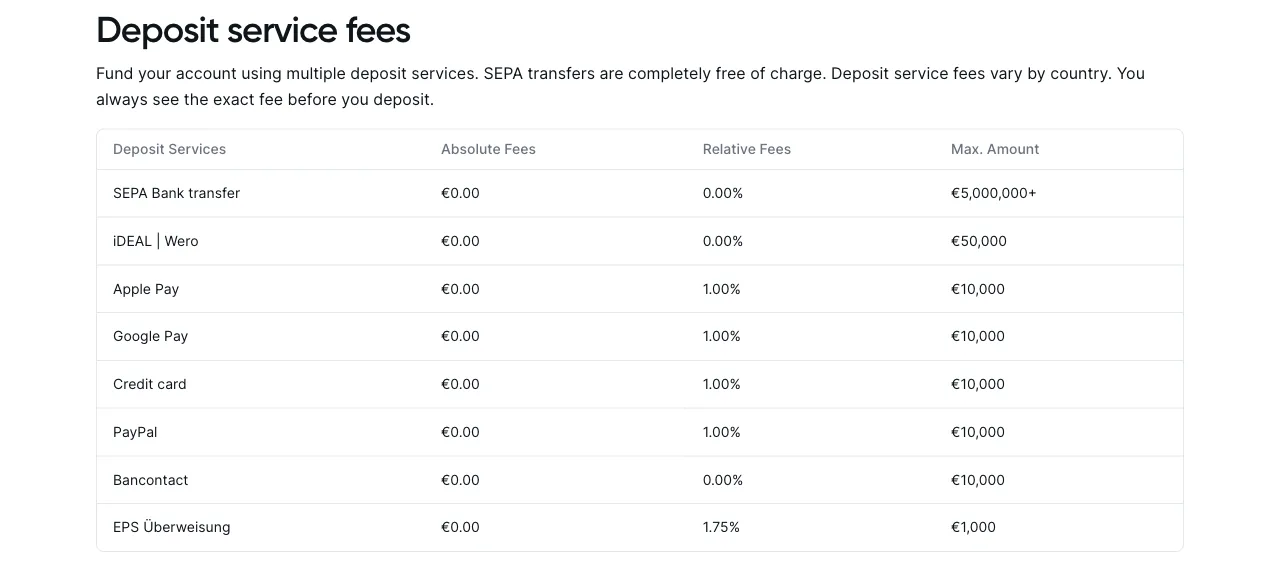
The first catch is also simple to avoid. The exchange does not charge the same fee for every way of funding your account.
A SEPA bank transfer is free. So are iDEAL, Wero and Bancontact. Cards and wallets cost more. The fee page lists credit cards, Apple Pay, Google Pay and PayPal at 1.00%, each with a €10,000 cap. On a €1,000 deposit that is €10 gone before you place a single order.
The one caveat is that the platform's own pages do not fully agree. The English version of the help centre's deposit table shows EPS at 0%, while the fee page shows 1.75%. The help centre's Apple Pay page says the fee changed in August 2026. The fee page adds that deposit fees vary by country and that you always see the exact fee before you deposit, so treat that screen as the final word.
A second rule matters more than the percentage. A deposit by Bancontact, PayPal, Apple Pay or credit card does not verify a bank account. You cannot withdraw until you have deposited by another method. Deposits must also come from a bank account in your own name. Accounts are personal, so a couple needs two accounts. Payments from a third-party account are refunded automatically within several business days, and business accounts cannot be used.
If you need the money at once, the help centre points to the other payment methods rather than SEPA, and some of those carry fees. Its deposit table lists SEPA as direct and taking up to two business days.
SEPA bank transfers cost nothing on the fee page, while cards and PayPal carry a percentage fee
2. The Price on Screen Can Include a Spread
The fee page lists fees by pair category. Our video calls Pro Mode cheaper than the simple buy screen, and the difference it points to is the spread, so that is worth spelling out.
Trading fees depend on the order type and your 30-day volume. Takers pay when an order matches at once, which covers every market order. Makers pay when an order adds liquidity to the order book, for example a limit order that does not fill immediately.
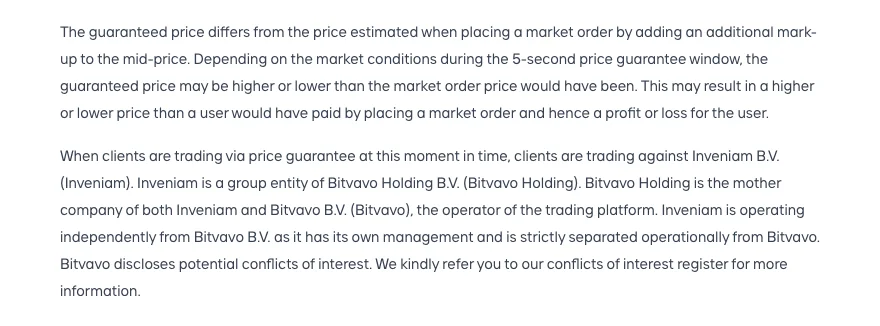
The extra cost sits elsewhere. Outside Pro Mode you can place a price guarantee order, where a market maker holds the price for up to five seconds. To cover that risk the market maker adds a spread, described as a mark-up on the mid-price, the midpoint between the current bid and ask. The help centre's price guarantee page also states that you are then trading against Inveniam B.V., a group company of Bitvavo Holding B.V. It adds that Inveniam has its own management and works independently. The guaranteed price can also end up higher or lower than a market order would have paid, the same page notes.
Limit orders avoid that mark-up. The help centre itself points to a limit order if you prefer to pay 0% spread and trade directly with other users. Pro Mode offers market, limit and stop limit orders but no price guarantee. Some markets, which Bitvavo says may have lower activity and liquidity, can now be reached only through price guarantee, so never in Pro Mode.
You choose your default order type in the app settings, between a market order and a price guarantee order. Check which one is active before you buy. Market orders also come with warnings when the spread passes 0.75% or the estimated slippage passes 1.5%, and they are blocked above a 2% spread. Bitvavo also blocks market orders with very high estimated slippage. Slippage is the drift from the quoted price when a large order eats through the order book.
3. Four Services Sit Outside MiCA
MiCA lets Bitvavo serve customers across the EU, yet it does not reach everything the company sells.
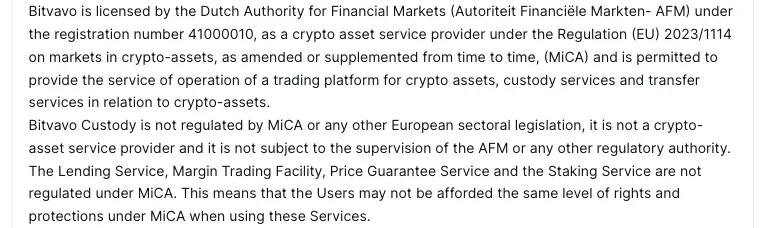
The User Agreement says so in its opening pages. The Lending Service, the Margin Trading Facility, the Price Guarantee Service and the Staking Service are not regulated under MiCA, and users may not get the same level of rights and protections there. Our video named staking and lending. The agreement adds margin trading and the price guarantee.
Staking is provided by Bitvavo B.V. and lending by Bitvavo Custody B.V. According to the User Agreement, Bitvavo Custody is not a crypto-asset service provider and is not subject to the supervision of the AFM or any other regulatory authority. That matters because Auto Earn groups flexible staking and lending, and you can switch each on or off. Your coins stay tradable, according to the help centre, though clauses 10.11 and 11.11 of the terms allow Bitvavo to introduce opt-out and withdrawal periods. Where lending is on, they can be lent to partners to generate liquidity.
For a small number of assets, lending has to be switched on before you can buy them. Once you consent, you cannot opt out in the settings. You sell or withdraw the asset instead. According to the help centre, fixed staking locks coins for 30 calendar days, although the earn page says lock-up periods are subject to change.
The trade-off is yield against protection. Rewards come from services where MiCA safeguards do not apply. So the question is not only the percentage. It is who stands behind the coins while they are lent out.
4. The Euro Balance Has No Deposit Guarantee Under the Standard Terms
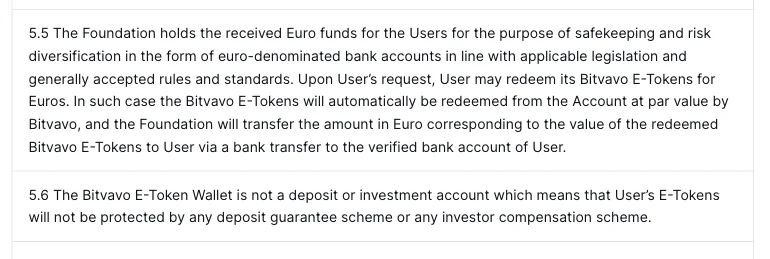
Clause 5.6 of the User Agreement says the Bitvavo E-Token Wallet, which shows your euro balance, is not a deposit or investment account. Its E-Tokens are not protected by any deposit guarantee scheme or investor compensation scheme. Under the standard terms, a foundation called Stichting Bitvavo Payments holds your euros in euro-denominated bank accounts. Bitvavo describes it as a bankruptcy-remote vehicle, and the agreement says your assets stay outside Bitvavo's estate if the company goes bankrupt. Separation is useful, yet it is no guarantee scheme. Our guide to whether Bitvavo is safe goes through the custody chain, the liability clauses and the account settings.
Two country annexes change the picture. For residents of France, Article 5 does not apply. Euros are topped up by buying euro stablecoins such as EURC, and Bitvavo states that it is not the issuer, holds no euro reserve for them and is not obliged to buy them back. For residents of Germany, funds sit in a trust account at Sutor Bank GmbH, and Bitvavo offers no bank account of its own. Read the annex for your country before you rely on any of this.
On top of that, crypto balances are a separate matter. Users have a claim against the foundation, and the agreement warns that if a third-party custody provider defaults or goes bankrupt, you may not keep all of your assets.
For full independence, the help centre itself suggests moving coins to a wallet you manage yourself.
The Bitvavo Account Guarantee comes with narrow conditions. It may reimburse an eligible user up to €100,000, but only after unauthorised access and an unauthorised withdrawal. Eligibility includes completed verification, at least 30 days of trading eligibility, authenticator-app two-factor authentication for at least 30 days before the incident, a police report and a claim within 90 days. Bitvavo states that it is not part of the EU deposit guarantee schemes and not an insurance policy. The agreement calls it a pilot programme that can be changed or cancelled without notifying users.
One more clause matters if you leave an account idle. After 12 months without use, and with the user unreachable, the User Agreement allows custody fees. Should they exceed the balance, whatever remains can be reported as unclaimed property and the account closed. Accounts with a running staking or lending contract are exempt.
5. Trading a Coin Is Not the Same as Moving It
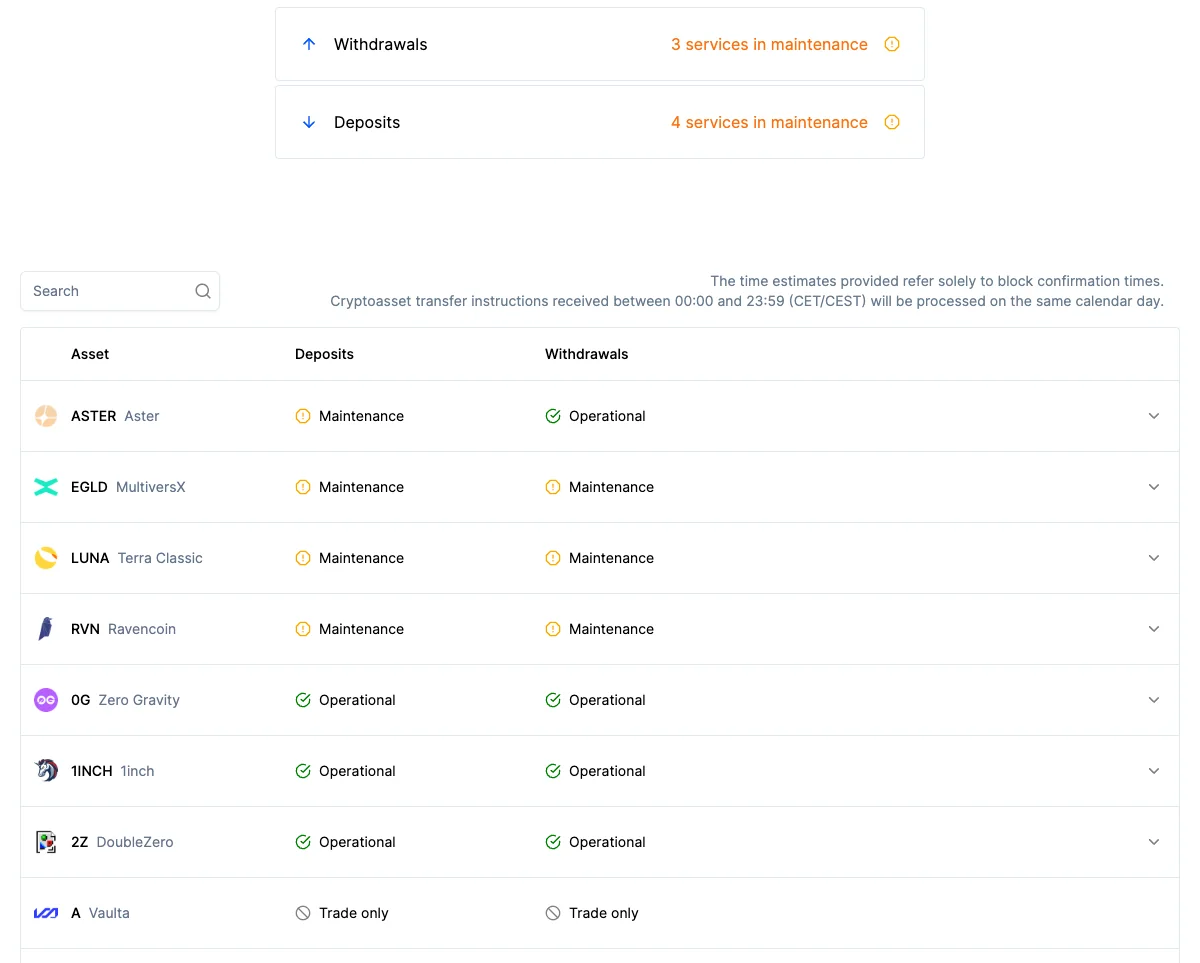
Bitvavo lists more than 400 assets. Being able to trade one does not mean you can send it in or out.
When we checked, the networks page flagged 15 assets as trade-only, among them Arweave, Decred, Flow and Mina. You can buy and sell them, but not deposit, withdraw or stake. According to the help centre, withdrawals stay permanently unsupported. After a delisting you must sell before the deadline, otherwise the balance is converted to euros automatically.
Some assets are merely under maintenance. That same day, three withdrawal services and four deposit services stood paused. Bitvavo calls such pauses often temporary, and deposits made before or during the work are credited afterwards. The page is easy to follow and worth checking before you buy a coin you plan to move.
Our video says USDC cannot be deposited or withdrawn. That is outdated. The networks page shows USDC deposits and withdrawals as operational, and the fee page lists a USDC withdrawal fee of 1.1 USDC.
The bigger danger is the network you choose. Ethereum deposits work on the Ethereum mainnet, Base and Arbitrum, but Bitvavo supports more than one network for an asset only in specific cases. Sending to the wrong network may mean the full loss of your funds. For crypto deposited to Bitvavo via the wrong network, the fee page adds that Bitvavo may be able to assist with recovery efforts in some cases, for a €50 administration fee. Check the asset on the networks page before you send anything.
6. The Savings Plan Lives in the App and Runs on Your Euro Balance
Bitvavo calls its savings plan Recurring Buy, and it works differently from a direct debit.
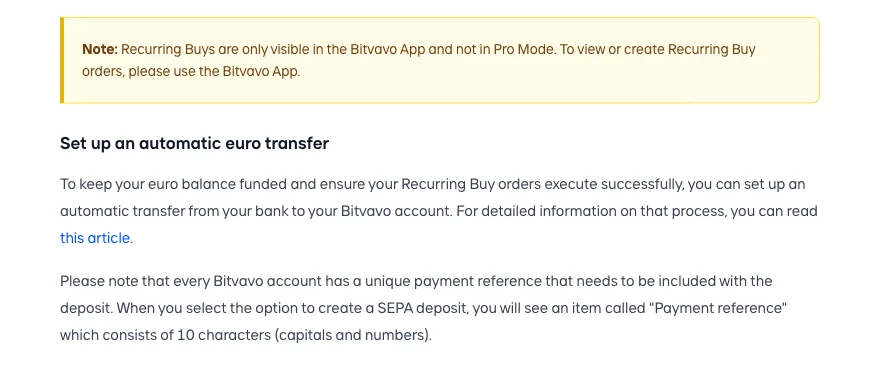
Pick a coin, a euro amount, a start date and a frequency: daily, weekly, every two weeks or monthly. The help centre's Recurring Buy page starts its steps in the app and adds that Recurring Buys are only visible there, not in Pro Mode.
The money does not come straight from your bank account. The exchange takes the amount from your euro balance, at a random time on the day you picked. If the balance is too low, the order is not executed. The practical fix is a standing order from your bank to your Bitvavo account, set up a few days ahead. Every account has its own payment reference, and it must appear on the transfer. Our guide to Bitvavo beginner mistakes shows what happens to a deposit when the reference is wrong.
Regular trading fees apply, and by default these are taker fees. A reminder arrives three days before each purchase. You can cancel a plan at any time. The same page says editing one is not yet possible, even though the homepage advertises changing the amount or frequency and skipping a purchase. That is a minor limitation if you live in the app anyway, and a real one if you work from a laptop.
Buy on a daily, weekly, two-weekly or monthly schedule from your euro balance, with the regular trading fees applying
7. Tax Reporting Under DAC8 Is Built In
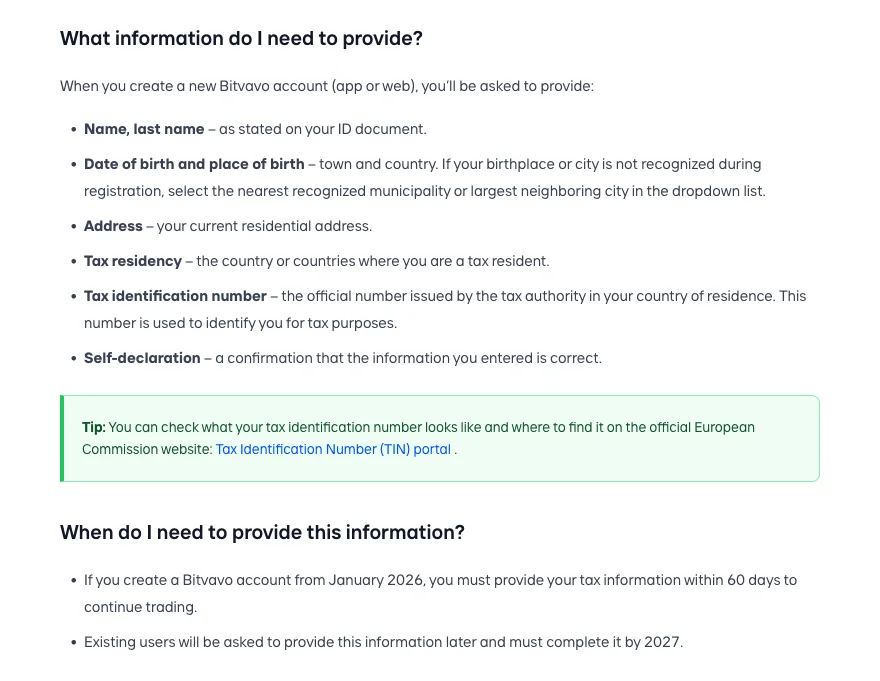
DAC8 is the EU directive on tax transparency for crypto-assets. It took effect on 1 January 2026, and Bitvavo now builds it into onboarding.
If you open an account from January 2026, you must give Bitvavo your tax details: tax residency, tax identification number, place of birth and address. One help article gives new accounts 60 days to provide them, and existing users must complete the step by 2027. Another one, the page on why Bitvavo asks for these details, says a temporary limitation applies if the details are still outstanding after Bitvavo's first request. You can still sell crypto and withdraw euros, while crypto purchases and deposits of euros and crypto are paused. The limitation ends once the details are complete.
What happens next follows the directive. According to the European Commission, crypto-asset service providers collect the data from 1 January 2026 and report between 1 January and 30 September 2027. Information on investors who live in another EU country is then exchanged with that country's tax authority. The help centre's tax details page says Bitvavo reports certain customer information to the Dutch Tax Administration, the Belastingdienst, from 2027.
Bitvavo does not generate ready-made tax reports. In the web version, not the mobile app, you can export a CSV transaction history and a PDF balance statement. The help centre's tax report page also names three partner tools: CoinTracking, Blockpit and TaxDown. It gives no tax advice and points you to a tax professional. We cover one of those tools in our guide to CoinTracking beginner mistakes.
8. Bitvavo Is Built for Spot Buyers, and Margin Is New
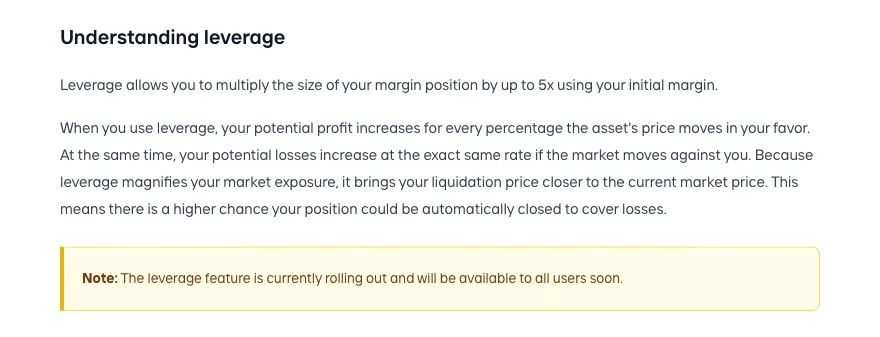
Margin trading is rolling out, with long and short positions. Our video says Bitvavo has no leverage, which is no longer accurate. The pages do not agree on the size. The homepage advertises up to 10x leverage on 20 assets. The help centre's margin page says up to 5x and adds that margin longs and the leverage feature are still being rolled out and may not be available to everybody. Check the figure shown in the app before you rely on either.
Margin comes with its own costs. The fee page lists a borrowing fee of 0.0023% per hour on the borrowed amount, plus a 2% liquidation fee if a position is closed automatically. The Margin Trading Facility is also one of the four services outside MiCA. Leverage magnifies losses at the same rate as gains, and a position can be closed before you decide to sell.
Beyond margin, the exchange remains a spot venue. Pro Mode offers market, limit and stop limit orders, and an OCO order, where one order cancels the other, is listed as coming soon. If your plan needs more than that, compare providers before you commit.
9. Large Withdrawals May Require Proof of Funds
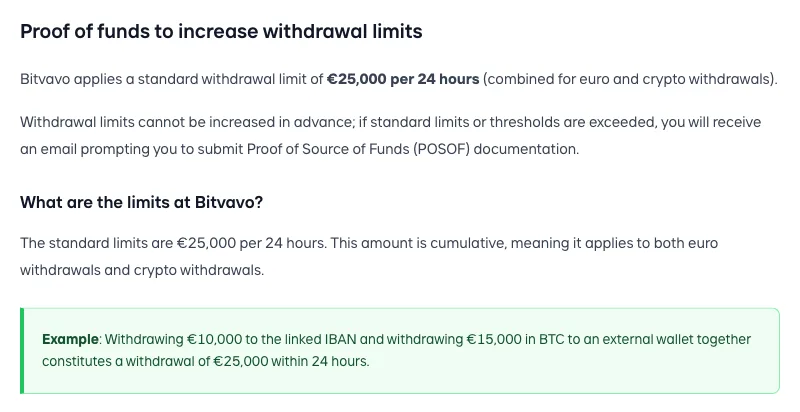
Bitvavo caps standard withdrawals at €25,000 per 24 hours, counted together across euro and crypto. Withdrawing €10,000 to your bank and €15,000 in Bitcoin to a wallet uses the whole allowance.
Our video talks about deposits and withdrawals in one breath. The limit applies to withdrawals. Proof of the source of funds is a separate rule. The help centre's proof-of-funds page says it may be requested at any time under financial regulations, and it has to cover at least your total deposits. The page adds that limits cannot be increased in advance: Bitvavo emails you for documents once standard limits or thresholds are exceeded. Only final versions are accepted, not drafts or provisional tax assessments.
Accepted proof depends on where the money came from. For salary or savings, the help centre lists payslips not older than six months or a tax return not older than twelve months. Our video mentions payslips from the last three months, while the help centre says payslips may be up to six months old. For crypto bought elsewhere, expect bank statements, invoices and transaction histories.
Beyond that, you cannot pre-clear a large deposit. The compliance team asks for documents only after the money has arrived. You benefit from keeping the paperwork ready. Support runs through live chat and email, with human agents from 07:00 to 23:00 CET every day and a next-working-day reply to emails outside those hours. A pending withdrawal is not the moment to start collecting documents.
10. Moving Coins Out Has Its Own Rules
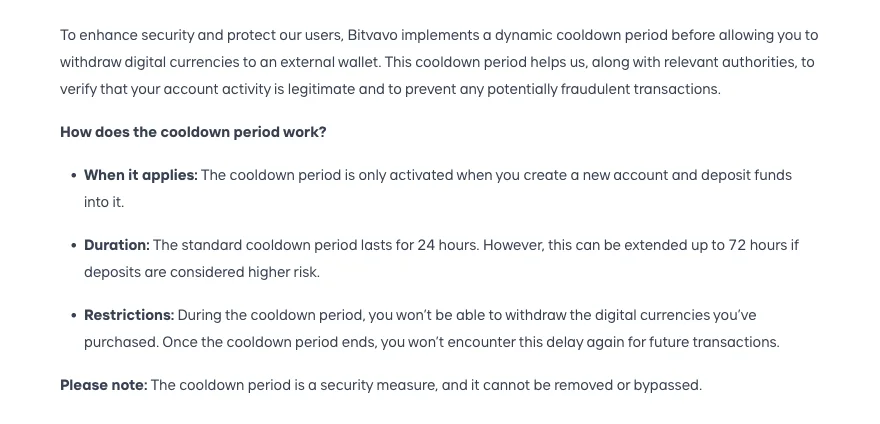
Bitvavo's help centre recommends withdrawing to your own external (cold) wallet, and our video suggests the same for larger balances. Getting there takes three steps that are easy to miss.
A cooldown comes first. After you open a new account and deposit, withdrawals of the digital assets you bought to an external wallet are blocked for 24 hours. The period can stretch to 72 hours if the deposit is seen as higher risk. That said, it applies once, and it cannot be bypassed.
Wallet verification under the Travel Rule comes next. A withdrawal to your own wallet can show the status awaiting wallet verification, which means the exchange must confirm that the address is yours. You connect the wallet and sign a message, or you upload an image, which may mean manual checks and delays. Each address is verified once. The rule affects crypto deposits and withdrawals only, not trading or euro transfers.
Network fees come last. Crypto deposits are free, while withdrawals pass on blockchain costs. On 11 October 2026 the fee page showed 0.000017 BTC for Bitcoin, 0.00032 ETH for Ethereum and 0.0056 SOL for Solana, and the amounts shift with blockchain capacity.
What Bitvavo Charges to Trade
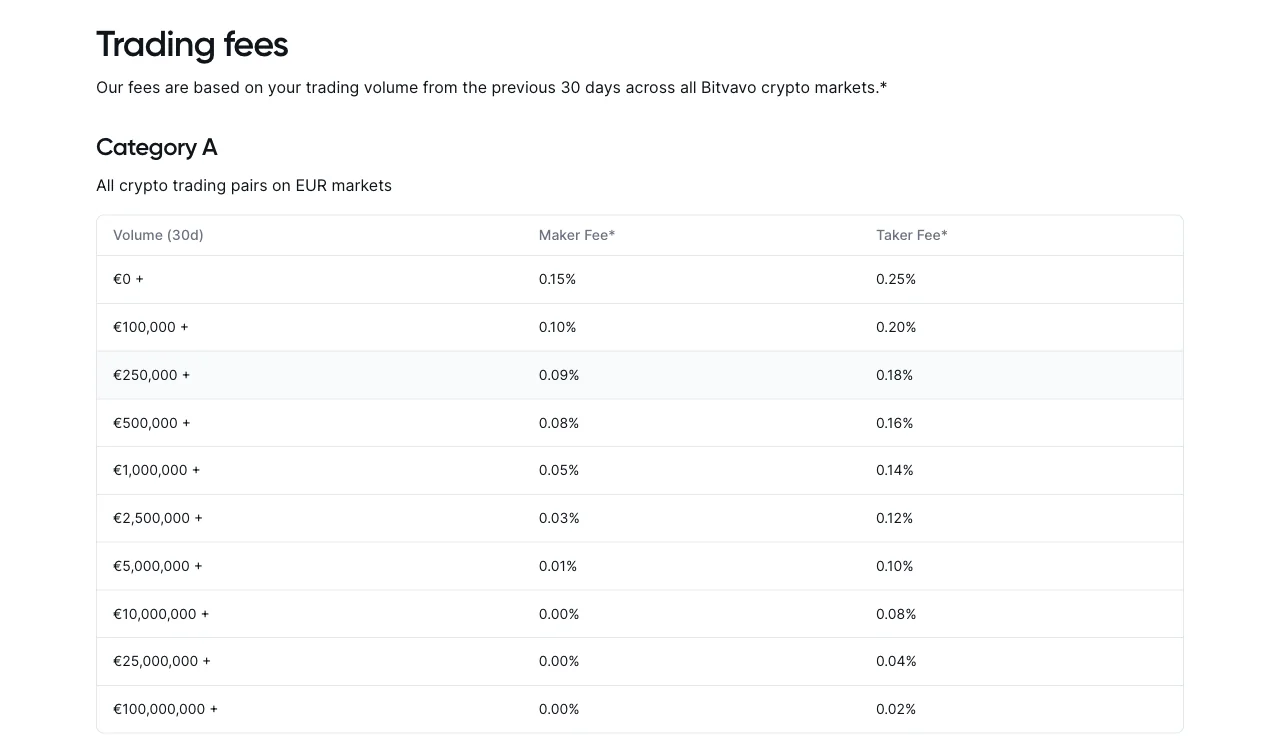
The fee page is well-structured, and the schedule itself is straightforward. Fees depend on your volume over the previous 30 days, and the tier is recalculated nightly.
Category A covers EUR pairs: 0.15% for makers and 0.25% for takers at the base tier, dropping to 0.10% and 0.20% from €100,000 of 30-day volume. Category B, the USDC markets, begins at 0.05% for both sides and gets cheaper further up. Some stablecoin pairs, such as USDC/EUR, form category C with 0.10% on both sides at the base tier and less above it.
Stablecoin volume does not count towards your tier. That matters for a practical reason. To trade on a USDC market you first need USDC, and buying it with euros goes through the USDC/EUR pair, which is category C.
A limit order that does not fill at once reserves the maximum fee of 0.25%. If it executes at a lower tier, the difference is refunded. Personalised fees are not offered, so the published table applies to everyone.
Base trading fee on EUR pairs: 0.15% for makers and 0.25% for takers, falling with 30-day volume
What the Sign-Up Offer Covers
New customers who register through our link qualify for a welcome offer. Currently it is €20, paid once you have verified your identity and made a first deposit of at least €20. The deposit must land within seven days of opening the account. Credit follows within 48 hours, and the value has to remain in your account for 180 days. According to the help centre's welcome bonus page, verification includes a bank check, and any trading or activity requirements for your campaign show up in the app.
Eligibility is limited to adults who are new customers, live in the Eurozone and sign up through the offer page. Accounts also go through an internal review, and readers outside the Eurozone are not eligible under the current terms. The offer page mentions zero trading fees on the first €10,000 traded during the first seven days. Registration closes on 31 December 2026, provided the page stays active, and terms may change at any time.
A welcome bonus does not change the overall picture of the ten catches above.
Pros and Cons Before You Sign Up
Set side by side, the catches and the strengths look like this.
What works well
- MiCA licence from the Dutch AFM for trading, custody and transfers
- More than 400 assets and a base fee of 0.15% maker and 0.25% taker
- Free SEPA, iDEAL, Wero and Bancontact deposits
- Under the standard terms, customer assets held through a foundation that Bitvavo describes as bankruptcy-remote
- A public networks page and a transparent fee table
- Live chat and email support, with human agents every day from 07:00 to 23:00 CET
What to weigh up
- No deposit guarantee on the euro balance under the standard terms, and a custody provider's default could cost you crypto
- Lending, margin, price guarantee and staking sit outside MiCA
- Price guarantee orders add a spread and, according to Bitvavo, are traded against a group company with its own management
- Bitvavo's own pages disagree on some deposit fees and on margin leverage
- Trade-only assets, maintenance, cooldowns and wallet checks slow transfers out
- Savings plan managed in the app and not editable
- A €25,000 withdrawal limit per 24 hours, and proof of funds for more
Bitvavo handles the basics well, and many of the catches sit around them: what the licence covers, what the terms protect and how freely money can leave.
Who Bitvavo Suits, and Who It Does Not
Bitvavo works well if you want a regulated place to buy major coins at clearly published base fees and you are comfortable moving them to your own wallet. The fee page is transparent, the networks page is easy to follow, and the MiCA licence holds up for the core trading and custody services.
It works less well as a place to park a large balance. Under the standard terms the euro balance has no deposit guarantee, and staking, lending, margin and the price guarantee sit outside the licence. The deciding factor is how much you leave on the platform and for how long.
Plan for the paperwork as well: tax details under DAC8, proof of funds for large withdrawals and wallet verification for transfers out. DAC8 and the Travel Rule are EU rules rather than Bitvavo's own, and all three are easier to handle at your desk than in the middle of a withdrawal.
Prices in crypto can drop sharply, and a total loss is possible. Commit only money you could afford to lose completely, and read the terms that apply in your country of residence. None of this is investment advice.
For new Eurozone customers after verification and a first deposit of €20 or more. Check the terms for your country first and only use money whose total loss you could absorb
Frequently asked questions
Legal information
The content on this site has been researched carefully. Our sources are the providers' publicly available information and their terms and conditions. Despite regular checks we cannot warrant that the data is current, accurate or complete. Binding information on products and prices is only available on each provider's own website. Unless stated otherwise, the conditions shown apply to new customers.
Not financial advice
Our content is informational and comparative only. It is not financial, tax or legal advice, and it is neither a recommendation to buy nor an invitation to take out a financial product. Make your decisions based on your own situation and risk tolerance, and consult an independent adviser if you need one.
Risk warning
Every investment carries risk. Values can rise or fall, and past performance does not indicate future returns. You can lose part or all of the capital you invest. Crypto-assets are largely unregulated, are not covered by deposit guarantee or investor compensation schemes, and carry a high risk of total loss.
Advertising and affiliate links
Some links on this site are marked with an asterisk (*) and are affiliate links (advertising). If you take out a product through one of these links, we receive a commission from the provider at no additional cost to you. That is how you support our work.