Crowdlending 2026: P2P lending platforms compared
P2P lending platforms for investors, put through a regulation check
Last updated: 18 August 2026
Crowdlending looks attractive because of its double-digit returns, but the most important question is not the return. It is: who regulates the platform, and who ultimately owes you your money? We have analysed 16 crowdlending platforms for investors by return, regulation, buyback, minimum investment and risk. We give regulated providers more weight and flag unregulated ones honestly.

Licensed with a full buyback obligation
* Historical return, not guaranteed.
The 16 crowdlending platforms compared
16 platforms at a glance, with the top 3 of our selection highlighted. The star rating for each provider is calculated from fixed criteria. Scroll sideways to see all providers and criteria.



Strong concentration risk: 7 of 12 originators belong to the Creditstar group

Personally closely intertwined with the main lender Stikcredit


Pilot operation: only 4 financed projects, no loan matured yet, no buyback, no secondary market

The majority of the lenders belong to the founders themselves

In 2026, a deposit/withdrawal freeze of around three months after the payment provider lost its licence; strong concentration in one dominant originator

Negative equity of around €1.27 million

No audited platform figures and no portfolio or performance metrics disclosed

Unregulated (no licence), buyback in the contract only as a right of the lender, group guarantee without contractual text; the underlying value depends on an undisclosed group.

Unregulated and self-dealing: one owner controls the platform, all lenders and the buyback; the underlying value depends entirely on this group, whose lenders operate at an operating loss.
Operator details inconsistent (Canada per the T&Cs vs. SVG per the glossary), the homepage figure reflects the corporate group, not the platform alone
Scroll sideways to see all providers
| Provider | Our recommendation 1Debitum Go to provider 1% cashback1% cashback on your investments during the first 30 days via our link, combinable with the four-tier loyalty programme (loyalty bonus up to 2% p.a.). | Broad diversification 2Mintos Go to provider up to €350 bonusRegistration with the code plus a first investment in the same calendar month, tiered by the amount invested.Code: GO-FINANZARENA | From €1 3 | 4 | 5 Lendermarket Go to provider 1.5% cashbackRegistration via our link, cashback on investments in the first 90 days. | 6 | 7 Monefit SmartSaver Go to provider 0.25% cashbackCashback on transfers in the first 90 days, up to €1,250 deposited. No separate welcome bonus. | 8 | 9 Indemo Go to provider up to 5.5% cashbackNew-investor bonus via our link, currently up to 5.5% cashback on your investments. | 10 | 11 Loanch Go to provider €20 + 1% cashbackFor new investors via our link; plus a loyalty programme with 6 tiers from €3,000 portfolio up to +1.50% interest. | 12 | 13 Maclear Go to provider up to 3% cashbackCashback for 90 days, welcome bonus from €50 invested within 7 days. | 14 | 15 Revest Go to provider up to 1% cashbackNew customer cashback via our link: 1% on business loans, 0.25% on consumer loans (first 90 days). | 16 |
|---|---|---|---|---|---|---|---|---|---|---|---|---|---|---|---|---|
| Our rating | Very good (4.7) | Very good (4.4) | Very good (4.4) | Good (4.1) | Good (4.0) | Good (3.6) | Satisfactory (3.4) | Satisfactory (3.3) | Satisfactory (3.2) | Satisfactory (3.0) | Adequate (2.9) | Adequate (2.5) | Adequate (2.4) | Adequate (2.1) | Adequate (2.1) | Poor (1.9) |
| Return p.a. | up to 15%* | approx. 10.8%* | up to 6%* | approx. 10-14%* | approx. 13.5%* | approx. 8-16%* | approx. 7.5%* | 9-12%* | 15%* | approx. 11.8%* | up to 15.9%* | approx. 12.5%* | up to 15.6%* | approx. 11.5%* | approx. 13.5-16%* | approx. 22%* |
| Minimum investment | €10 | €50 | €1 | €50 | €10 | €10 | €10 | €150 | €10 | €10 | €10 | €10 | €50 | €50 | €10 | 100 USDC (approx. €100) |
| Head office | Latvia | Latvia | Estonia | Latvia | Ireland | Bulgaria | Estonia | Latvia | Latvia | Croatia | Croatia (loans in Southeast Asia) | Croatia | Switzerland | Croatia | Croatia | Offshore (Canada / SVG) |
| Licence / Regulation | EU-licensed MiFID II (investment brokerage) | EU-licensed MiFID II (investment firm) | Other supervision The platform itself is not regulated, the parent is EFSA-licensed | EU-licensed ECSP (EU 2020/1503) | EU-licensed ECSP licence (C513967) | EU-licensed ECSP licence (EU 2020/1503) | Other supervision The platform itself is not regulated, the lender Creditstar is | EU-licensed ECSP (EU 2020/1503) | EU-licensed MiFID II (investment firm) | No licence Unregulated (ECSP applied for) | No licence None (unregulated) | No licence No financial licence | Other supervision PolyReg SRO member (Switzerland) | No licence No licence (only Croatian commercial register) | No licence No licence (the operator is explicitly not authorised as an investment firm) | No licence No financial licence (only AML registration) |
| Supervision | Latvijas Banka (Latvia) | Latvijas Banka (Latvia) | EFSA (Estonia) at the level of the parent company | Latvijas Banka (Latvia), with an EU-wide passport | Central Bank of Ireland | Financial Supervision Commission (Bulgaria) | No platform licence, the lender Creditstar is licensed in 8 countries | Latvijas Banka (Latvia), with an EU-wide passport since June 2026 | Latvijas Banka (Latvia) | No financial services licence (pre-licensing) | No financial supervision | No financial services supervision | Swiss self-regulation (SRO), no EU/MiFID/ECSP licence | No financial supervision | No financial supervision | No financial supervision (FINTRAC MSB / PolyReg SRO, a pure anti-money-laundering registration) |
| Loan types | Business loans (B2B), partly agricultural and forestry | Loans, bonds, real estate, ETFs, Smart Cash | Unsecured consumer loans (5 markets) | Agricultural loans (land, machinery, grain) | Consumer and business loans (12 originators) | Business loans, and since 2026 also real estate | Consumer loans of the Creditstar group (8 countries) | Property-secured business loans | Non-performing residential property loans from Spain | Business loans, mortgages, vehicle and long-term loans | Consumer loans (Malaysia/Indonesia) | Short-term business loans (30-90 days), Linqo product up to 24 months | Secured EU SME business loans (15+ countries) | Consumer and business loans from 3 lenders (Malaysia, Singapore, Mexico) | Kazakh consumer loans (25 days) and business loans to the group itself (1 to 24 months) | Business loans (P2B) worldwide, only in USDC |
| Loan term | approx. 3-36 months (per investment) | 1-120 months | Flexible, available at any time | 3-60 months (avg. 21) | from 30 days | 1-60 months | Flexible; Vaults 12-24 months | 12-36 months | Estimated up to approx. 5 years (foreclosure) | 1-12 months | Not officially published | 30 days to 24 months | approx. 9-14 months | 1, 3, 6 or 12 months | 25 days (consumer), 1 to 24 months (business) | 4-16 months (bullet repayment) |
| Buyback / Protection | Yes | Yes | No | No | Yes | No | No | No | No | Yes | Yes | Yes | Partial | Partial | Partial | Partial |
| Secondary market | No | Yes | Not applicable | Yes | No | No | Not applicable | No | No | Yes | No | No | Yes | No | Yes | Yes |
| Liquidity | Classic ABS locked until maturity; the separate Debitum Flow product (8% p.a.) allows withdrawal requests of up to EUR 1,000 next business day / EUR 5,000 per week with no exit fee, but with no withdrawal guarantee | Smart Cash daily; loans via the secondary market (0.85%) | Near-instant access (Go & Grow), practically without limit | Locked until maturity; early exit only via the secondary market (no guarantee) | FLEX: early exit by giving up 50% of the annual interest | SaveSmart: up to 30% early (1% fee), loans locked | Available daily (instant up to €1,000/month) | Locked until maturity (12-36 months), no secondary market and no buyback | Locked until recovery, no early exit | Cash-out/secondary market, but the provider can deactivate it | Illiquid, capital generally locked until loan maturity; no guaranteed early exit | Locked until maturity, no secondary market | Exit via the secondary market (2.5% fee, market-dependent) | Locked until the end of the term, no secondary market; early exit only with the lender's consent and at the cost of all interest | Consumer loans are short at 25 days; otherwise exit is via the secondary market (since 03/09/2026, face value only, only through auto-invest, not guaranteed to be available) | Only via a thin secondary market; per the T&Cs, locked until maturity |
| Default rate | 0% (provider figure) | Yes, rate not public | 0% (provider figure) | Yes, around 4.8% (by volume); Art. 20 ECSPR rate 2025: 5.61% | 0% (provider figure) | 0% (provider figure) | n/a | No meaningful rate: no loan has matured yet | n/a | 0% (provider figure) | No default rate published; per its own statistics page, at Tambadana 21.9% of investments are 1-15 days and 21.64% are 16-30 days overdue (live check 27.08.2026) | n/a | Yes, 1 default, fully recovered | n/a | n/a | n/a |
| Investor capital losses | No, none documented | Yes, loss year 2022, individual originators defaulted | No, withdrawal queue in 2020, no capital loss | No investor capital losses reported (provider figure, not externally confirmed); defaults in recovery | Partly, pending-payments crisis 2022-24 (resolved) | No, none documented | No, none documented | None reported, but without significance, because no loan has matured yet | No realised investor losses, a young platform, so far only a rising market | No, none documented | No documented capital losses | No, none documented | No, 1 default in 2025, 100% recovered | No documented investor losses; according to the platform, no payout delays since 2023 | No documented investor losses, but the platform has only been active since December 2025 | No, none documented (a young platform) |
| Operator profitable | Yes, provider figure | No, group loss of €2.74 million (2024) | Yes, profitable since 2017 | Yes, audited (profit 2024: €196,086, 2025: €206,485) | No, loss of around €300,000 (2024) | Partly, the parent Stikcredit is profitable | Partly, the parent Creditstar is profitable | Not officially disclosed (operator founded in 2024, pilot phase) | Operator Indemo SIA at a loss in 2025 (around €0.69 million), going concern with an unqualified audit opinion | No figure, no public figures | Unknown, no audited platform figures (operator: €5,000 share capital) | No, going-concern note (2024) | No, loss in 2024, negative equity | Only the 2025 annual accounts are filed in the register; the Space Crew Finance group does not disclose audited figures | The operator is a company with EUR 2,500 share capital and no figures of its own; the lenders report profits that, per their own reports, stem largely from provision releases and currency gains (operationally negative) | No figure, an offshore operator, no figures |
| Auto-invest | Yes | Yes | Yes | Yes | Yes | Yes | Yes | Yes | Yes | Yes | Yes | Yes | Yes | Yes | Yes | No |
| Payment methods | Card, open banking, SEPA (EUR only) | SEPA/Sofort free, card and Apple/Google Pay (2%) | SEPA transfer only | SEPA transfer, Pay by Bank (instant) | SEPA (EUR only), card | Bank transfer (Lemonway), no card | SEPA free, card and Apple Pay (1%) | Transfer from your own account (wallet via Lemonway) | SEPA (EUR only) | Bank transfer from an EU account | Bank transfer | SEPA transfer only | Bank transfer (EUR) | SEPA in euros only (no card), withdrawal limit €5,000 per week | SEPA in euros only from your own account, minimum withdrawal EUR 50 | Only USDC via a crypto wallet (Base network) |
| Platform | 💻📱🤖 | 💻📱🤖 | 💻📱🤖 | 💻📱🤖 | 💻📱🤖 | 💻📱🤖 | 💻📱🤖 | 💻📱🤖 | 💻📱🤖 | 💻📱🤖 | 💻📱🤖 | 💻📱🤖 | 💻📱🤖 | 💻📱🤖 | 💻📱🤖 | 💻📱🤖 |
| Support | Live chat | Chatbot | Ticket system | Ticket system | Personal line | Live chat | Live chat | Personal line | Personal line | |||||||
| Fees | Deposits and withdrawals free of charge | Account free, inactivity €4.90/month, sale 0.85% | Withdrawal €1 flat, otherwise free of charge | No investor fees, free withdrawal | 1st withdrawal per month free, then €2 | Free of charge for investors | SEPA free of charge, card payment 1% | No investor fees except €1 per withdrawal | Investing, deposits and withdrawals free, inactivity fee €2.90/month | No platform fees | 0% platform fees | n/a | Deposits/withdrawals 0%, sale 2.5% | Investing, deposits and withdrawals are free (the terms allow for a future service fee) | Investing, deposits and withdrawals are free (the terms allow for future service fees) | No platform fee for investors (only gas fee); the 3% is borne by the borrower |
| Investors / Volume | 34,700+ investors · €223 million funded | 700,000+ users · €12.8bn funded | 500,000+ investors · €2.1bn invested | 11,158 investors · €63.5 million funded | 29,000+ investors · €657 million funded | €38 million invested | 48,000+ investors · €450 million paid in | 200 registered investors · around €83,000 financed (4 projects) | 23,000+ investors · over €37 million invested | €979 million invested | 16,000 investors · €110.8 million cumulatively invested · €11.8 million outstanding portfolio (own figure, 27.08.2026) | 29,000+ investors · €182 million funded | 41,000+ investors · €114 million funded | 1,025 investors · around €2.2 million outstanding portfolio (€3.7 million cumulative) | 679 active investors · around €3.0 million outstanding portfolio (€10.6 million cumulative) | 2,620 investors · around 19.7m USD funded (8lends only, as of 25.08.2026) |
| Founded | 2019 | 2015 | 2008 | 2019 (as LendSecured) | 2018 | 2023 | 2022 | 2024 (first project June 2026) | 2022 (operating since November 2023) | 2020 | 2024 | n/a | 2022 | 2023 | 2025 (platform live since December 2025) | 2025 |
| Notable points | A licensed niche for business loans, with 0% default so far according to its own figures | The broadest offering, a licensed marketplace and wide diversification across many lenders | A very simple entry from €1, in return capped at a maximum of 6% | Real collateral (property/registered pledge) instead of a buyback promise, a conservative loan-to-value | A high target return on short-term consumer loans | A regulated ECSP structure with a high return | A flexible, daily-available product with a very high Trustpilot rating | A regulatorily clean ECSP newcomer, but only four financed projects and around €83,000 total volume | Discloses the annual accounts of the Spanish recovery firms, unusually transparent, but with no fixed rate and no liquidity | An attractive return and a broad originator network | High advertised interest, but unregulated and internally intertwined within the group (the Fingular group) | A high return and short terms | A high Trustpilot rating and a strong bonus stack, but only a Swiss SRO instead of an EU licence | Small, unregulated platform from the Space Crew group (structurally like Robocash in miniature), three in-house lenders, buyback after 90 days | Structurally a Robocash clone: an unregulated refinancing channel for a Kazakh lending group, three in-house lenders, buyback from 31 days | Crypto crowdlending (USDC/Base), no licence, contradictory own documents, buyback only in the marketing, an illiquid reward token |
| Warning signs | – | – | – | – | Strong concentration risk: 7 of 12 originators belong to the Creditstar group | Personally closely intertwined with the main lender Stikcredit | – | Pilot operation: only 4 financed projects, no loan matured yet, no buyback, no secondary market | – | The majority of the lenders belong to the founders themselves | In 2026, a deposit/withdrawal freeze of around three months after the payment provider lost its licence; strong concentration in one dominant originator | Negative equity of around €1.27 million | No audited platform figures and no portfolio or performance metrics disclosed | Unregulated (no licence), buyback in the contract only as a right of the lender, group guarantee without contractual text; the underlying value depends on an undisclosed group. | Unregulated and self-dealing: one owner controls the platform, all lenders and the buyback; the underlying value depends entirely on this group, whose lenders operate at an operating loss. | Operator details inconsistent (Canada per the T&Cs vs. SVG per the glossary), the homepage figure reflects the corporate group, not the platform alone |
| Offer | Go to provider 1% cashback1% cashback on your investments during the first 30 days via our link, combinable with the four-tier loyalty programme (loyalty bonus up to 2% p.a.). | Go to provider up to €350 bonusRegistration with the code plus a first investment in the same calendar month, tiered by the amount invested.Code: GO-FINANZARENA | Go to provider €5 bonusRequires a first investment of at least €50. | Go to provider 3% cashbackFor new investors via our link in the first 30 days. | Go to provider 1.5% cashbackRegistration via our link, cashback on investments in the first 90 days. | Go to provider 0.5% cashbackRegistration via our link. | Go to provider 0.25% cashbackCashback on transfers in the first 90 days, up to €1,250 deposited. No separate welcome bonus. | Go to provider 3% cashbackFor new investors via our link (promotion). | Go to provider up to 5.5% cashbackNew-investor bonus via our link, currently up to 5.5% cashback on your investments. | Go to provider 0.5% cashbackRegistration via our link. | Go to provider €20 + 1% cashbackFor new investors via our link; plus a loyalty programme with 6 tiers from €3,000 portfolio up to +1.50% interest. | Go to provider 1% cashbackRegistration via our link, cashback on every investment. | Go to provider up to 3% cashbackCashback for 90 days, welcome bonus from €50 invested within 7 days. | Go to provider 1% cashbackVia our link, 1% cashback on all investments in the first 90 days. | Go to provider up to 1% cashbackNew customer cashback via our link: 1% on business loans, 0.25% on consumer loans (first 90 days). | Go to provider 30 USDC + 6% tokenNew investor via our link, a first investment required. |
Return figures are average values observed by the platform in the past and are no guarantee for the future. Default rates are provider figures and are not directly comparable with one another. P2P investments carry the risk of partial or total loss and are not covered by the deposit guarantee scheme.
The 16 crowdlending platforms in detail
In the order of our selection. Each provider shows its regulatory status as a label.
Debitum: Licensed with a full buyback obligation
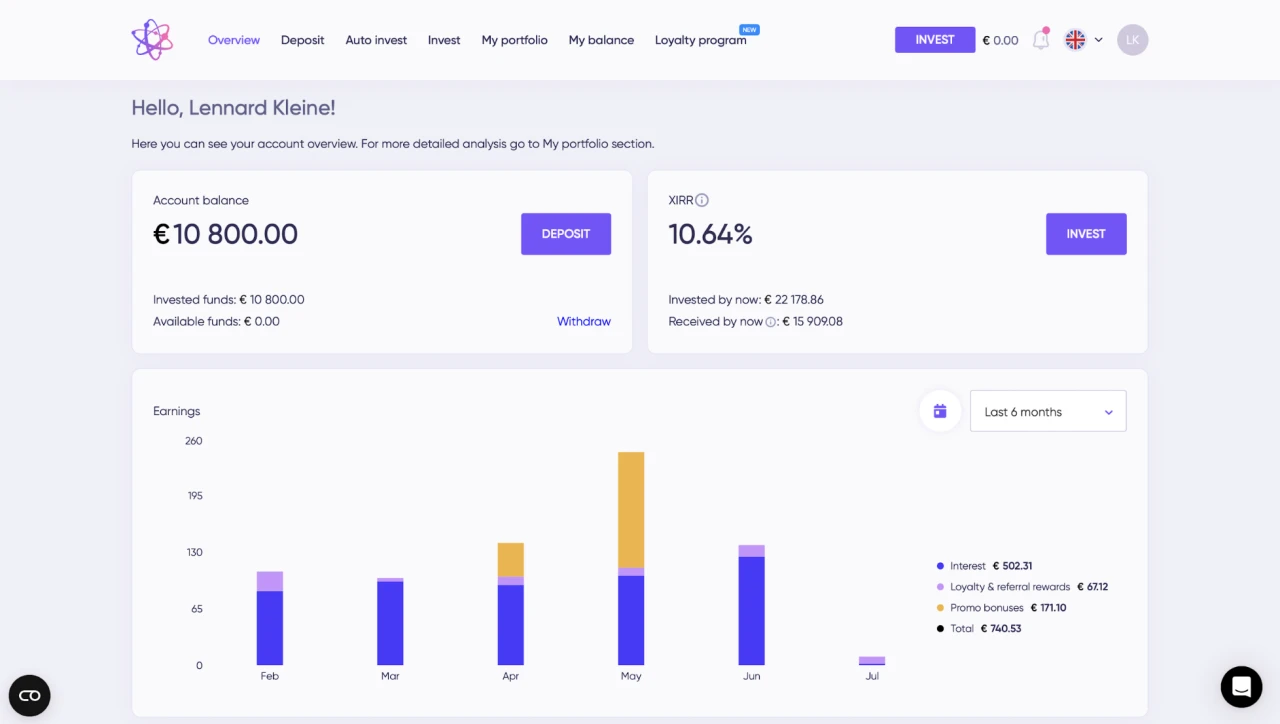
Debitum is one of the few P2P lending platforms with a genuine investment brokerage licence under the MiFID II framework and supervision by the Latvian central bank. You invest in secured business loans structured as asset-backed securities via a wholly owned subsidiary. You can start from €10.
The protection is comparatively strong, with a 100% buyback obligation and skin in the game from the lenders. Even so, buyback is an obligation of the originator, not external capital protection. The 0% default rate stated so far is a look back, not a guarantee for the future. There is no real secondary market yet.
You can get started from €10, deposits and withdrawals are free of charge for investors, and via our link there is 1% cashback for the first 30 days that combines with the four-tier loyalty programme (loyalty bonus up to 2% p.a.). The individual asset-backed securities run, depending on the investment, for around 3 to 36 months; with no secondary market, your capital is locked until repayment. You pay in by card, open banking or a classic SEPA transfer.
Pros
- Investment brokerage licence (MiFID II) supervised by Latvijas Banka
- 100% buyback obligation with skin in the game
- Entry from just €10
- 0% default to date according to its own figures
Cons
- No secondary market, capital is locked until repayment
- Focus on business loans, less diversification than Mintos
- Buyback is an originator obligation, not an insurance
Mintos: A strong all-rounder for broad diversification
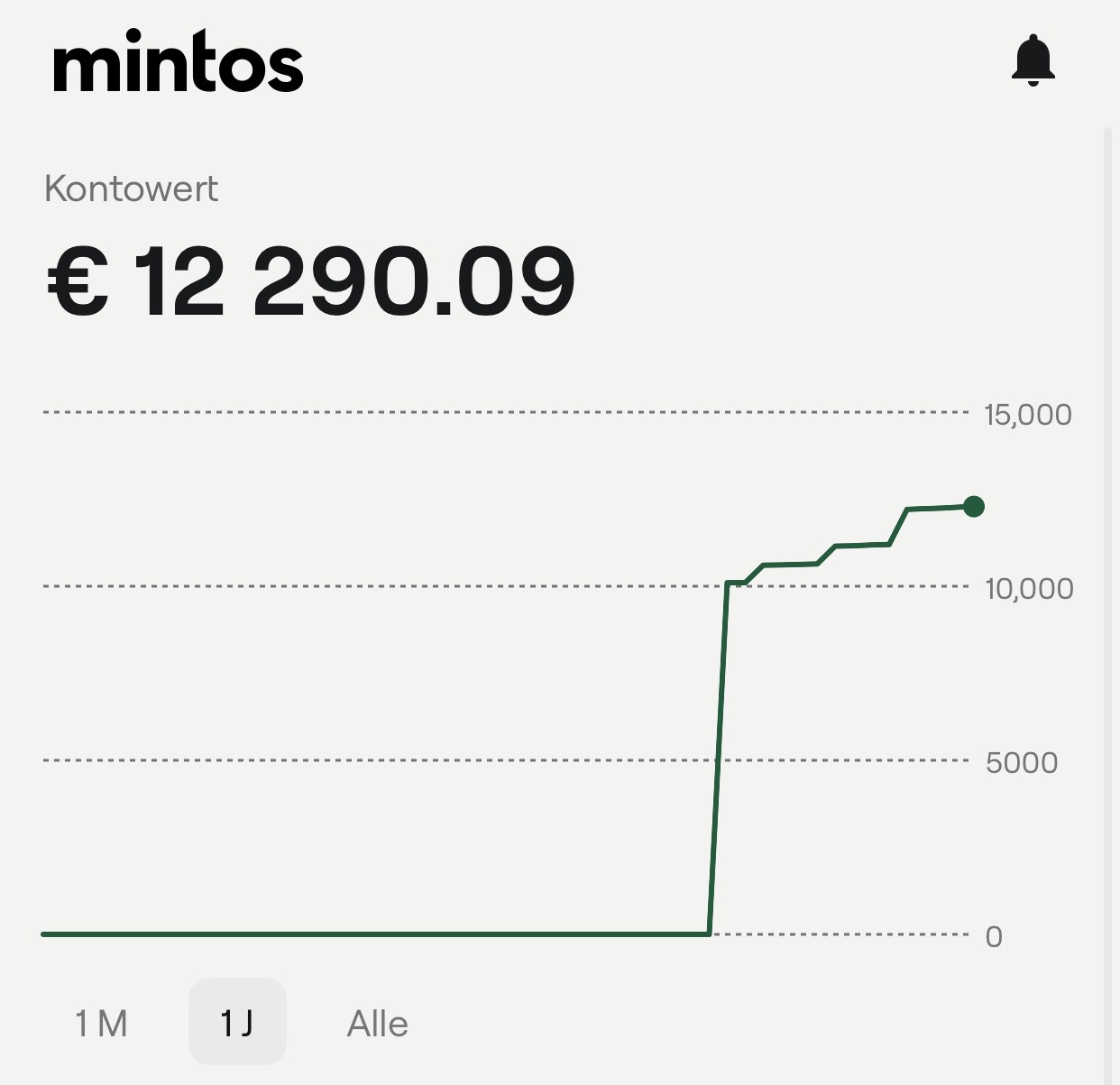
For us, Mintos is a standout all-rounder in the comparison, because as a licensed MiFID II investment firm it is supervised by the Latvian central bank while also offering one of the widest selections by far. Alongside classic loans, you can invest here in bonds, real estate, ETFs and an interest-bearing cash product, all from €50 and spread broadly across many lenders.
One important nuance: the MiFID licence and the investor compensation of up to €20,000 protect you against certain breaches of duty by the platform, but not against the default of individual loans. The buyback obligation comes from the respective lender and is not an insurance. The fact that a negative annual result was possible in 2022 shows that the return is real, but it fluctuates.
In practice you start from €50, pay in by SEPA transfer or card, and either spread your money automatically with Auto Invest or pick loans, bonds, real estate and the cash product yourself. Through the secondary market you can also exit positions early for a 0.85% sale fee. The account is free, only after prolonged inactivity does a €4.90 monthly fee apply, and Mintos is one of the few platforms in the comparison with an app for iOS and Android.
Pros
- Licensed MiFID II investment firm supervised by Latvijas Banka
- One of the widest selections: loans, bonds, real estate, ETFs and cash
- Broad diversification across many lenders from €50
- Secondary market for more flexibility
Cons
- The buyback comes from the lender, there is no external protection
- Historically also a loss year (2022) and some originator defaults
- Inactivity fee if the account sits idle
Go & Grow: A beginner-friendly loan-portfolio alternative
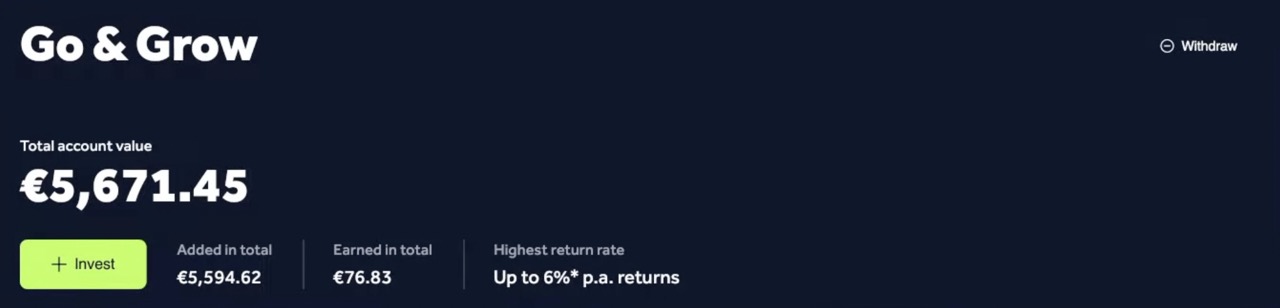
Go & Grow is Bondora's automatic loan-portfolio product and a particularly beginner-friendly solution, more a P2P-style loan-portfolio alternative than a classic loan-picking platform. You invest from €1 in an automatically diversified portfolio and the target return is up to 6%. By design, there is no option to pick individual loans.
A nuance worth noting: it is the parent company Bondora AS that is regulated, by the Estonian supervisor; the Go & Grow entity itself is not. The model is based on an assignment of claims, there is no classic buyback but an internal cash reserve buffer, and no deposit guarantee scheme. In return, the return is capped at 6%.
Go & Grow works in a deliberately simple way: you pay in from €1 by SEPA transfer, the money is spread fully automatically across many loans and is in principle available again at any time. There is no loan picking of your own and no secondary market. Each withdrawal costs €1 flat; otherwise the product is free of charge and can be used via an iOS and Android app.
Pros
- A very simple entry from €1, ideal for beginners
- Fully automatic diversification without your own loan picking
- A large, established user base
Cons
- Return capped at a maximum of 6%
- The product entity itself is not regulated (only the parent)
- No buyback and no secondary market
LANDE: Secured agricultural loans with an ECSP licence instead of buyback
LANDE is a Latvian crowdlending platform for agricultural loans in the Baltics and Eastern Europe, and as an ECSP-licensed platform it is supervised by the Latvian central bank, with an EU-wide passport. Instead of a buyback promise, the loans are usually backed by real collateral: a property lien on farmland, a registered pledge on machinery or a guarantee. Some loans are instead covered by a guarantee from the European Investment Fund (EIF). The conservative loan-to-value, at 42% on average, is the real protection.
An important nuance: LANDE deliberately offers no buyback. If a loan defaults, there is no quick money from the lender, but the recovery of the collateral, which can take months to years. The disclosed default rate is around 4.8% by volume. No investor capital losses are reported so far, though that is a provider figure and not externally confirmed.
In practice you invest from €50 per loan, pay in by SEPA or Pay by Bank and diversify with Auto Invest or pick projects yourself. There are no investor fees and withdrawal is free; for early liquidity there is a secondary market without a guarantee. LANDE is profitable per its audited accounts (profit of around €196,000 in 2024 and €206,000 in 2025), but with around 11,000 investors it remains a smaller, younger platform.
Pros
- ECSP-licensed (Latvijas Banka) with an EU-wide passport
- Real collateral or an EIF guarantee instead of a buyback promise (average LTV of 42%)
- Profitable per audited accounts, no investor fees
- Default rates disclosed under Art. 20 ECSPR, with a secondary market
Cons
- No quick buyback, recovery of the collateral takes months to years
- Capital locked until maturity, early exit only via the secondary market
- A young, smaller platform, with some legacy in Romania and in machinery
Lendermarket: ECSP-licensed with a high target return
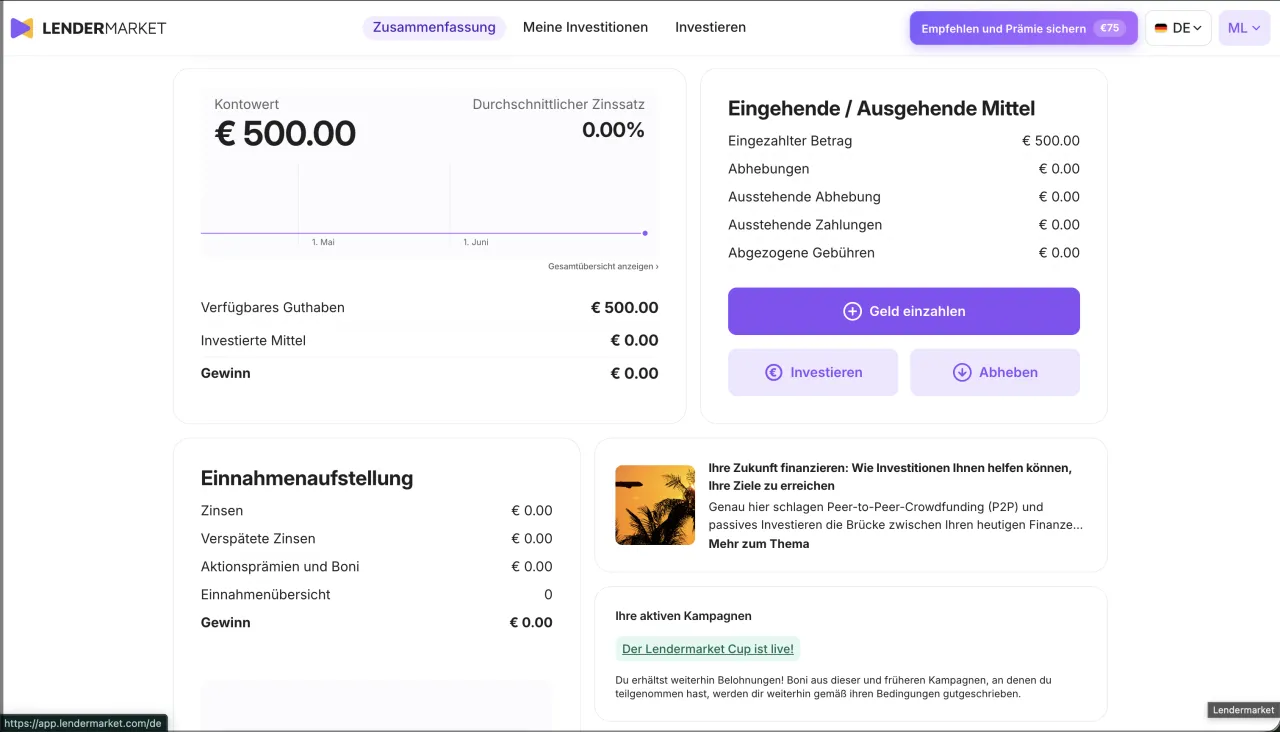
Lendermarket has held an ECSP licence from the Irish central bank since the end of 2024, which lets it operate across the EU. The target returns, with a weighted average around 13%, are among the higher ones in the comparison, entry is from €10 and new investors receive 1.5% cashback via our link.
To be honest, two points belong to the picture: Lendermarket works with a dual structure, a regulated crowdfunding service and a separate, unregulated claims service. And a large share of the originators belongs to the Creditstar group, which means a noticeable concentration risk. According to its own Risk Disclosure there is no deposit guarantee scheme and no investor compensation.
In practice you invest from €10 through an Auto Invest; there is no real secondary market, only the FLEX portfolios allow an early exit via an exit fee. The loans start at 30 days and you pay in by SEPA transfer or card. The first withdrawal per month is free and each further one costs €2.
Pros
- ECSP licence from the Central Bank of Ireland, with passporting across the EU
- High target return and low minimum investment from €10
- Early exits possible in the FLEX portfolios
Cons
- Concentration risk: most originators from the Creditstar group
- Dual structure of a regulated and an unregulated service
- No real secondary market, partly long lock-ups
Afranga: A clean ECSP structure without buyback
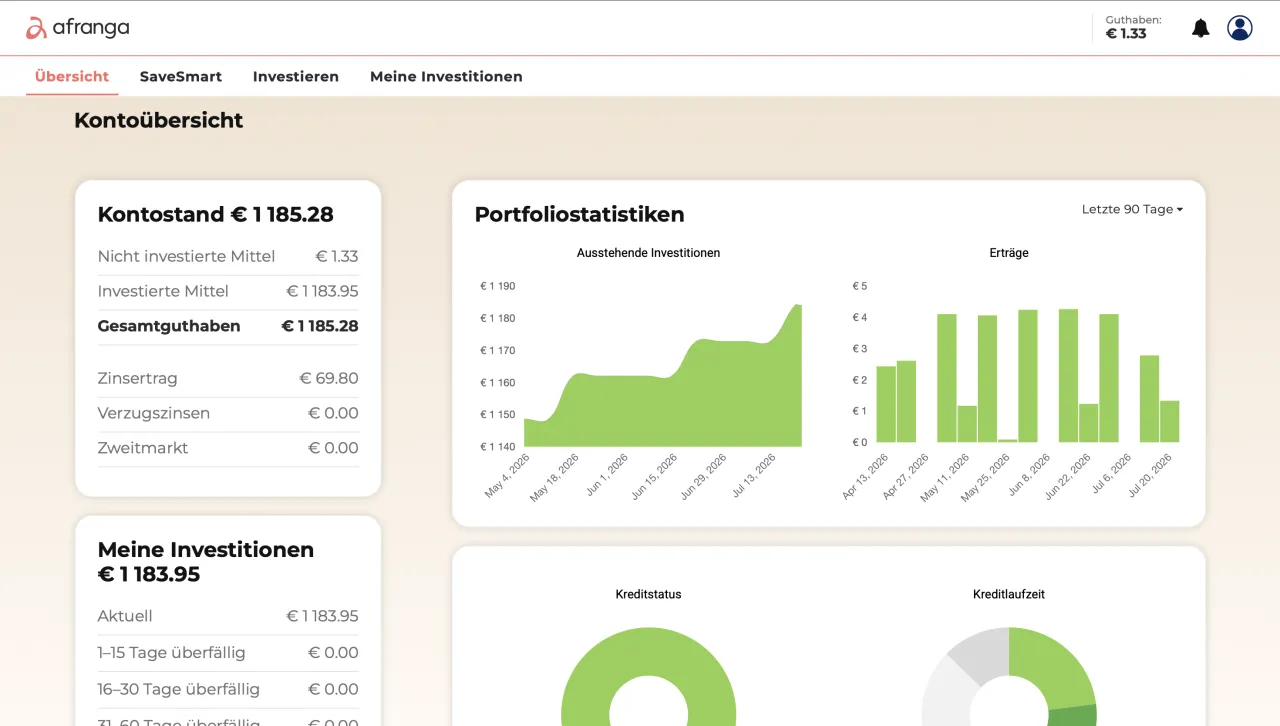
Afranga is a spin-off of the Bulgarian lender Stik-Credit and works with a clean ECSP structure supervised by the Bulgarian Financial Supervision Commission. Entry is from €10 and new investors receive 0.5% cashback via our link in the first 90 days.
The most important difference from many competitors: Afranga offers no buyback mechanism. The default risk therefore lies directly with the investor. On top of that, some of the lenders are close to the group, and the secondary market is not yet live. The ECSP licence brings standardised investor-protection rules, but no deposit guarantee scheme on the capital you invest.
Alongside the classic loan book, Afranga offers the SaveSmart fixed-rate product at 8 to 10% depending on term, and since 2026 also property loans. Terms run from 1 to 60 months. For the investor the platform is completely free of charge; you pay in only by bank transfer via the provider Lemonway, with no card payment option.
Pros
- ECSP licence supervised by the Bulgarian financial regulator
- The SaveSmart fixed-rate product as a plannable option
- Low minimum investment from €10
Cons
- No buyback, the default risk lies directly with the investor
- Some lenders close to the group
- No secondary market, Trustpilot rating still thin
Monefit SmartSaver: A flexible savings product, with the lender licensed
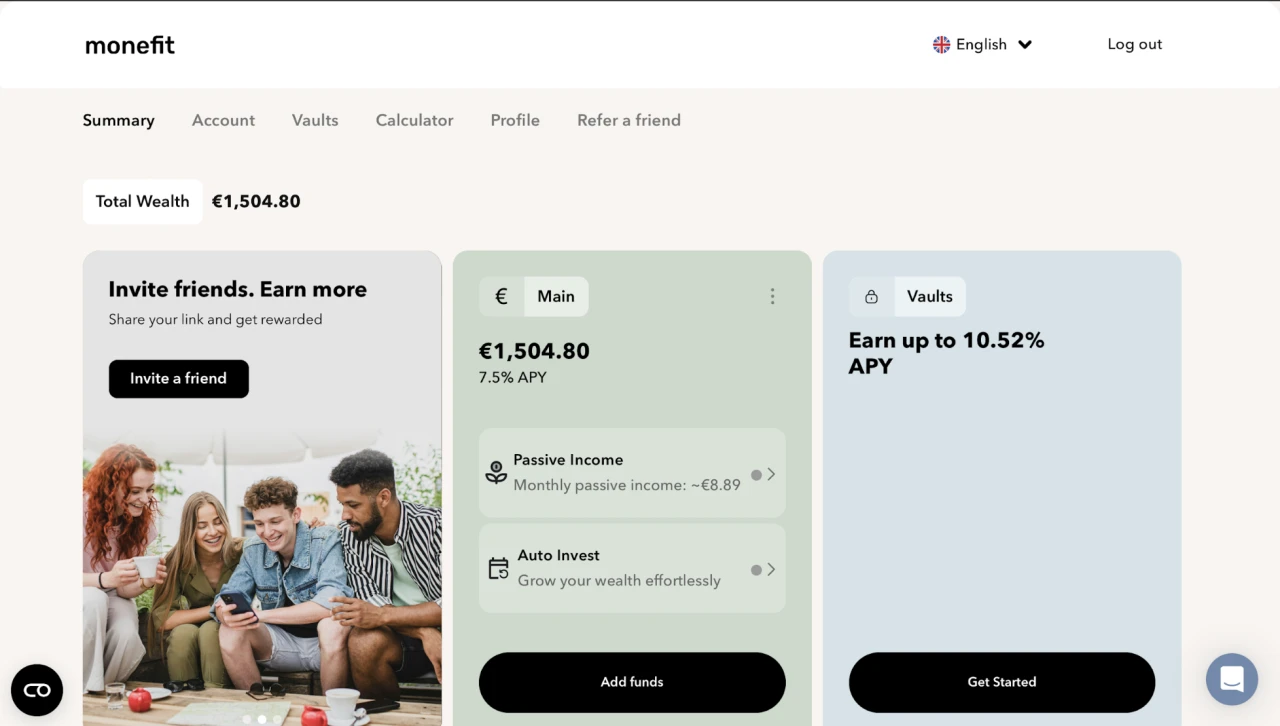
Monefit SmartSaver is less a classic P2P lending platform than a flexible savings product: the main account, with a target return of 7.5%, is available daily, and the fixed Vaults offer higher target values. With a 4.7 Monefit has the highest Trustpilot rating in the comparison and a large user base.
On regulation it is worth a close look: as with Bondora, the platform entity itself is not regulated, but behind it stands the Creditstar group as lender, licensed in eight countries. Your money flows into its consumer loan portfolio via an assignment of claims. There is no deposit guarantee scheme. On the plus side, the capital sits in a separate SmartSaver account. The rising debt load of the Creditstar group is worth keeping in mind. Returns are target values, not guaranteed interest.
The main account is possible from €10 and can be closed out daily; according to the provider, smaller amounts are available within minutes. Those who want a higher target return lock money into fixed Vaults of 12 to 24 months. SEPA deposits are free, card transactions cost 1% after the first seven days, and via our link there is 0.25% cashback on transfers. There is no dedicated app, Monefit runs in the browser.
Pros
- The highest Trustpilot rating in the comparison (4.7)
- A daily-available main account, very flexible
- Capital in a separate SmartSaver account
Cons
- The platform entity itself is not regulated (only the lender is licensed)
- Dependence on the Creditstar group (rising debt load)
- Vaults cannot be sold early
Digilo: An ECSP-licensed newcomer, property-secured, but still in pilot operation
Digilo is a young Latvian crowdlending platform for property-secured business loans, and as an ECSP-licensed platform it is supervised by the Latvian central bank (Latvijas Banka), with an EU-wide passport since June 2026. Investors give the loan directly to the borrowing company, each project is secured with a property lien (LTV of at most 60% per the provider) and managed via a security agent. Structurally this resembles the LANDE model.
The decisive point for assessing it is the early stage: Digilo has so far financed only four projects worth around €83,000, the first in June 2026, and not a single loan has matured yet. The disclosed default rate of zero percent therefore has no significance. There is expressly no buyback and no secondary market either, so your capital is locked until the end of the term of 12 to 36 months.
The terms: from €150 per project, a provider return expectation of 9 to 12% (11.44% realised on average so far across the four projects), no investor fees except €1 per withdrawal. Deposits and withdrawals run via a wallet at the payment provider Lemonway. There is no deposit guarantee scheme and no investor compensation. Digilo is regulatorily cleanly set up, but in the comparison it has a particularly low volume and a very short track record.
Pros
- ECSP-licensed (Latvijas Banka) with an EU-wide passport
- Each project secured with a property lien (LTV of at most 60% per the provider)
- Investor lends directly to the borrowing company (no risky intermediate construction)
- No investor fees except €1 per withdrawal
Cons
- Pilot operation: only 4 projects worth around €83,000, no loan matured yet
- No buyback and no secondary market, capital locked for 12 to 36 months
- No deposit guarantee scheme, operator profitability not disclosed
Indemo: MiFID-licensed, non-performing property loans from Spain
Indemo is a Latvian investment firm under MiFID II supervision by Latvijas Banka. Unlike classic P2P lending, Indemo sells shares in non-performing Spanish property loans, which a Spanish partner buys from banks at a high discount and recovers through foreclosure. There is no fixed interest rate and no monthly payment, but a payout at the end, whose amount and timing are both open.
The investor protection is narrower than the advertising suggests: the investor compensation of up to €20,000 covers only the case where Indemo itself does not return your money, not a poor recovery or falling property prices. The official KID classifies the product in risk class 6 of 7. There is no buyback, but with an already defaulted loan that is inherent to the system: the collateral is the property, not a promise by the platform.
You can start from €10, investing as well as deposits and withdrawals are free, only an inactive account costs €2.90 per month. The transparency stands out positively: Indemo discloses the audited annual accounts of the Spanish recovery firms, which is unusual in the sector. The operator, however, still works at a loss, and there is neither a secondary market nor an early exit, so your capital is locked for several years.
Pros
- A MiFID II investment firm supervised by Latvijas Banka
- Property as collateral instead of a buyback promise, unusually transparent
- Entry from €10, free investing and deposits/withdrawals
Cons
- No fixed rate, no monthly payment, payout only at the end of the recovery
- No liquidity: no secondary market, no early exit, capital locked for several years
- The operator works at a loss, risk class 6 of 7, focus only on Spain
Esketit: Unregulated, only for experienced investors
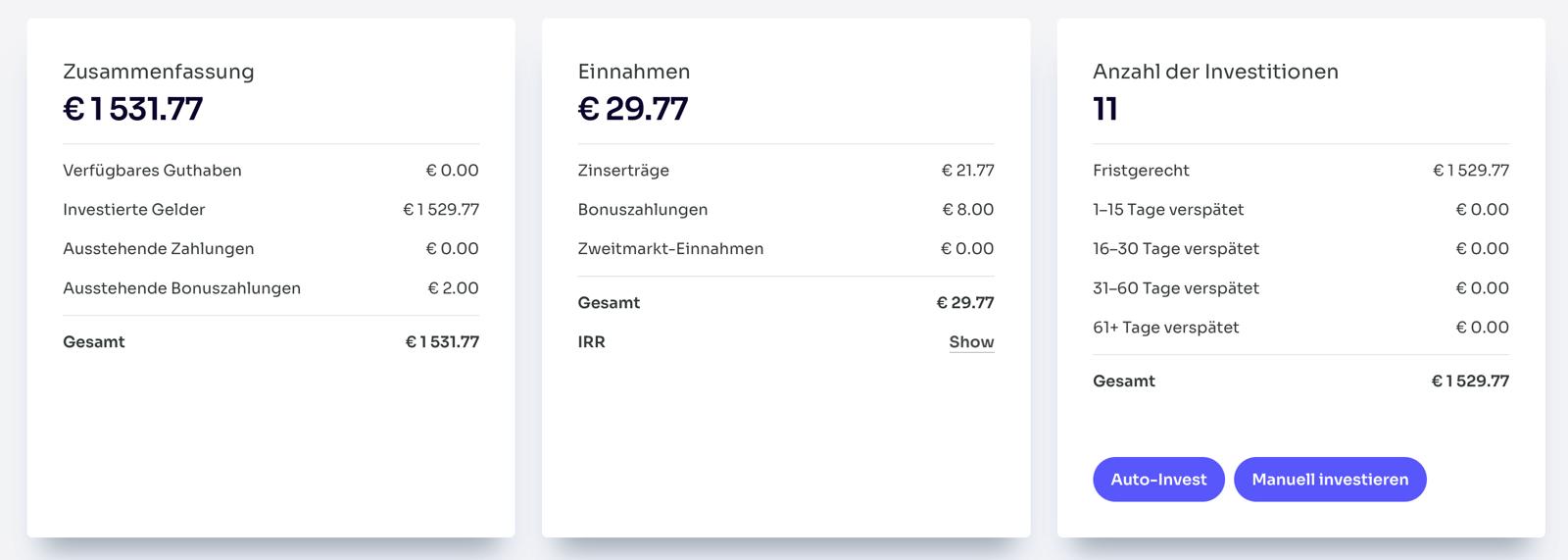
Esketit offers an attractive average return of around 11.8% and a buyback by the lenders. The platform is closely interlinked with its lenders and is backed by a strategic shareholder from the banking sector. Entry is from €10.
The decisive point for assessing it: according to its own footer, Esketit is not regulated by a financial services licence, though an ECSP licence has been applied for. The model is based on an assignment of claims. In addition, there was a change of registered office to Croatia in 2025, during which some funds were temporarily frozen. This platform is therefore better suited to experienced investors who can weigh the risk.
In practice you invest from €10, can use an Auto Invest and partly sell positions on the secondary market, which is however deactivated for one of the entities. The loans mostly run between 1 and 12 months. There are no platform fees and you pay in by transfer from a verified EU bank account.
Pros
- An attractive average return with buyback by the lenders
- A strategic shareholder from the banking sector
- Low minimum investment from €10
Cons
- No financial services licence (ECSP only applied for)
- Change of registered office in 2025 with funds temporarily frozen
- No regulatory investor protection
Loanch: High-interest consumer loans, unregulated and with self-dealing
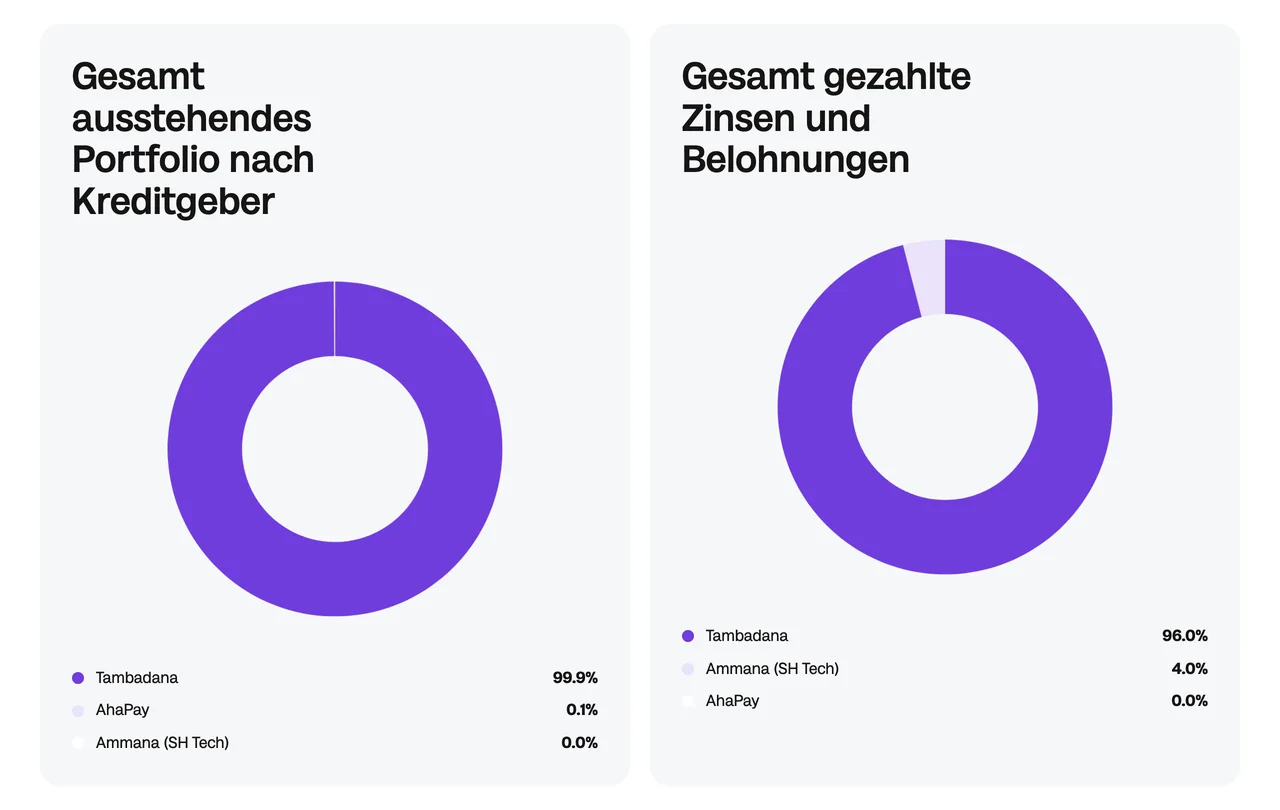
Loanch is a marketplace for assigned claims from consumer loans in Malaysia and Indonesia, operated by a Croatian company. It advertises up to 15.9% APR, its own statistics page quotes 14.75% average return, and the originator averages run at 11 to 13.82%. The protection comes via a buyback obligation of the respective lender, stated as 30 days in the marketing but as 60 days in the binding Risk Statement, and according to Loanch it does not apply to all offers.
The central point of criticism is the structure: Loanch is unregulated, there is no ECSP, MiFID or banking licence and no deposit guarantee scheme. The marketplace, all originators and the buyback guarantee belong to the same Fingular group, so there is no independent counterparty. The buyback guarantee is therefore worth only as much as this one group, and on top comes a strong concentration in one dominant originator.
In 2026 there was a real stress test: after the Polish regulator withdrew the payment provider's licence, deposits and withdrawals stood still for around three months. Buybacks have been served so far and there are no documented capital losses, but independent P2P reviewers expressly advise caution because of the structure and the lack of regulation. For us, Loanch is therefore at most a small, speculative add-on.
Pros
- High interest (up to 15.9% advertised, 14.75% average return per its own statistics)
- 30-day buyback by the originator, a low minimum investment (€10), no fees
- Buybacks served so far, no documented capital losses (provider figure)
Cons
- Unregulated, no deposit guarantee scheme, no financial supervision
- Self-dealing: the marketplace, originators and buyback belong to the Fingular group
- In 2026, around three months of a deposit/withdrawal freeze, strong concentration in one originator
Hive5: Unregulated, only for experienced investors
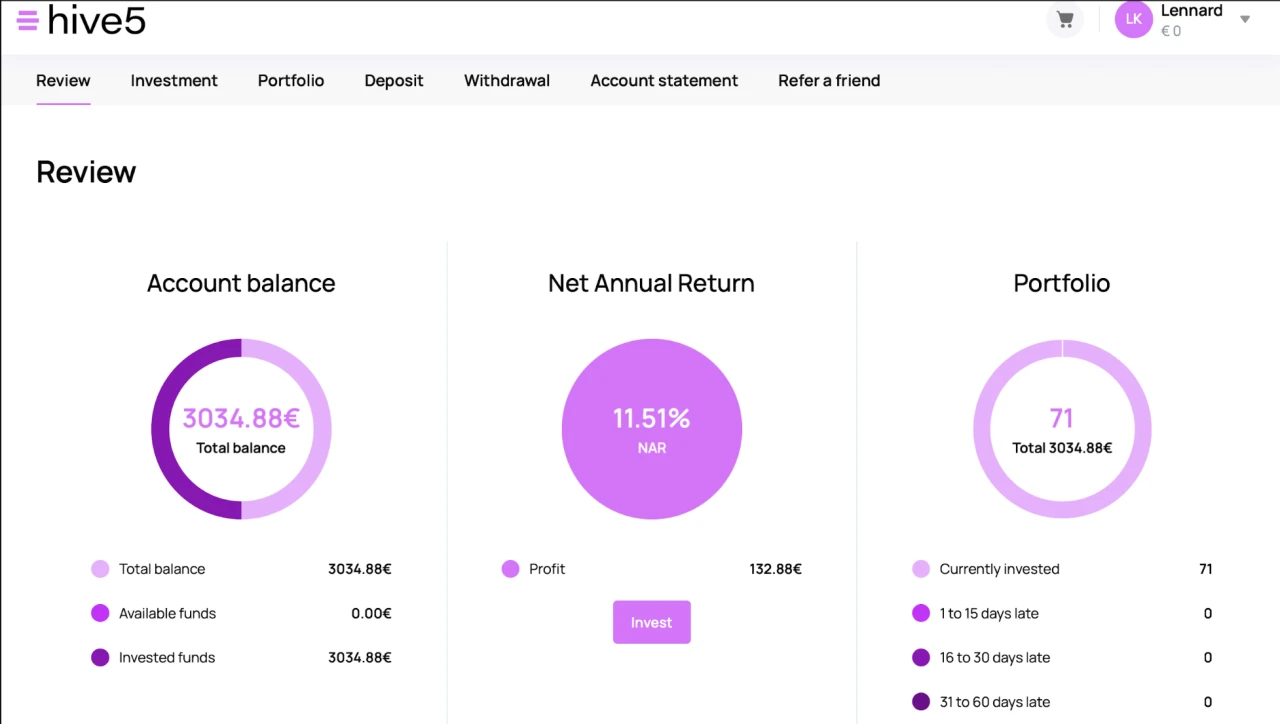
Hive5 draws investors with a high average return of around 12.5%, mostly short terms of 30 to 90 days (up to 24 months with the Linqo product) and a well-rated support. New investors receive 1% cashback via our link in the first 90 days, and a loyalty programme lifts the return further.
The platform holds no financial services licence and therefore falls into the high-risk category. On top of this comes a going-concern note in the 2024 accounts, with negative equity at operator level. The buyback promise comes from the originator and is not external protection. Hive5 is therefore suitable only for experienced investors willing to carry that risk consciously.
Typical of Hive5 are the short terms of 30 to 90 days, so capital often flows back quickly; with the Linqo product there are also terms of up to 24 months. You invest via Auto Invest, and a loyalty programme with the Navigator, Voyager and Pionier tiers lifts the return step by step. You pay in only by SEPA transfer, and Hive5 does not publish a fee schedule for investors.
Pros
- A high average return and short terms
- A good Trustpilot rating (4.4) and fast support
- Immediate repayment on some products
Cons
- No financial services licence (high risk)
- Going-concern note in 2024 with negative equity
- The buyback is an originator obligation, with no secondary market
Maclear: A Swiss provider with a high user rating
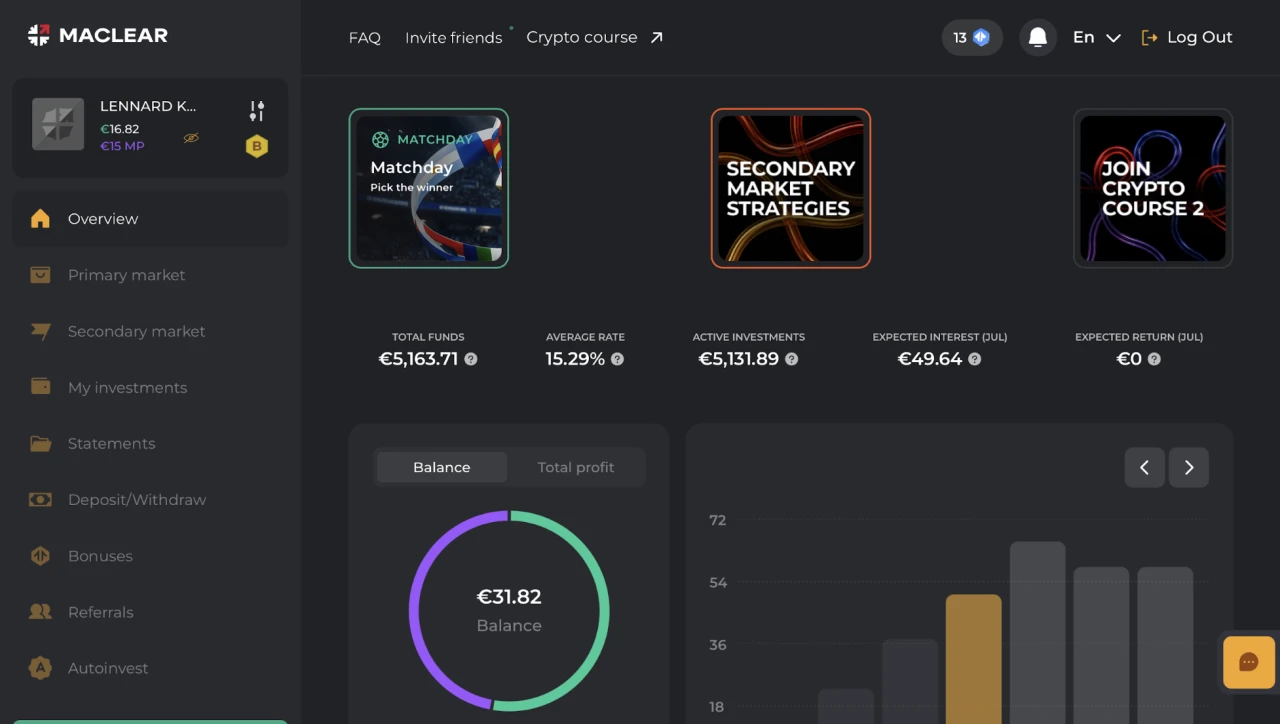
Maclear is a Swiss stock corporation and finances secured business loans to small and medium-sized companies in more than 15 countries. With a 4.6 it has one of the highest Trustpilot ratings in the comparison and the most extensive bonus stack, across cashback, welcome and loyalty bonus.
On regulation, precision matters: Maclear is a member of a Swiss self-regulatory organisation (PolyReg) and follows FINMA standards, but it is not FINMA-regulated and holds no EU, MiFID or ECSP licence. Instead of a classic buyback there is a segregated, externally audited reserve fund, plus the collateral on the projects. So far there has been only one default, fully recovered, which is a look back and not a guarantee.
You invest from €50 per project and the currently listed projects run for around 9 to 14 months. Since 2025 there has been an Auto Invest, and through the secondary market you can sell positions for a 2.5% fee, though with low liquidity. Deposits and withdrawals by bank transfer are free, and the bonus stack of cashback, welcome and loyalty bonus can be combined.
Pros
- Very high Trustpilot rating (4.6)
- Externally audited reserve fund plus secured projects
- Extensive, combinable bonus stack
Cons
- Only a Swiss SRO, no EU/MiFID/ECSP licence
- Higher minimum investment (€50 per project)
- Secondary market with a 2.5% fee and low liquidity
Lonvest: Small, unregulated platform from the Space Crew group
Lonvest is a small, unregulated P2P platform from Zagreb that launched in 2023 and belongs to the Ukrainian-rooted lending group Space Crew Finance. It collects euros from European investors and passes them on to three lenders from the same group in Malaysia, Singapore and Mexico. The average rate is 11.5% according to the platform, and investing is done exclusively via Auto Invest from €50 with terms of 1 to 12 months.
An important point for context: Lonvest has no licence and says so openly in its own FAQ. There is no deposit guarantee scheme and no investor compensation. The advertised 90-day buyback guarantee is, in the contract, only a right of the lender, and an obligation exists according to the terms only in the event of its insolvency. The additional group guarantee appears only in marketing and has no contractual text and no named guarantor. There is no secondary market, and an early exit costs all accrued interest.
On the plus side: over more than three years there is no documented late payout to investors, buybacks reportedly arrived on time according to the community, and client funds are contractually segregated. The friction tends to be around deposits and verification. Bottom line, Lonvest remains a high-yield addition for risk-aware investors whose underlying value rests entirely on three small lenders and an undisclosed group.
Pros
- Around 11.5% interest, entry from just €50
- No documented payout delay to investors since 2023
- No fees, client funds contractually segregated
Cons
- Unregulated, no licence and no deposit guarantee scheme
- Buyback only as a right of the lender, group guarantee without contractual text
- No secondary market, early exit only at the cost of all interest
Revest: Unregulated funding channel of a Kazakh lending group
Revest is the in-house funding channel of a Kazakh lending group. The platform is based in Croatia, collects euros from European investors and passes them on to lenders that belong to the same owner as the platform itself. It offers 13.5% on 25-day consumer loans and 14 to 16% on business loans with terms of 1 to 24 months, and investing is done exclusively via a portfolio automation from €10.
An important point for context: Revest is not regulated and states in its own footer that the operator is not authorised as an investment firm and does not provide investment services. There is no deposit guarantee scheme and no investor compensation. The real catch is the self-dealing: the platform, all three lenders, the buyback obligation and the collections belong to a single person. The business loans finance the group's own holding, so an independent counterparty is missing entirely.
On the plus side: Revest publishes an unusual amount of data, even the lenders' annual reports, and the short 25-day loans return capital quickly. But those very figures show the risk: the main lender GMoney had a default rate of almost 19% in 2024, and the reported profits stem largely from provision releases and currency gains, while the lenders operate at an operating loss. Bottom line, Revest is a highly speculative high-yield addition whose underlying value rests entirely on a group that is not independent.
Pros
- 13.5 to 16% interest, entry from just €10
- Secondary market at face value and very short 25-day consumer loans
- An unusual amount of published data, including lender reports
Cons
- Unregulated, no licence and no deposit guarantee scheme
- Self-dealing: one owner controls the platform, all lenders and the buyback
- Lenders operationally negative, GMoney default rate almost 19% in 2024, active only since December 2025
8lends: Crypto crowdlending without a licence, only for experienced investors
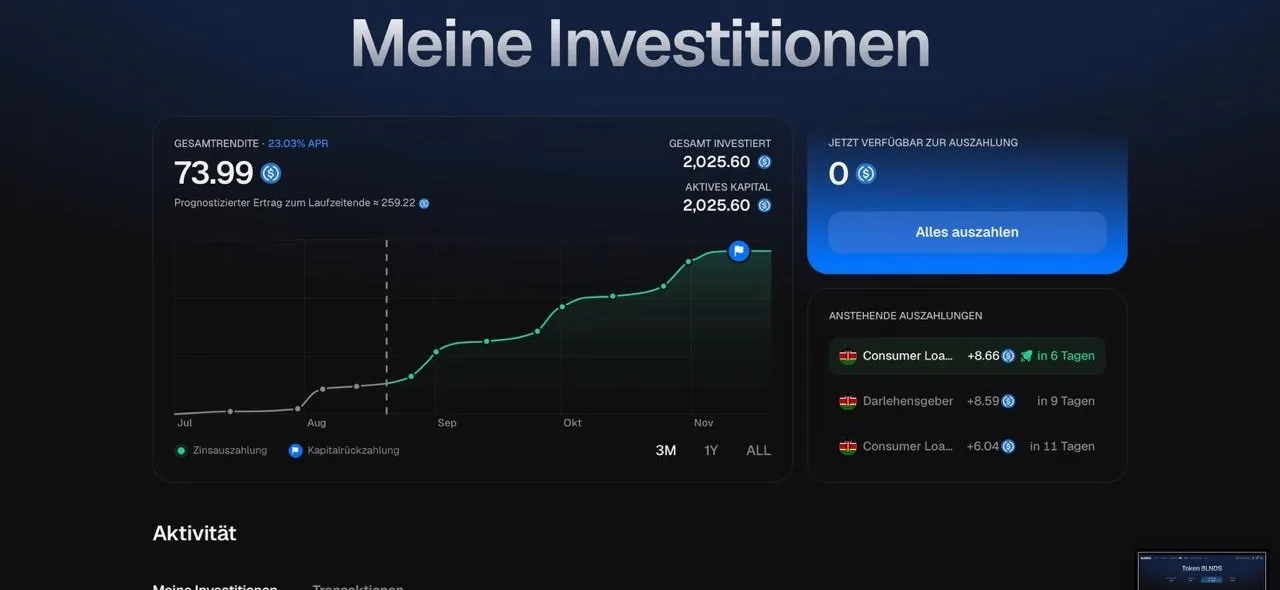
8lends is a crypto crowdlending platform. You invest only in the stablecoin USDC on the Base network via a self-custodied wallet; investing in euros is not possible. It finances business loans to small and medium-sized firms worldwide, with live-observed returns of around 22% and terms of 4 to 16 months.
The core of the risk is the lack of regulation: 8lends holds no ECSP, MiFID or banking licence, only AML registrations (FINTRAC in Canada, PolyReg SRO in Switzerland). There is no deposit guarantee scheme and no investor protection, and the total-loss risk is stated expressly in the T&Cs. The advertised 100% capital protection and the buyback commitment appear only in the marketing and have no basis in the binding T&Cs.
On top of this comes an inconsistent operator detail in its own documents (Canada per the T&Cs versus St Vincent per the glossary). The homepage statistics also show the figure for the entire corporate group, not that of 8lends alone (8lends only, most recently around 19.7m USD, as of 25.08.2026). For us, 8lends is at most a very small, speculative add-on for experienced crypto investors, not a building block for serious wealth-building.
Pros
- A high observed return (around 22% p.a.)
- Smart-contract audits from CertiK and CyberScope
- No platform fee for investors
Cons
- No financial licence, an offshore operator setup
- Inconsistent operator details in its own documents
- Buyback and 100% capital protection only in the marketing, not in the T&Cs
- Added crypto risk plus an illiquid reward token (8LNDS)
Licence types, explained
Not every licence is worth the same. This overview shows what each licence type gives you as an investor and what it expressly does not protect.
| Licence type | What it gives you | What it does not protect |
|---|---|---|
| ECSP (EU 2020/1503) | EU-wide standardised investor protection with information and due-diligence obligations, the crowdlending gold standard | No deposit guarantee scheme, the capital you commit remains at risk |
| MiFID II investment firm | EU investor compensation up to €20,000 for certain breaches of duty | Does not apply to a normal loan default |
| Full banking licence | Deposit guarantee scheme up to €100,000 on cash held in the account | Not on capital invested in loans |
| National licence (e.g. EFSA) | National supervision over the company | Check the scope and passporting case by case |
| Swiss SRO | Self-regulation to FINMA standards in the non-banking sector | No EU licence, no EU investor protection |
| No licence | No regulatory protection | Highest risk, only for experienced investors |
Who owes you the money?
The decisive question in crowdlending is rarely the return, but the counterparty. On some platforms you lend directly to a project, on others you buy a loan that the platform assigns to you. Depending on the model, your capital depends on the solvency of the end borrower, the lender or the platform itself. That is exactly what determines what happens when something goes wrong.
How to check a platform yourself
- Does the licence appear in the ESMA register of crowdfunding service providers or in your national supervisor's register?
- Does the licence match the actual activity, or is only a parent company regulated?
- Who is the contractual counterparty: the platform, a lender or a special purpose vehicle (SPV)?
- How does the buyback work, and who stands behind it if a lender defaults?
- Is there a secondary market, and how quickly do you get your money back if you need it?
Crowdlending platforms we do not recommend
Not every platform with high interest deserves a place in your portfolio. Here we collect documented cases where we advise against investing, and the warning signs behind them. The list is deliberately short: we only mention cases that are officially on record.
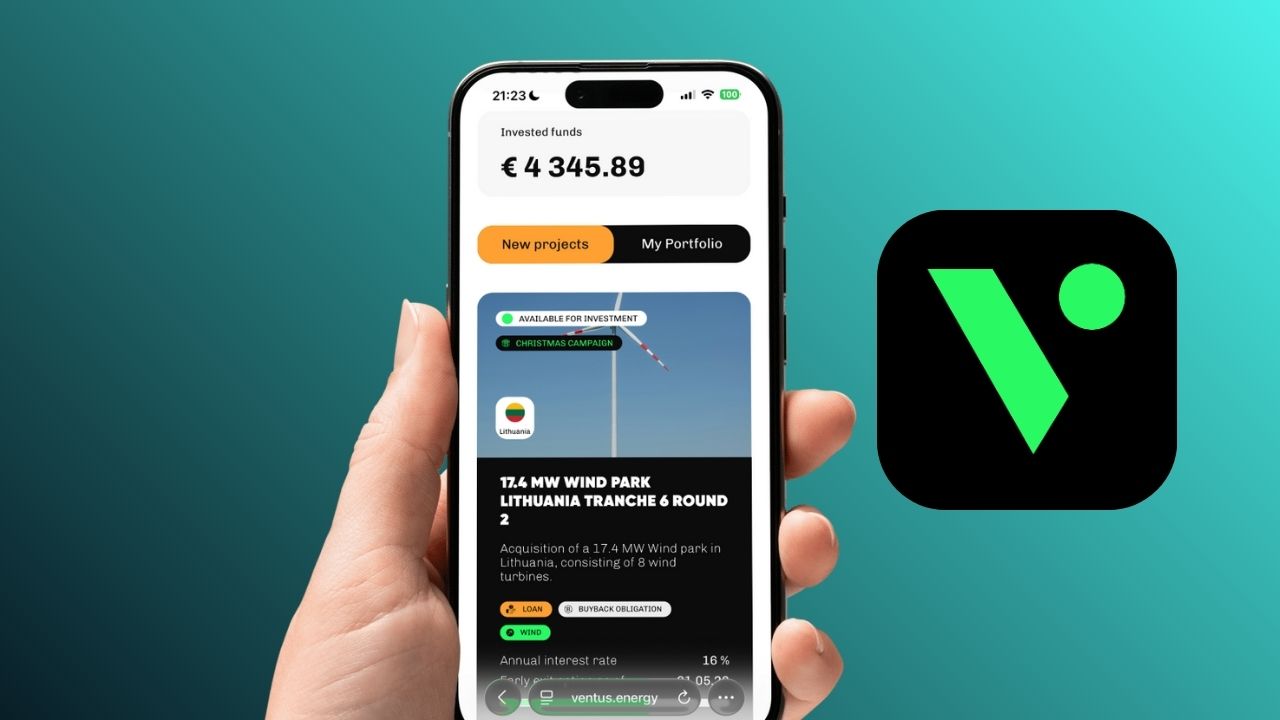
Ventus Energy
🇪🇪 EstoniaNot recommendedWhat happened: In May 2026 the German financial regulator (BaFin) prohibited Ventus Energy Group from taking deposits without authorisation and ordered the immediate repayment of investor money. The payment provider Paysera then blocked withdrawals, and investors could not access their money for a time.
The trigger was the contractual construction: under the contract, investors granted a direct loan to the platform itself, with fixed interest and fixed repayment, and partly with re-lending within the group. The regulator classified this as deposit-taking requiring authorisation under the German banking act (KWG), for which Ventus held no banking licence.
Our takeaway: The case shows two things: the country of domicile does not protect you (Ventus operated from Estonia and the regulator still acted, because it expressly targeted foreign investors), and a contract in which the platform itself is your debtor is a warning sign. As an investor, always check the licence in the ESMA register and with the national regulator. We only include platforms in the comparison whose model and licence we can understand.
Crowdlending FAQ
Crowdlending (P2P or peer-to-peer loans) are loans brokered via an online platform directly between investors and borrowers, without a classic bank granting the credit. As an investor you buy shares in these loans and earn interest, but you carry the default risk. In this comparison we look at crowdlending from the investor's point of view, that is, as a form of investment and not as a way to take out a loan of your own.
In our comparison Mintos is the strongest all-rounder, because as a licensed MiFID II investment firm it combines a broad offering with wide diversification. But the right platform depends on your goal: beginners often start with Go & Grow from €1, and those who look at user ratings find high ones at Maclear and Monefit.
An EU financial licence is held in our comparison by Mintos and Debitum (MiFID II, Latvia), as well as Lendermarket (ECSP, Ireland), Afranga (ECSP, Bulgaria), LANDE and Digilo (ECSP, Latvia) and Indemo (MiFID II, Latvia). Maclear is supervised via a Swiss self-regulation. With Go & Grow and Monefit it is not the platform itself that is regulated, but the parent or lender company. Esketit, Hive5, 8lends and Loanch hold no financial services licence of their own.
Crowdlending is not a savings account. There is no deposit guarantee scheme, and a partial or total loss is possible. A financial licence lowers the risk through supervision and obligations, but does not protect against the default of individual loans. Those who spread the risk, start small and rely on regulated platforms can limit it, but not rule it out.
ECSP stands for European Crowdfunding Service Provider, EU Regulation 2020/1503. It sets uniform rules for crowdlending, such as information sheets, a suitability test and a reflection period. It is regarded as the gold standard for regulating crowdlending platforms, but it does not replace a deposit guarantee scheme.
No. Capital invested in loans is not covered by the deposit guarantee scheme of up to €100,000. That guarantee only covers cash deposited at a bank with a banking licence. In crowdlending you carry the default risk of the loans yourself.
Yes, investing in crowdlending as an investor is legal across the EU. The platforms are usually based in the EU and for crowdlending they generally need an ECSP licence; investors living in the EU can invest freely. Interest income is taxable, and the exact rules depend on your country of residence. There is no state deposit guarantee scheme as there is on a bank account.
It depends on your goal. Go & Grow is simpler, starts from €1 and is capped at a maximum of 6%, which can suit beginners. Mintos offers more choice, higher possible returns and a MiFID licence, but demands more learning and at least €50. Those who want maximum simplicity find it sooner with Go & Grow; those who want to diversify more and steer things themselves, with Mintos.
Interest income from crowdlending is generally taxable. Many platforms do not withhold tax at source, so you usually have to declare the interest yourself in your tax return. The exact treatment depends on your country of residence. This is not tax advice; if in doubt, a tax adviser can help.
Crowdlending is among the higher-risk investments. In the community it is often mentioned to commit only a small part of your total wealth, the part you could absorb losing, and to diversify broadly across several platforms and lenders. This is not investment advice, but a general orientation.
A buyback guarantee means that the lender buys back a defaulted loan after a certain period in arrears, often after 60 days. Important: this is an obligation of the lender, not external insurance. If the lender itself fails, the guarantee can come to nothing.
It makes sense to start small on a regulated platform, activate a broad Auto Invest diversification and increase gradually once you know how it works. Pay attention to the licence, the buyback conditions, the fees and the key question: who actually owes you the money.
* Historical return, not guaranteed.
More reviews and comparisons
Legal information
The content on this site has been researched carefully. Our sources are the providers' publicly available information and their terms and conditions. Despite regular checks we cannot warrant that the data is current, accurate or complete. Binding information on products and prices is only available on each provider's own website. Unless stated otherwise, the conditions shown apply to new customers.
Not financial advice
Our content is informational and comparative only. It is not financial, tax or legal advice, and it is neither a recommendation to buy nor an invitation to take out a financial product. Make your decisions based on your own situation and risk tolerance, and consult an independent adviser if you need one.
Risk warning
Every investment carries risk. Values can rise or fall, and past performance does not indicate future returns. You can lose part or all of the capital you invest. Crypto-assets are largely unregulated, are not covered by deposit guarantee or investor compensation schemes, and carry a high risk of total loss.
Advertising and affiliate links
Some links on this site are marked with an asterisk (*) and are affiliate links (advertising). If you take out a product through one of these links, we receive a commission from the provider at no additional cost to you. That is how you support our work.