Digilo is a Latvian crowdlending platform where you fund loans to companies, each backed by real estate according to Digilo. The listed projects pay 9% to 12% interest a year, the operator holds an ECSP licence, and one loan has been repaid in full. The track record is short: eight funded projects. Capital is at risk, no deposit guarantee applies, and Digilo offers no secondary market.
Digilo Review: The Short Answer
Digilo is a Latvian crowdlending platform. You lend money to companies, and according to Digilo's FAQ and clause 4.6 every project is backed by real estate. The funded projects pay 9% to 12% interest a year, and the minimum per loan is €150. That part is straightforward.
The harder part is the track record. On 4 November 2026 the platform showed eight funded projects, a funded total of €152,142.86 and one loan repaid in full. The project list adds up to less, as shown below. A total loss is possible. No deposit guarantee applies, and Digilo offers no secondary market, so you may not be able to sell a loan before it ends.
Here is our short read, point by point.
- •Structure: your loan agreement is with the borrowing company, not with Digilo. Clause 4.4 of the Terms says Digilo and its Collateral Agent are not parties to it.
- •Licence: Latvijas Banka lists the operator, CSP Growth Solutions SIA, under licence 27-10/2025/222, valid from 16 September 2025.
- •Returns: the funded projects pay 9% to 12%. The statistics page shows an average of 11.03% under the label 'Average annual return'. We read it as an average borrower rate, not as what investors earned.
- •Collateral: the eight funded projects show a loan-to-value (LTV) of 9% to 50%. One open project shows 100%, which does not match the 60% ceiling in Digilo's FAQ.
- •Liquidity: Digilo offers no secondary market, and Digilo and its Collateral Agent give no repurchase guarantee. Plan for the full term.
- •Track record: short. One repaid loan, no default shown, and a very small sample.
We have invested in Digilo ourselves since September 2026. We share no amounts here. That is our experience, not a recommendation, and it changes none of the risks below.
Each loan starts at €150, and Digilo says each one carries real estate collateral. Losses are possible, and no deposit guarantee exists.
The Digilo Review on Video
Our video covers the same ground on camera. Several of its numbers have moved since we recorded it.
Where this article updates the video
- •Platform numbers are newer. The video names five projects, about €109,000 and 220+ users. The statistics page now shows eight projects, €152,142.86 and 266 investors.
- •The first loan is repaid. The video says none had been repaid yet.
- •The video quotes a maximum LTV of 60%. One open project now shows 100%.
- •The video says the mortgage always ranks first, citing Digilo. We found no such wording on any public Digilo page, in the Terms or in the risk warnings. The section on collateral returns to this.
- •The video says the platform is open across the EEA. The Latvijas Banka register lists the freedom to provide services in 26 EU countries, and the Terms (clause 3.3) let residents of any EEA state register.
- •The video says '1 euro per withdrawal'. Clause 10.6 says a commission of 1 EUR 'may automatically be deducted'.
- •The video says new investors get a four-day cooling-off period. Clause 7.12 grants it to inexperienced investors only, and clause 13.11 (13.12 in the German version) excludes loans made through Auto-Invest.
- •The video mentions a cashback offer. Digilo's campaigns page lists a 3% cashback for a partner code, but we cannot tie it to our link, so this article names no bonus.
Who Owes You the Money
In P2P lending, this question decides most of the risk. At Digilo, the answer is written into the Terms.
The borrower owes you. Clause 2.13 defines the loan agreement as a contract between an investor and a borrower. Clause 4.4 adds that Digilo and the Collateral Agent are not parties to it but perform administrative functions. Your claim runs against the company that borrowed, not against the platform.
A separate agent holds the security. The Collateral Agent is CSP Assets SIA. It acts 'in its own name but in the interests of the Investors' (clause 2.16), and the collateral is secured in its name (clause 11.1). It follows Digilo's instructions (clause 11.2). Your name does not appear in the land register. The agent structure adds one more party between you and the property.
Your cash sits in a payment wallet. Registration creates a Lemonway wallet automatically (clause 3.5). Deposits must come from a bank account in your own name. Clause 10.3 says no interest is paid on wallet funds. Clause 10.4 deserves a careful read. You assume the risk of losing funds held there if the payment or credit institution fails, and you waive claims against Digilo for that loss.
If Digilo itself is wound up, clause 15.2 says users' financial assets in separate accounts are isolated from Digilo's and are not affected by the liquidation. Digilo's rights and obligations may be sold or assumed to keep contracts running, and the collateral continues to be managed. Overall, the structure is transparent on paper. In practice we know of no platform failure that has tested it, and we cannot test it either. On platforms where a lender group stands behind the loans, the question looks different. Our Lendermarket safety check shows that case.
The Licence and What It Gives You
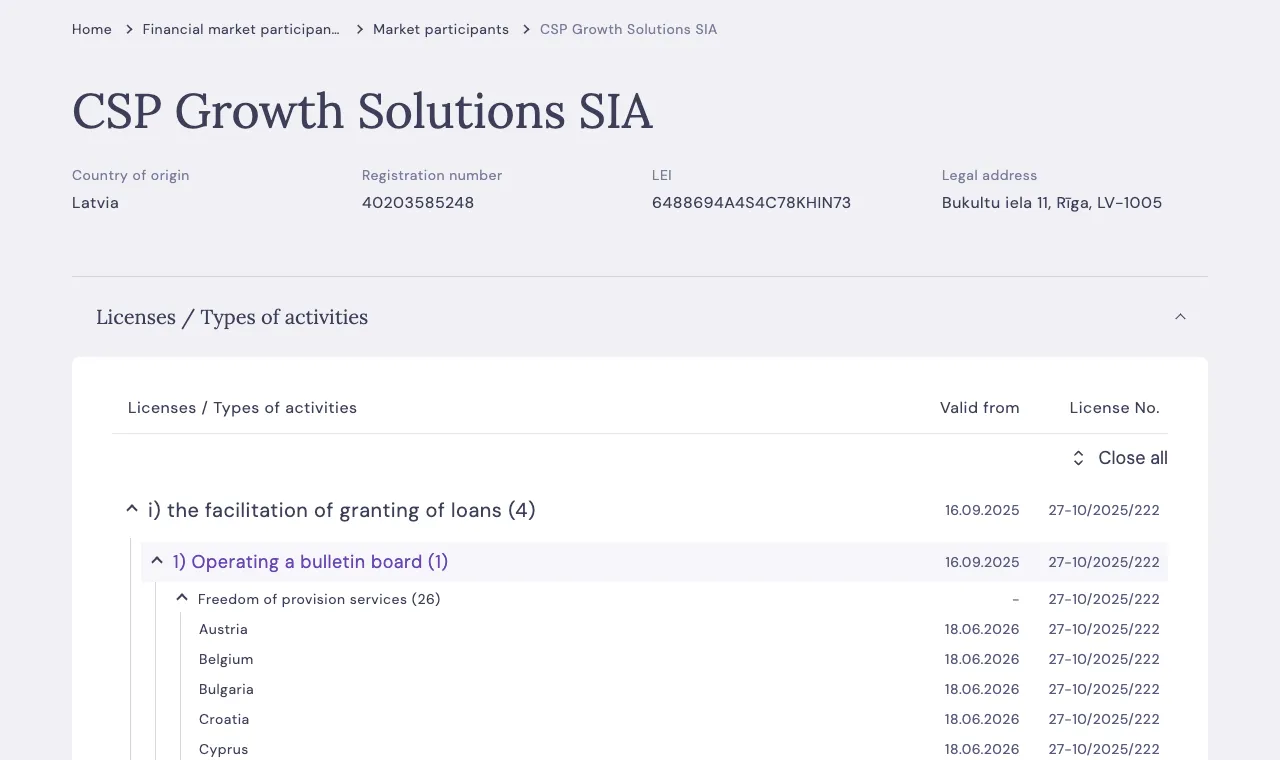
The operator of Digilo is CSP Growth Solutions SIA in Riga. The Latvijas Banka register lists it under licence 27-10/2025/222, valid from 16 September 2025. The activity is 'the facilitation of granting of loans', with four sub-activities. One is operating a bulletin board. The register also lists price or interest suggestions, credit assessment and portfolio management.
The same entry shows the freedom to provide services in 26 EU countries, each dated 18 June 2026. Spain, Germany, France, Italy, the Netherlands and Ireland are on the list. Iceland, Liechtenstein and Norway are not.
This is a licence under the EU crowdfunding rules, Regulation (EU) 2020/1503. The Terms refer to that regulation for the investor classification, the suitability test and the cooling-off right. What does the licence give you? It means a supervised operator. Clause 14.4 points to Digilo's published complaint policy and to the Bank of Latvia as the supervisory authority.
What it does not give you is protection against losses. Clause 1.11 says the investments are not covered by deposit guarantee systems under Directive 2014/49/EU or by investor compensation schemes under Directive 97/9/EC. The licence is a framework, not a promise that borrowers repay.
One thing to flag: the licence is recent. It dates from 16 September 2025, so the supervision has a short history too.
Latvijas Banka lists the operator. A licence sets rules for the platform and does not guarantee repayment.
Returns, Minimum Amount and Fees
The table lists the terms we could confirm from the platform and the Terms on 4 November 2026.
The 9% to 12% range comes from the project list. The funded projects carry rates of 9%, 10%, 11% and 12%. Digilo's statistics page shows an average of 11.03% under the label 'Average annual return'. Our reading is that this is the average interest rate of the funded loans. It is not a figure for what investors earned, and it is not a promise. We could not reproduce 11.03% exactly from the project list. If a borrower defaults, your return can be far lower.
The minimum per loan is €150 (clause 7.5). Auto-Invest starts at €150 for the Set & Forget plan and €300 for Select & Maximize (clause 13.4).
The fee picture is lean, with one caveat. Clause 8.1 says the borrower pays the platform's fees, and clause 8.2 says investors pay nothing for Digilo's services. Clause 8.2 also lets Digilo pass on Lemonway fees if its Price List names them, and we found no public price list. Clause 10.6 says a commission of 1 EUR may be deducted when you withdraw from the wallet. We saw no hidden investor fee, but the Price List is the document to read before you deposit.
Taxes are your own job. Digilo does not document any withholding tax treatment that we could find. The Terms leave tax to the user (clause 5.2), so you declare the interest in your country of residence. We make no claim either way.
Term | What we confirmed | |
|---|---|---|
| Interest on funded loans | 9% to 12% a year | Project interest rates, not a platform promise |
| Minimum per loan | €150 | Clause 7.5; Auto-Invest from €150 or €300 |
| Terms of listed projects | 24 or 36 months | All nine listed projects are in Latvia |
| Investor fees | No regular fee named; €1 per withdrawal may be deducted | Clauses 8.2 and 10.6; Price List not found |
| Deposit guarantee | None | Clause 1.11 |
| Interest on wallet cash | None unless otherwise agreed | Clause 10.3 |
Tip: scroll horizontally to see all columns
Collateral: From 9% to 100% Loan-to-Value
Clause 4.6 says offers are posted only if they are secured by real estate. That is the heart of the pitch, and it works well as a rule. The numbers on the project pages decide how much it protects you.
LTV is the loan amount divided by the collateral value. A loan of €60,000 against a €100,000 property has an LTV of 60%. A lower LTV leaves a bigger buffer if the property sells for less than expected.
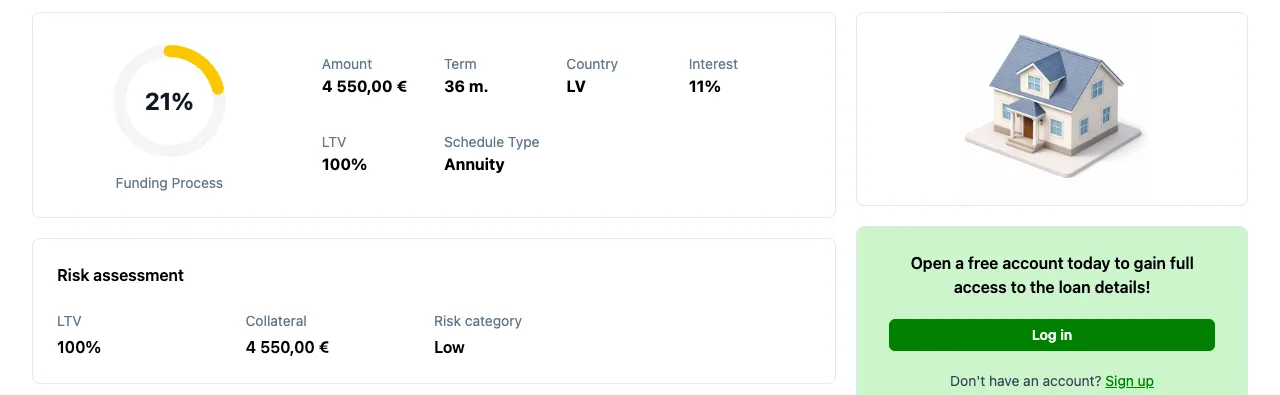
The eight funded projects show LTVs of 9%, 19%, 21%, 37%, 39%, 39%, 45% and 50%. That is a wide spread. The open project we saw on 4 November 2026 is different. It asks for €4,550 at 11% over 36 months. Its LTV is 100%, and the collateral is listed at €4,550. The page still labels the risk 'Low'.
Digilo's investor FAQ says LTV does not exceed 60%. Its borrower FAQ and a November 2025 blog post say the same. A 100% project does not match that sentence, and we found no explanation on the public pages. Clause 4.7.9 adds that Digilo is not liable for changes in collateral value or for how the LTV moves.
The rank of the mortgage is unconfirmed. The video says the mortgage always ranks first, citing Digilo. A first-rank mortgage means no other creditor sits ahead of the investors in the land register. We searched the public Digilo pages, the Terms and the risk warnings and found no such wording. Digilo told us in a private message that the mortgage is always first rank. That is a provider statement made to us, not a published document. Project documents sit behind the login, and we saw no investor information sheet on the public pages. Until you see the rank in the project documents, treat it as an open question.
Project size matters too. These are small loans. The open project asks for €4,550, and the largest funded one is €26,000.
The Track Record Today
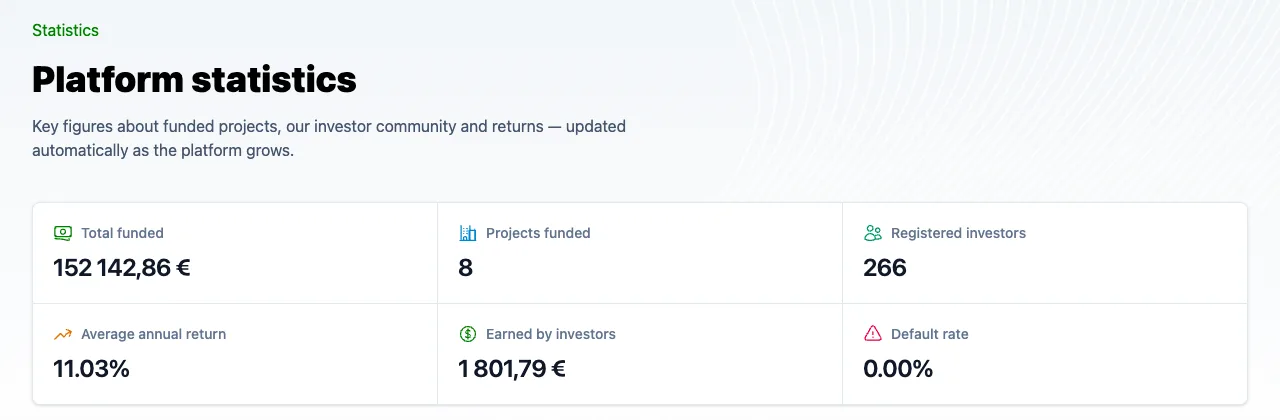
The statistics page is public and updates hourly. When we checked on 4 November 2026 it showed these figures: €152,142.86 funded, eight projects, 266 investors, an average annual return of 11.03%, €1,801.79 earned by investors and a default rate of 0.00%.
The €1,801.79 equals about 1.2% of the funded total. That fits a young platform where most loans are only months old. We read the 0.00% default rate as no recorded defaults, but we found no definition of the term on the page, and with one repaid loan the sample proves little.
One gap is worth knowing. The eight funded projects in the list add up to €135,465.05. The page shows €152,142.86 as the total funded, which is €16,677.81 more. By our arithmetic the difference sits in the August row of the monthly table, and we found no explanation on the public pages. We do not claim a mistake. We only note that the project list and the total do not reconcile with each other.
On top of that, the team behind the platform describes a longer history. Digilo says it builds on related and associated companies, and states 'zero capital loss in our own lending operations'. Those are the provider's own statements, and the page does not tie them to this platform. A group's history is not this platform's track record, and we do not count it as one.
Young platform, small sample. Check the numbers yourself before you commit money.
The Nine Listed Projects
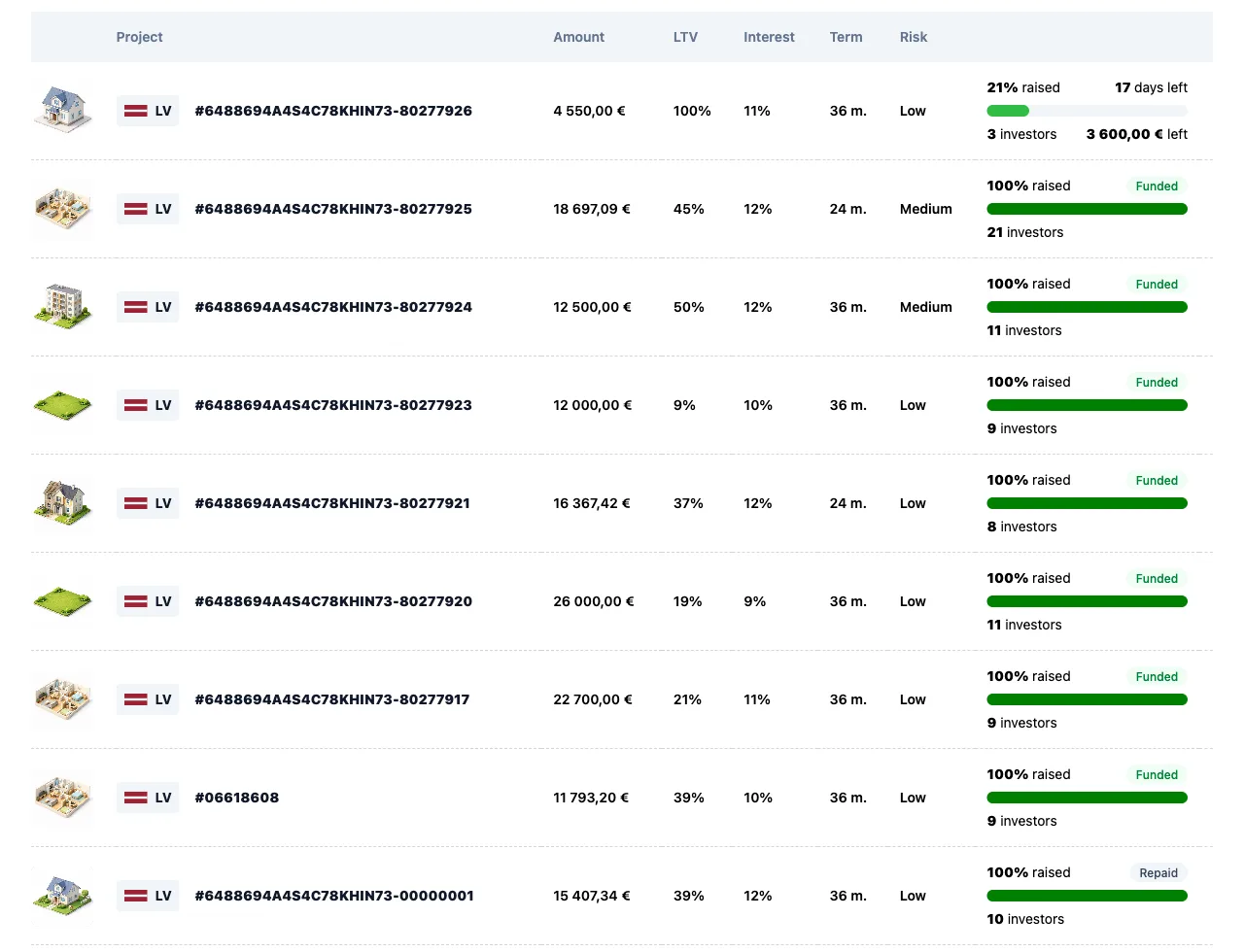
The public loan list shows nine projects, all in Latvia. One is open and eight are funded, one of them repaid. The list shows what the platform has actually done so far.
Funded loans range from €11,793.20 to €26,000. Each one drew between 8 and 21 investors. Terms are 24 or 36 months, interest runs from 9% to 12%, and the risk label is 'Low' or 'Medium'. The two projects labelled 'Medium' have LTVs of 45% and 50%.
What stands out is the pattern. Eight funded projects stay at an LTV of 50% or lower. The one open project sits at the top and breaks that pattern with its 100% LTV, as the collateral section above explains. Borrower names sit behind the login.
The First Loan Is Repaid
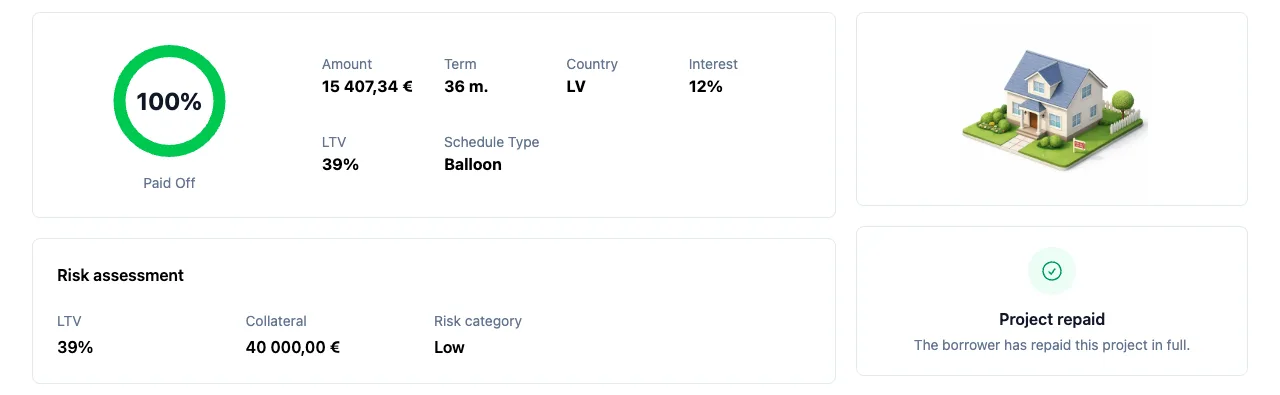
The first project on the platform, number 00000001, is now marked 'Paid Off'. The page says the borrower has repaid the project in full. The loan was €15,407.34 at 12% for 36 months, with an LTV of 39%.
The public schedule shows small instalments on 15 July, 15 August and 15 September 2026. A last row on 17 September 2026 shows €15,112.90 of capital. By our reading, the borrower repaid within the first months of a 36-month term. The page does not use the word 'early', and it gives no reason. The borrower's name and the loan documents sit behind the login.
This is the first real data point, and it is a good one. A project completed, and the page says the borrower repaid it in full. One loan is still one loan, though. Early repayment also ends the interest. Your money then needs a new project, and that depends on what is open that week.
The video says no project had been repaid yet. That is out of date now.
Liquidity: Digilo Offers No Secondary Market
Digilo offers no secondary market. The risk warnings say the message board is not a secondary market and that you may not be able to sell or end a loan early. Clause 7.10 lets an investor transfer rights only with Digilo's prior written agreement.
Clause 4.3.6 lists loan repurchase guarantees among the services Digilo and the Collateral Agent do not provide. They give no guarantee for the loans. Digilo points to the collateral as the protection, and the collateral section shows what we could and could not verify about it.
Clause 7.6 says a loan agreement cannot be cancelled unilaterally, except in special circumstances. For you, that means the money is locked for the term, which is 24 or 36 months on the listed projects. Only put in money you will not need before then. Our Mintos safety check shows how another platform handles protection and early exits, in case you want a point of comparison.
Delays are covered too. Clause 12.3 gives borrowers a grace period of five days on payments. If debt collection is needed, clause 12.11 transfers your claim to the Collateral Agent, and clause 12.13 lists the enforcement steps. We cannot say how long enforcement would take, because the platform shows no default yet.
Funded projects arrive in batches, three in October 2026 and none so far in November. A new deposit can therefore wait in the wallet, where it earns nothing under clause 10.3 unless otherwise agreed.
How to Start With Digilo
The sign-up path is simple enough to follow without help.
- •Register. The Terms (clause 3.3) allow residents of any EEA state, and the register entry lists 26 EU countries for cross-border service.
- •Verify and answer the tests. Digilo checks your identity and runs a suitability test. The result classifies you as experienced or inexperienced under Regulation 2020/1503.
- •Fund the wallet. Your Lemonway wallet is created at registration. Transfer from a bank account in your own name only.
- •Choose a project or a plan. You can pick projects by hand or set up Auto-Invest. The minimum per loan is €150.
One thing deserves a pause before step 4. The four-calendar-day cooling-off period (clause 7.12) is for inexperienced investors. It does not apply to loans made through Auto-Invest (clause 13.11, or 13.12 in the German version). Only loans you pick by hand carry that safety net. Our lists of beginner mistakes on Mintos and Lendermarket are a useful checklist for any P2P start.
The Terms are long, and the English version has some numbering slips. The German version is cleaner. The English version prints the collateral clauses 11.3 to 11.6 as 10.3 to 10.6, so those numbers appear twice. We cite the first ones, the wallet clauses. Read the clauses on the wallet (10.3 and 10.4), fees (8 and 10.6) and liquidation (15.2) before you deposit.
What Supports Trust and What Does Not
This summary sets the supporting points against the weak ones, and every point rests on a section above.
What supports trust
- Operator listed in the Latvijas Banka register under ECSP licence 27-10/2025/222
- Loan agreement runs between you and the borrower, not the platform (clause 4.4)
- Funded projects show an LTV of 9% to 50%
- First project repaid in full, and the page says so
- Investors pay no platform fee under clause 8.2, and clause 10.6 allows a 1 EUR withdrawal commission only as a possible deduction
- Risk warnings are public and name the lack of a secondary market
What weakens it
- One open project shows an LTV of 100%, against a 60% ceiling in Digilo's FAQ
- Mortgage rank is not stated on any public page we read
- Eight funded projects, so the track record is very short
- The sum of the listed projects is €16,677.81 below the funded total
- Digilo offers no secondary market, and neither Digilo nor the Collateral Agent gives a buyback guarantee, while no deposit guarantee applies
- Wallet risk sits with the investor under clause 10.4
In short, the supporting points describe structure and disclosure. Digilo scores well on both. The weak points describe evidence. Eight projects cannot show how the collateral works in a default, and the 100% project matters less only if it stays an exception. That is the trade-off: a clear framework with little proof behind it so far.
Questions to Answer Before You Invest
A sensible checklist is a set of questions. Answer these five for your own situation.
- •Could you need this money within 36 months? Digilo offers no secondary market, so plan for the money to stay in until the loan ends.
- •Can you accept a total loss of what you lend? No deposit guarantee or investor compensation scheme applies (clause 1.11).
- •Have you read the LTV on the project itself? Digilo's FAQ names 60%, and one open project shows 100%.
- •Have you read the Terms on the wallet? Clause 10.4 puts the risk of a payment provider failure on you.
- •How will you tax the interest where you live? Digilo documents no tax treatment that we could find, so you declare the interest yourself.
We name no amount and no share of a portfolio, because that depends on your situation. This article assesses the platform and is not personal financial advice. Anyone who needs the money soon, or who is only starting to invest, should skip this one.
So, Is Digilo Worth a Look?
Digilo is a well-structured platform with a short history. The licence is real and checkable. The Terms put the loan contract between you and the borrower. The rules on collateral, fees and risk are public, and the first loan has been repaid.
That said, the evidence is thin. Eight funded projects are too few to judge how the collateral works when a borrower stops paying. One open project shows an LTV of 100% against the 60% ceiling the FAQ names. The mortgage rank is not stated on any public page we read. And the sums on the statistics page do not reconcile with the project list.
The deciding factor is your time horizon. If you can lock money away for two to three years, accept a total loss as a possible outcome and read the project documents before each loan, the platform's terms at least match your horizon. If you need access to your money, or you want proof from many years of data, it does not fit yet. We will update this article when the numbers change.
Lend only what could stay locked for the whole term and what you could afford to lose.
Frequently asked questions
You might also like
Is Mintos Safe? Regulation, Risks and Protection in 2026
Regulation, the 90% investor protection cap, fees and the default risks of P2P lending, checked one by one.
Is Lendermarket Safe? Licence, Buyback and the Creditstar Link
The Central Bank of Ireland licence, buyback chains and the 2025 accounts behind another P2P platform.
Legal information
The content on this site has been researched carefully. Our sources are the providers' publicly available information and their terms and conditions. Despite regular checks we cannot warrant that the data is current, accurate or complete. Binding information on products and prices is only available on each provider's own website. Unless stated otherwise, the conditions shown apply to new customers.
Not financial advice
Our content is informational and comparative only. It is not financial, tax or legal advice, and it is neither a recommendation to buy nor an invitation to take out a financial product. Make your decisions based on your own situation and risk tolerance, and consult an independent adviser if you need one.
Risk warning
Every investment carries risk. Values can rise or fall, and past performance does not indicate future returns. You can lose part or all of the capital you invest. Crypto-assets are largely unregulated, are not covered by deposit guarantee or investor compensation schemes, and carry a high risk of total loss.
Advertising and affiliate links
Some links on this site are marked with an asterisk (*) and are affiliate links (advertising). If you take out a product through one of these links, we receive a commission from the provider at no additional cost to you. That is how you support our work.